
Ever wonder why plants on your windowsill always lean towards...
 Biology1 pregledi·Ažurirano Jun 11, 2026·7 stranice
Exploring Plant Growth and Environmental Responses

1 / 7
1
of 7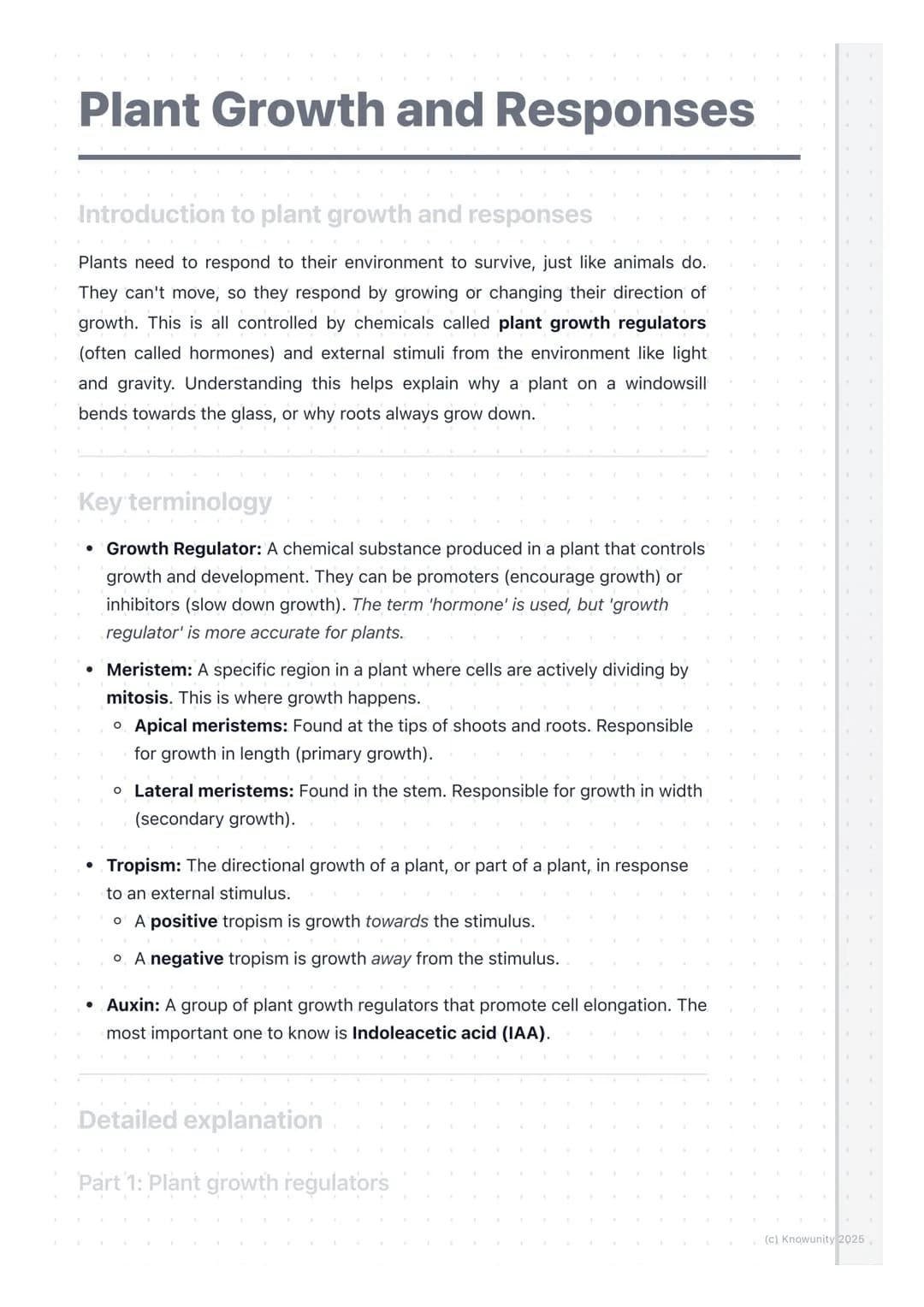
Plant Growth Basics
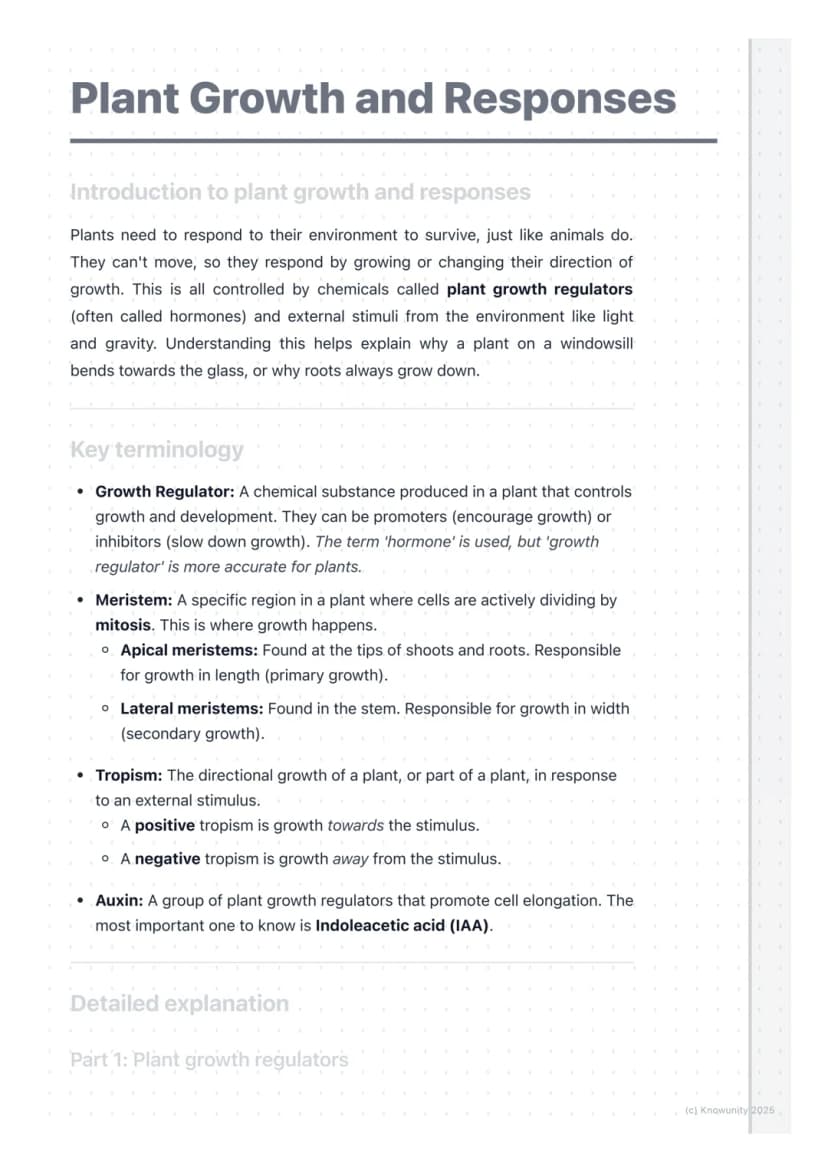
Plants are basically chemical communication systems that use growth regulators (often called hormones) to control everything from which direction to grow to when to sprout. These chemicals work at specific locations called meristems - think of them as plant growth factories where cells are constantly dividing.
Apical meristems sit at the tips of shoots and roots, making plants grow longer. Lateral meristems run along stems and make them thicker. When plants detect environmental signals like light or gravity, they create directional growth responses called tropisms.
The star player here is auxin (especially one called IAA), which controls how cells stretch and elongate. This single chemical is responsible for most of the clever growth tricks plants pull off.
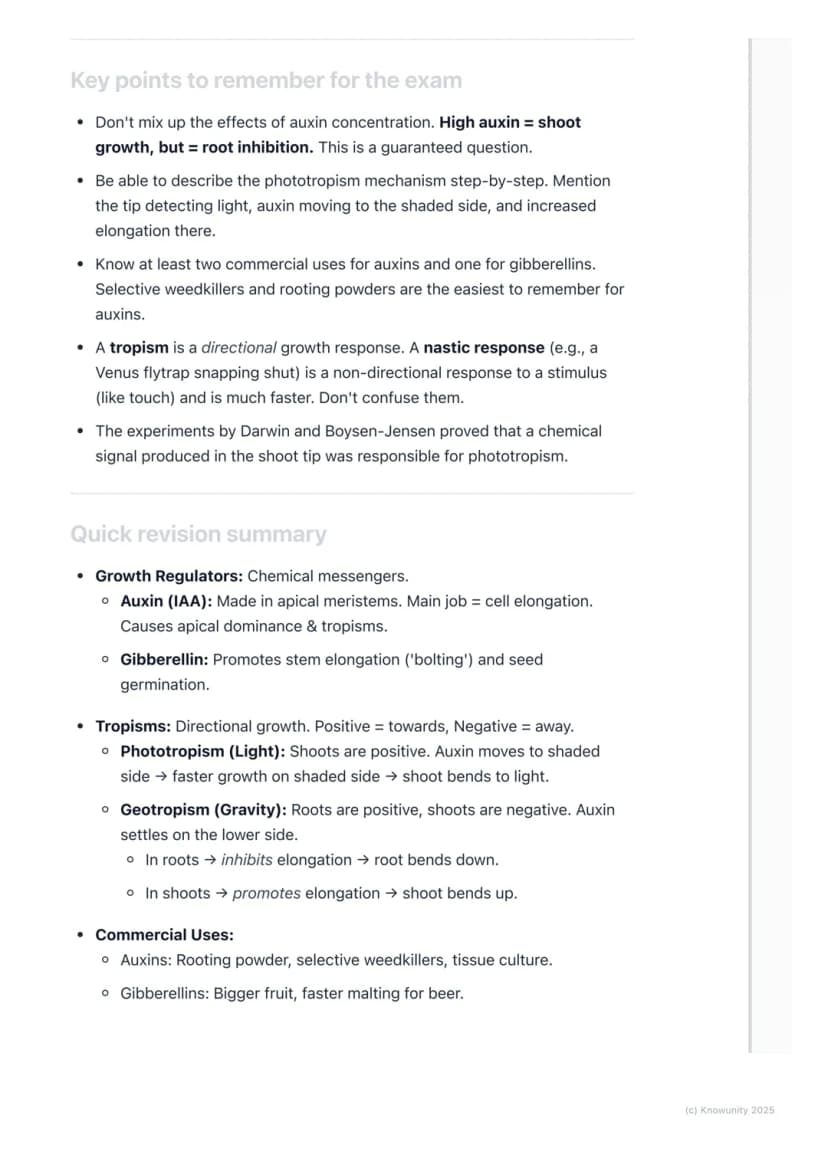
Key Point: A positive tropism means growing towards something, whilst negative tropism means growing away from it.
2
of 7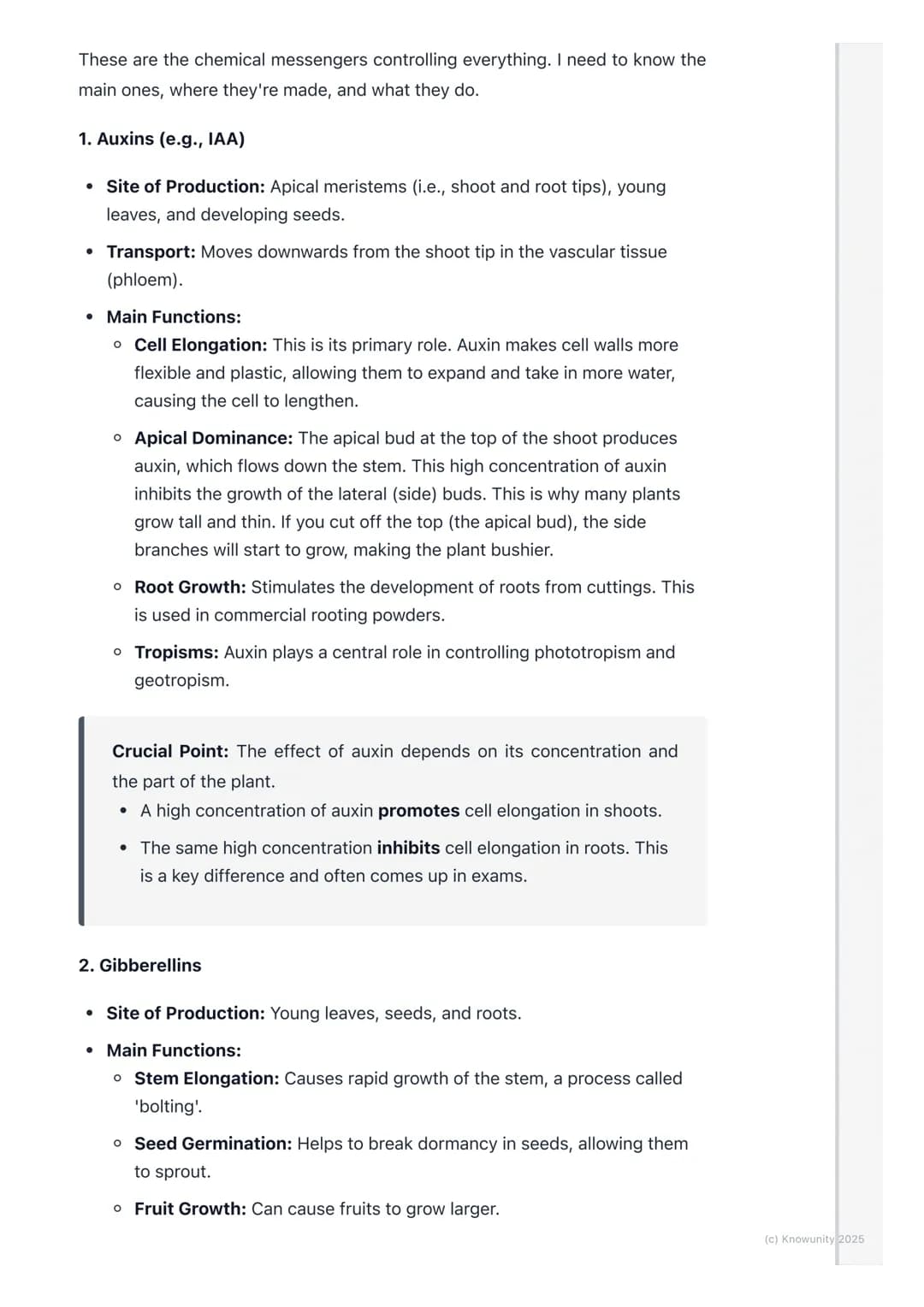
Auxins - The Master Controllers
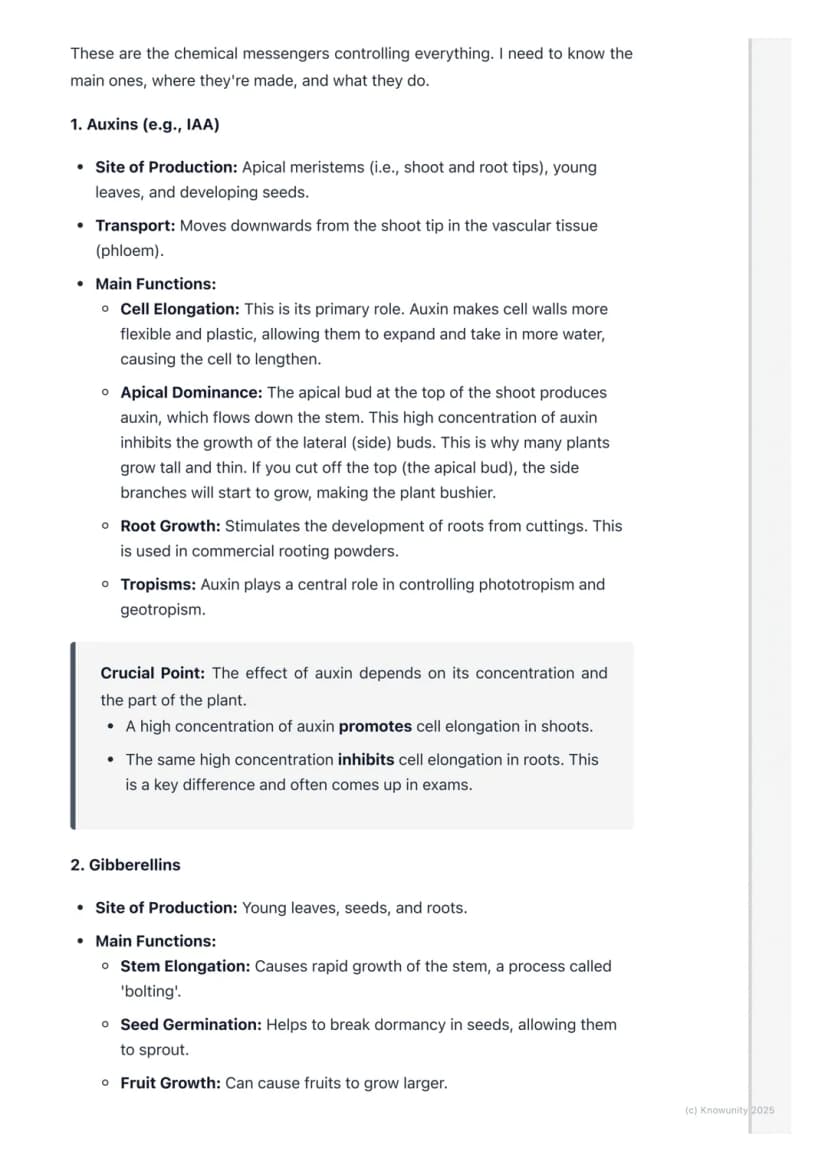
Auxin is basically the plant world's multitool, produced in shoot tips, young leaves, and developing seeds. It travels downward through the plant's vascular system, but here's where it gets interesting - auxin has completely opposite effects depending on where it is.
In shoots, high concentrations of auxin promote cell elongation, making stems stretch towards light. But in roots, that same high concentration actually inhibits growth. This difference is crucial for exams and explains why plants can coordinate complex responses.
Auxin also controls apical dominance - the reason many plants grow tall and thin rather than bushy. The main shoot tip pumps out auxin that travels down and tells side buds to stay dormant. Cut off that top shoot (like when pruning), and suddenly those side branches spring to life.
Exam Tip: Remember the golden rule - high auxin concentration promotes shoot growth but inhibits root growth. This concept appears in nearly every plant biology exam.
3
of 7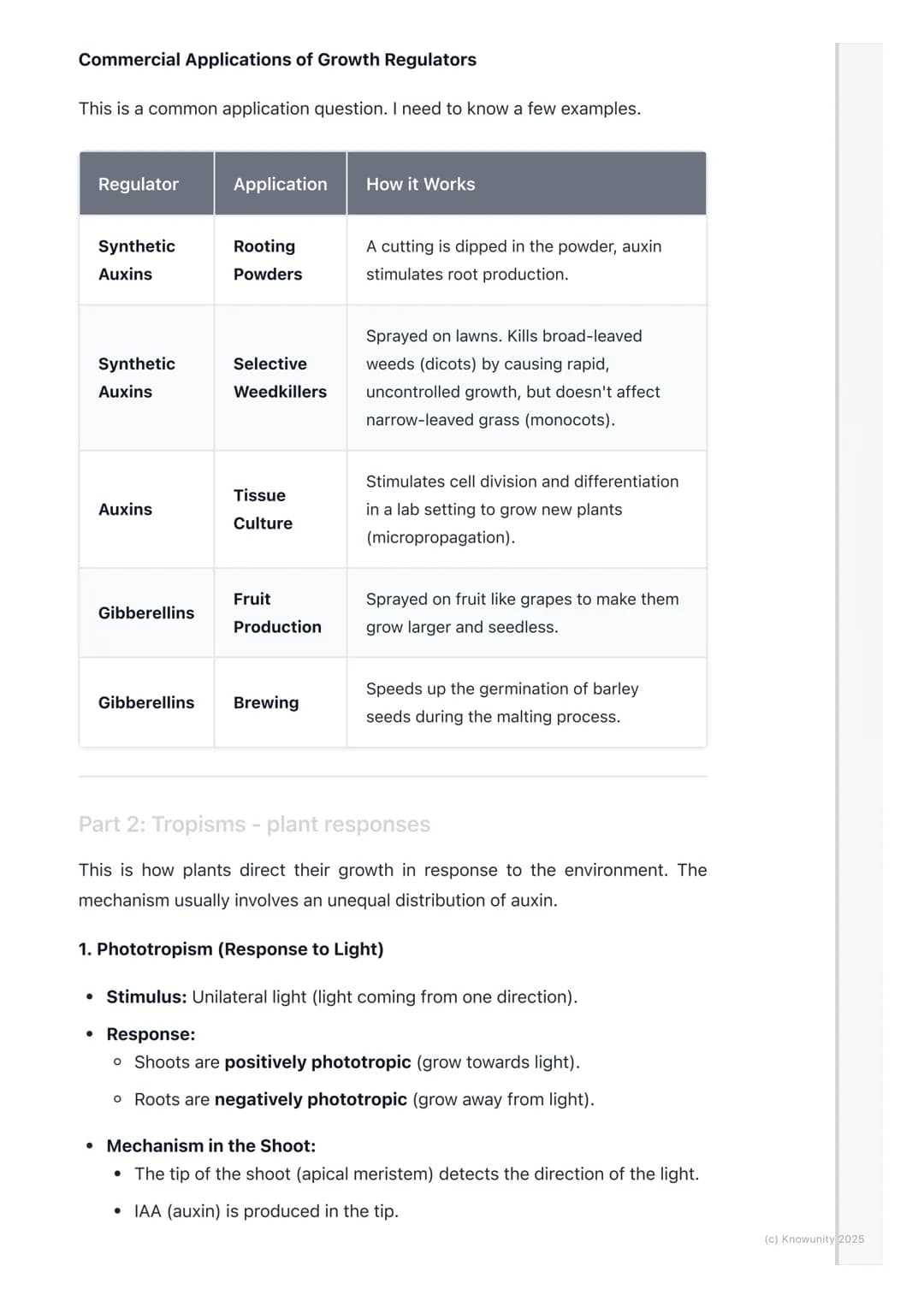
Commercial Applications
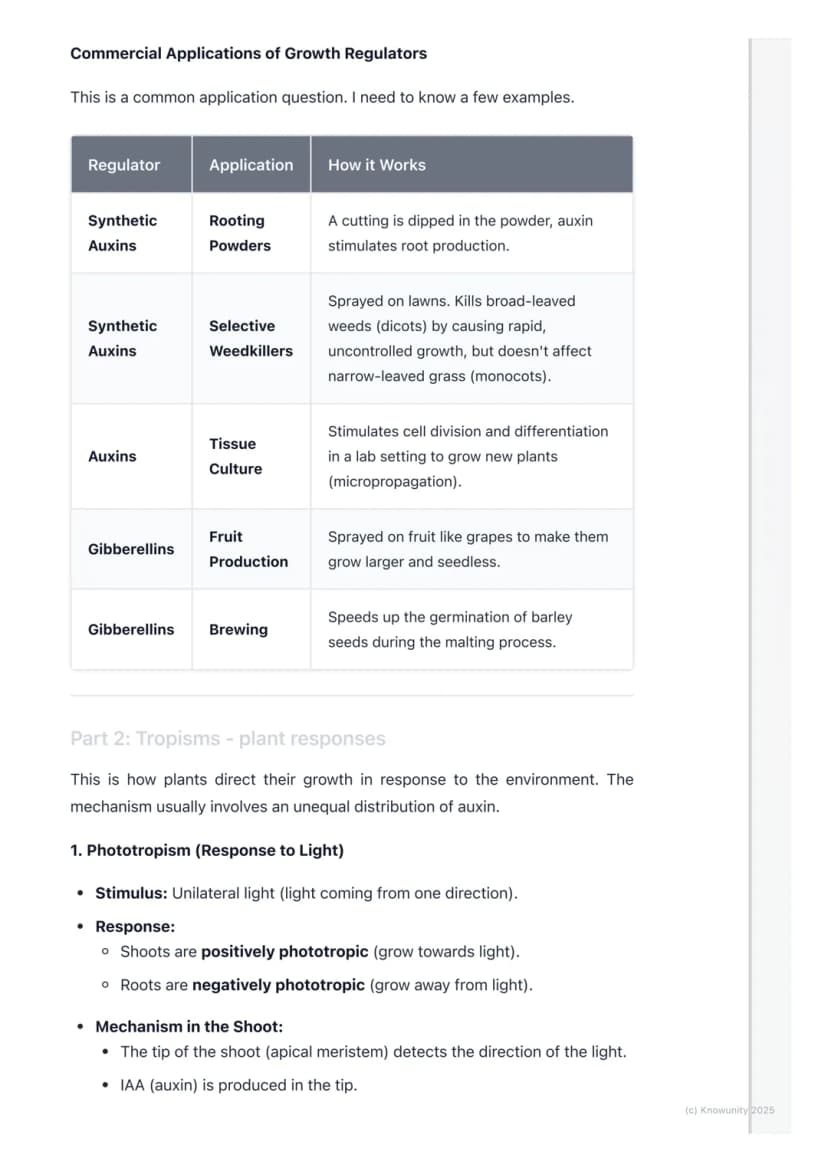
Plant growth regulators aren't just academic theory - they're big business. Synthetic auxins in rooting powders help gardeners grow new plants from cuttings by stimulating root development. The same chemicals become selective weedkillers when sprayed on lawns, causing broad-leaved weeds to grow themselves to death whilst leaving grass unharmed.
Gibberellins are the other major player, causing rapid stem elongation (called 'bolting') and breaking seed dormancy. Fruit growers spray them on grapes to create those massive, seedless varieties you see in shops. Breweries use them to speed up barley germination during the malting process.
In tissue culture labs, precise combinations of auxins and gibberellins can trick plant cells into growing entire new plants in test tubes. This micropropagation technique produces millions of identical plants commercially.
Real-World Connection: That rooting hormone powder at the garden centre? It's synthetic auxin doing exactly what natural plant hormones do, just more reliably.
4
of 7
Phototropism - Chasing the Light
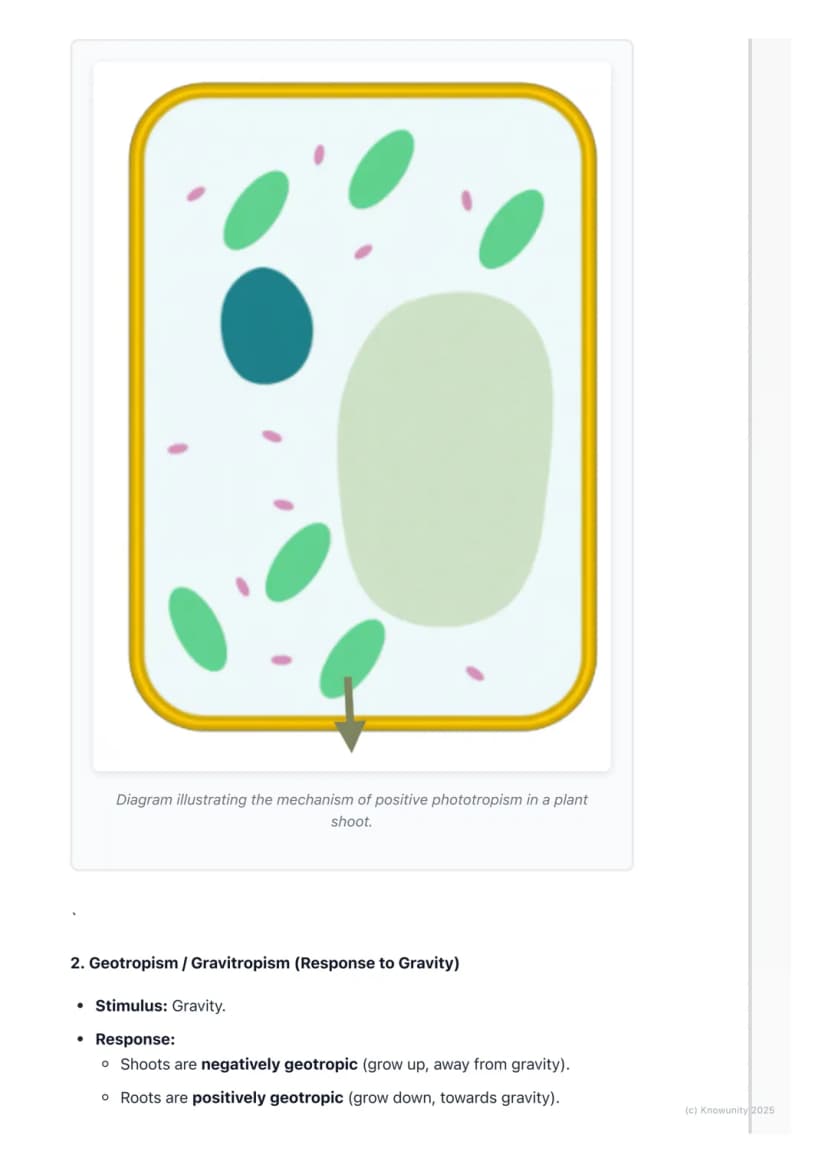
When light hits a plant from one side, you're watching phototropism in action. The shoot tip detects the light direction and immediately starts redistributing IAA (auxin) away from the bright side towards the shaded side.
This creates an unequal distribution of auxin - more on the shaded side means faster cell elongation there. Since one side grows quicker than the other, the shoot bends towards the light source. It's like having a biological GPS system that always points towards maximum photosynthesis potential.
Roots do the opposite, showing negative phototropism by growing away from light. This makes perfect sense - shoots need light for photosynthesis, whilst roots need to head into dark soil to find water and nutrients.
Memory Trick: Think "shade side grows faster" - the auxin moves to the shaded side and makes those cells stretch more, bending the plant towards light.
5
of 7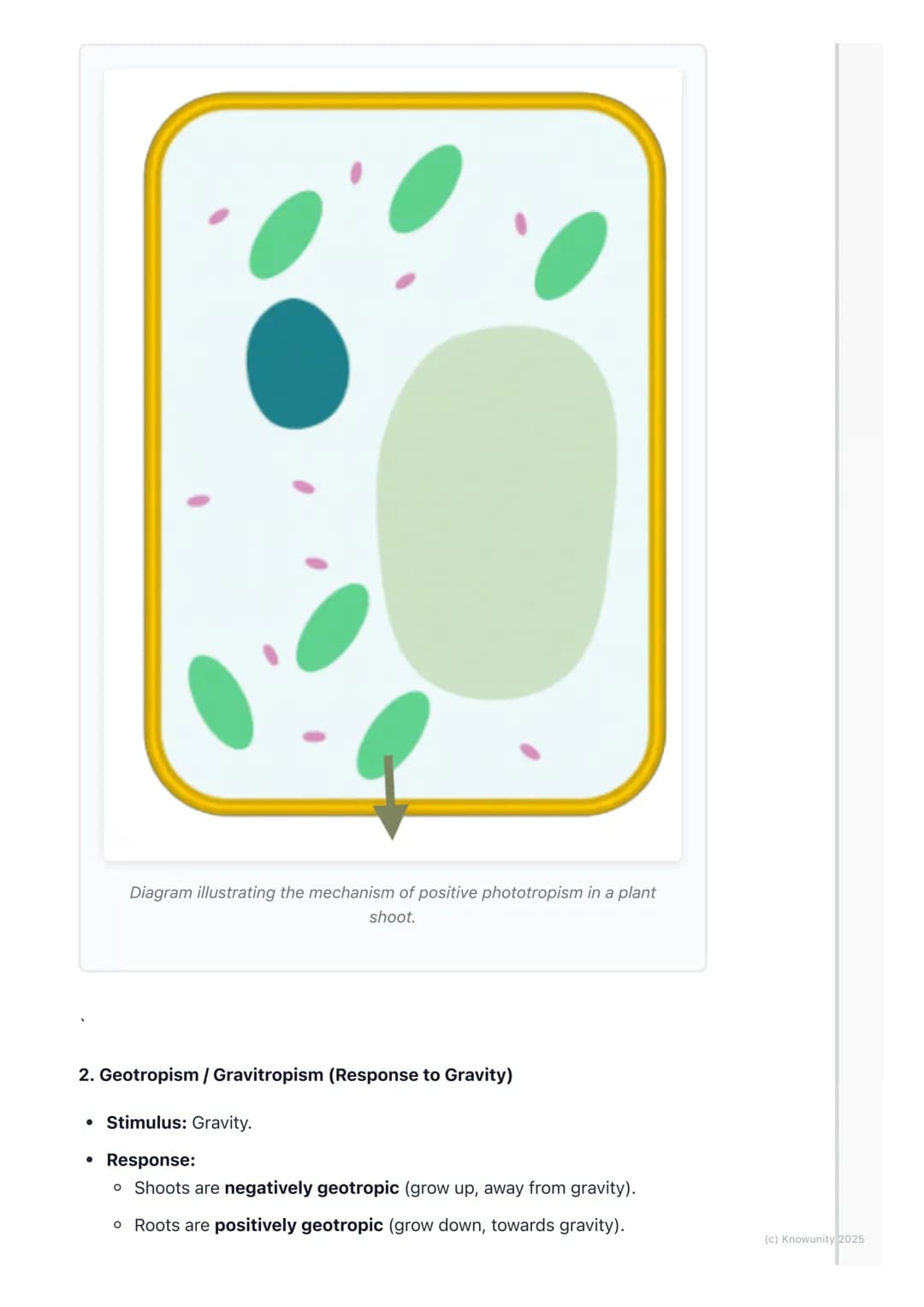
Geotropism - Feeling the Pull
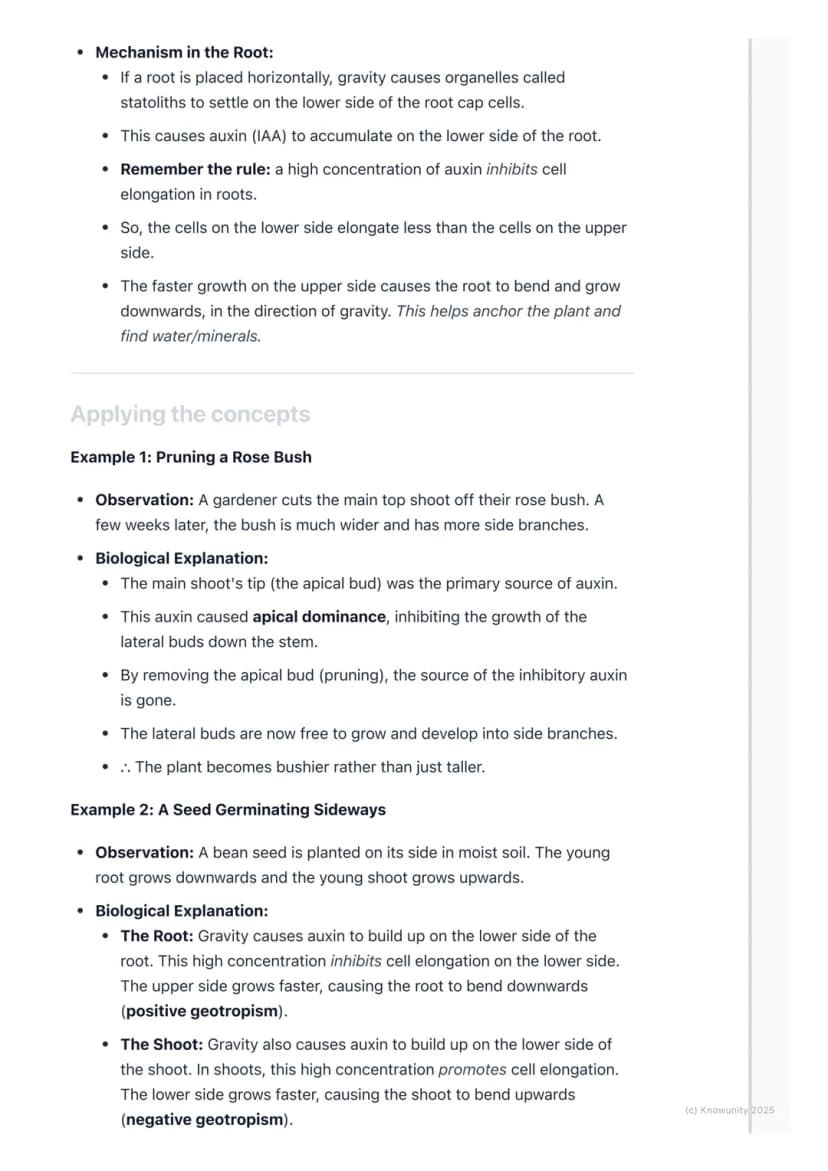
Geotropism (also called gravitropism) is how plants use gravity as their compass. Place a seed on its side, and the emerging shoot will still grow up whilst the root grows down, regardless of how you planted it.
The mechanism involves tiny organelles called statoliths that act like biological ball bearings. In roots, gravity pulls these statoliths to the lower side of cells, triggering auxin accumulation there. Since high auxin concentrations inhibit root cell elongation, the lower side grows slower.
This means the upper side of the root grows faster, causing the root to curve downward towards gravity. Meanwhile, shoots use the same auxin redistribution but with opposite effects - high auxin promotes shoot elongation, so the shoot curves upward against gravity.
Quick Check: Positive geotropism = growing with gravity (roots down), negative geotropism = growing against gravity (shoots up).
6
of 7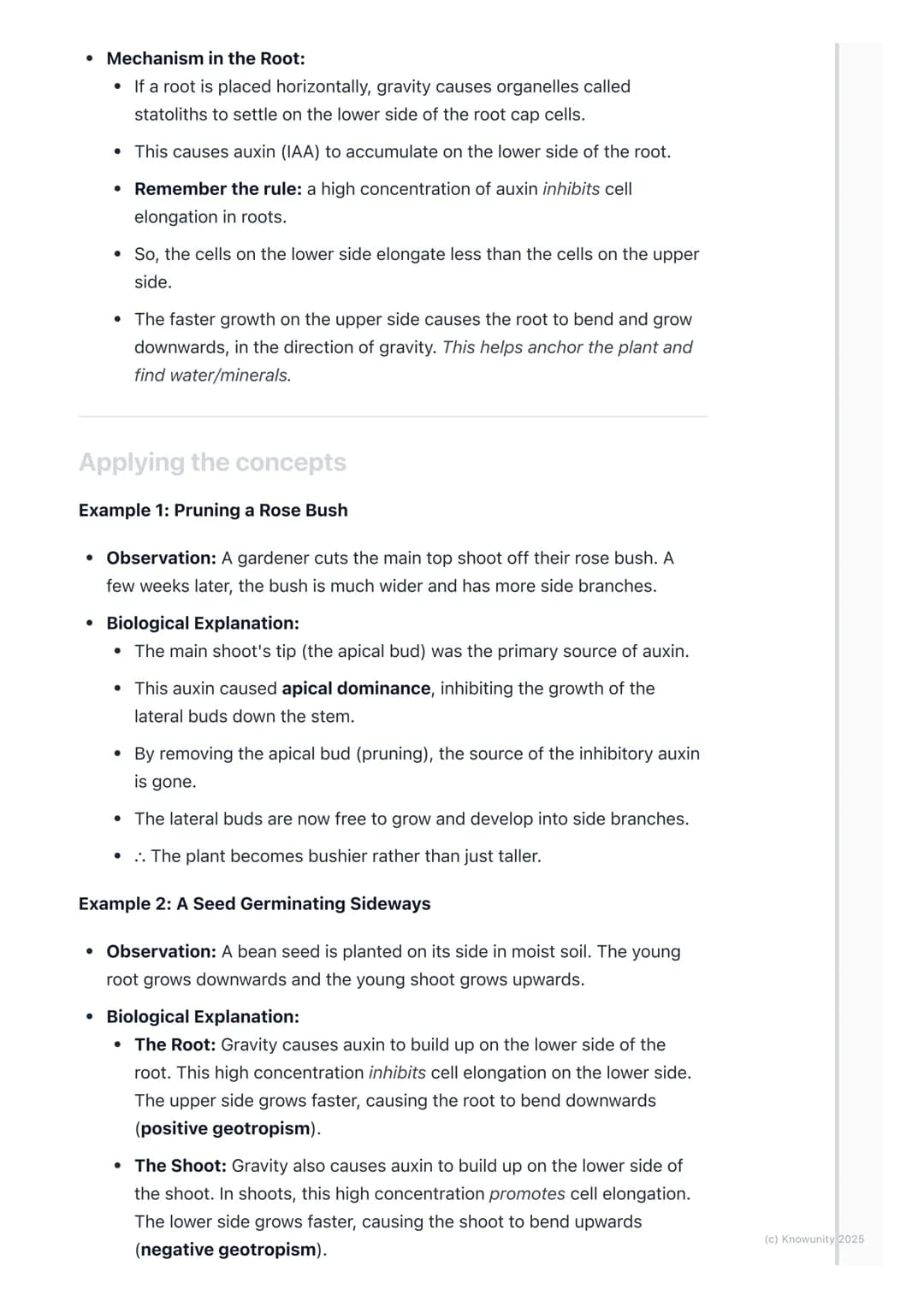
Putting It All Together
Understanding these concepts helps explain everyday plant behaviour. When you prune a rose bush by cutting the main shoot, you're removing the source of apical dominance. Without that steady stream of auxin from the tip, lateral buds burst into growth, creating a bushier plant.
Similarly, when a seed germinates sideways, both phototropism and geotropism work together. The root uses gravity to find "down" whilst the shoot uses both gravity and light to find "up", ensuring the plant establishes itself correctly regardless of how it lands.
These responses happen because plants have evolved sophisticated chemical communication systems that let them respond to environmental cues without a nervous system. Every bend, every growth spurt, every directional change is the result of auxin redistribution and cellular responses.
Exam Success: Focus on understanding the mechanisms rather than memorising facts. If you grasp how auxin moves and where it acts, you can work out most plant responses logically.
7
of 7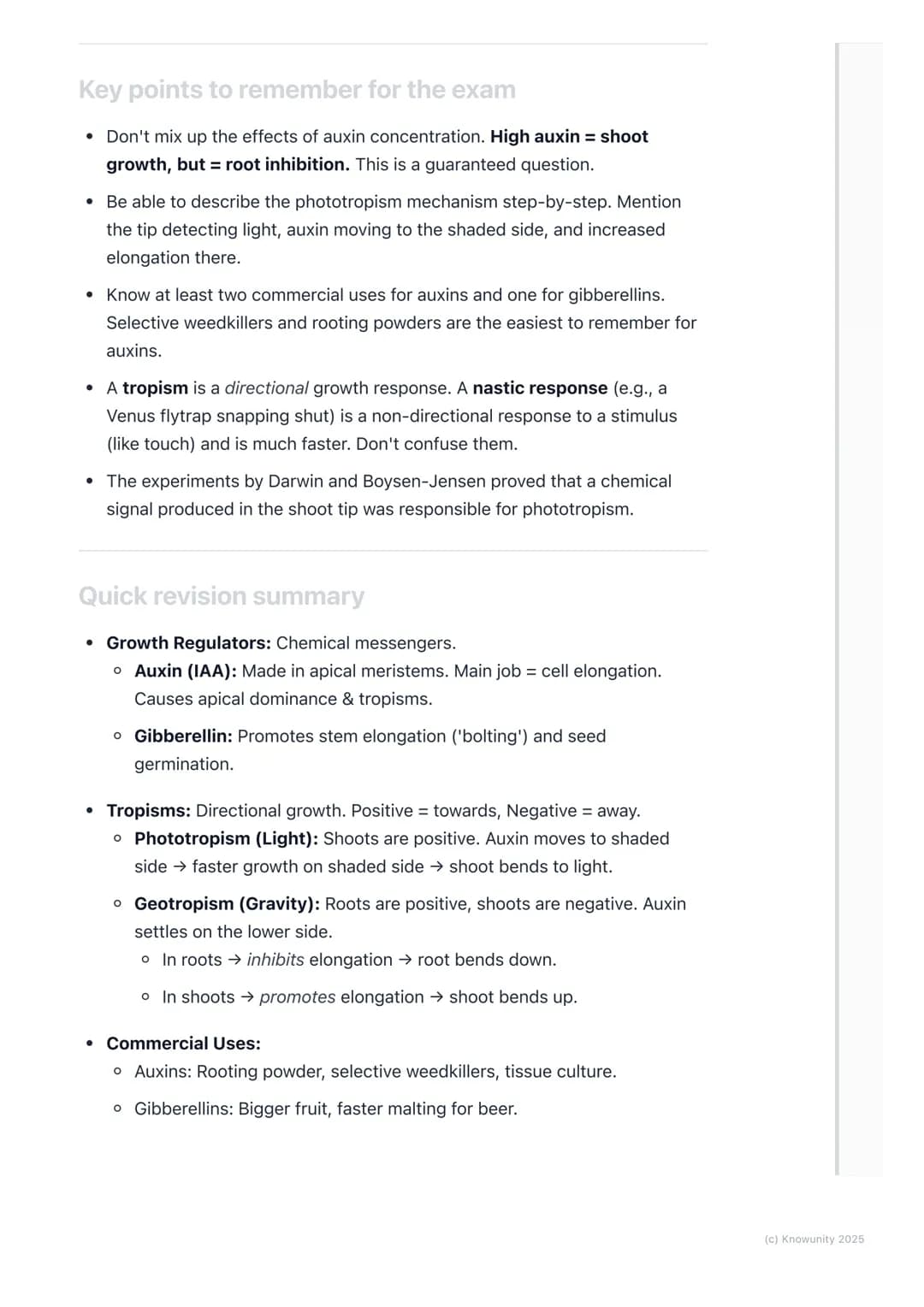
Mislili smo da nikad nećeš pitati...
Šta je Knowunity AI companion?
Naš AI Companion je AI alat fokusiran na učenike koji nudi više od samih odgovora. Napravljen na milionima Knowunity resursa, pruža relevantne informacije, personalizovane planove učenja, kvizove i sadržaj direktno u chatu, prilagođavajući se tvom individualnom putu učenja.
Gde mogu da preuzmem Knowunity aplikaciju?
Možeš preuzeti aplikaciju sa Google Play Store-a i Apple App Store-a.
Da li je Knowunity stvarno besplatan?
Tako je! Uživaj u besplatnom pristupu sadržaju za učenje, povezuj se sa drugim učenicima i dobijaj trenutnu pomoć – sve na dohvat ruke.
Najpopularniji sadržaj u Biology
8BiologyEcology introduction notes!
Start of the leaving cert ecology chapter
6th Year131
BiologyDNA & RNA
All notes on DNA & RNA including protein synthesis which is a HL topic
5th Year250
BiologyVertebrates and Invertebrates
Students will distinguish between animals that have a backbone (vertebrates) and those that do not (invertebrates), identifying examples of each.
2nd Year240
BiologyBiomolecules: chapter 8
Summary and easily understandable notes to revise chapter 8 biomolecules. Includes good labelled diagrams for visual learners
5th Year210
BiologyCirculatory System
Students will learn about the heart, blood, and blood vessels, and how this system transports oxygen, nutrients, and waste products around the body.
3rd Year140
BiologyRespiration
All respiration notes including simple diagrams and glycolysis and the Krebs cycle
5th Year120
BiologyPhotosynthesis : Biology
Photosynthesis
6th Year371
BiologyPlant Cells
Learning about the unique structures found in plant cells, such as the cell wall, chloroplasts, and large vacuole, and how they differ from animal cells.
1st Year80
Najpopularniji sadržaj
9 Irish
IrishIrish oral questions and answers
Questions and answers for the leaving cert oral
5th Year4264
 English
Key Quotes : Sive
Key Quotes and explanations: Sive
6th Year2842
IrishIrish oral questions
Outline of oral questions
5th Year2055
IrishIníon- le hÁine Durkin
Aine Durkin’s poem, Iníon: Themes & summary
5th Year850
IrishIrish poetry 2027
Iníon + Dínit an Bhróin
5th Year1133
IrishLC HL notes- Iníon (poem)
Includes poem in English and Irish, theme, key words & phrases
5th Year2284
EnglishCultural Context : Shawshank Redemption : Sive : Small Things Like These
Comparative Study : Cultural Context : Shawshank Redemption, Sive and Small Things Like These
6th Year1430
IrishMo Ghrá-sa (Idir Lúibíní)
Notes on mo ghrá-sa
5th Year380
IrishAn Gaeilge Aiste
Irish Language essay
6th Year1320
Ne možeš da nađeš ono što tražiš? Istražuj druge predmete.
Učenici nas obožavaju — i ti ćeš takođe.
4.6/5App Store
4.7/5Google Play
Aplikacija je super laka za korišćenje i odlično dizajnirana. Našao sam sve što mi je trebalo i dosta sam naučio iz prezentacija! Definitivno ću koristiti aplikaciju za školski zadatak! A naravno, pomaže i kao inspiracija.
Stefan SiOS korisnik
Ova aplikacija je stvarno odlična. Tu je toliko beleški za učenje i pomoći [...]. Na primer, problem mi je francuski, a aplikacija ima toliko opcija za pomoć. Zahvaljujući ovoj aplikaciji, poboljšao sam francuski. Preporučio bih je svima.
Samantha KlichAndroid korisnik
Vau, stvarno sam oduševljena. Probala sam aplikaciju jer sam je videla u reklamama mnogo puta i bila sam potpuno šokirana. Ova aplikacija je POMOĆ koju želiš za školu i pre svega, nudi toliko stvari, kao što su vežbe i sažeci, što mi je lično bilo VEOMA korisno.
AnaiOS korisnik
Biology1 pregledi·Ažurirano Jun 11, 2026·7 straniceExploring Plant Growth and Environmental Responses
Ever wonder why plants on your windowsill always lean towards the glass, or how roots know to grow downwards? Plants can't move like animals, but they're constantly responding to their environment through clever growth patterns controlled by chemical messengers called ...
1
of 7
Registruj se da vidiš sadržaj. Besplatno je!
- Pristup svim dokumentima
- Poboljšaj svoje ocene
- Pridruži se milionima učenika
Plant Growth Basics
Plants are basically chemical communication systems that use growth regulators (often called hormones) to control everything from which direction to grow to when to sprout. These chemicals work at specific locations called meristems - think of them as plant growth factories where cells are constantly dividing.
Apical meristems sit at the tips of shoots and roots, making plants grow longer. Lateral meristems run along stems and make them thicker. When plants detect environmental signals like light or gravity, they create directional growth responses called tropisms.
The star player here is auxin (especially one called IAA), which controls how cells stretch and elongate. This single chemical is responsible for most of the clever growth tricks plants pull off.
Key Point: A positive tropism means growing towards something, whilst negative tropism means growing away from it.
2
of 7Registruj se da vidiš sadržaj. Besplatno je!
- Pristup svim dokumentima
- Poboljšaj svoje ocene
- Pridruži se milionima učenika
Auxins - The Master Controllers
Auxin is basically the plant world's multitool, produced in shoot tips, young leaves, and developing seeds. It travels downward through the plant's vascular system, but here's where it gets interesting - auxin has completely opposite effects depending on where it is.
In shoots, high concentrations of auxin promote cell elongation, making stems stretch towards light. But in roots, that same high concentration actually inhibits growth. This difference is crucial for exams and explains why plants can coordinate complex responses.
Auxin also controls apical dominance - the reason many plants grow tall and thin rather than bushy. The main shoot tip pumps out auxin that travels down and tells side buds to stay dormant. Cut off that top shoot (like when pruning), and suddenly those side branches spring to life.
Exam Tip: Remember the golden rule - high auxin concentration promotes shoot growth but inhibits root growth. This concept appears in nearly every plant biology exam.
3
of 7Registruj se da vidiš sadržaj. Besplatno je!
- Pristup svim dokumentima
- Poboljšaj svoje ocene
- Pridruži se milionima učenika
Commercial Applications
Plant growth regulators aren't just academic theory - they're big business. Synthetic auxins in rooting powders help gardeners grow new plants from cuttings by stimulating root development. The same chemicals become selective weedkillers when sprayed on lawns, causing broad-leaved weeds to grow themselves to death whilst leaving grass unharmed.
Gibberellins are the other major player, causing rapid stem elongation (called 'bolting') and breaking seed dormancy. Fruit growers spray them on grapes to create those massive, seedless varieties you see in shops. Breweries use them to speed up barley germination during the malting process.
In tissue culture labs, precise combinations of auxins and gibberellins can trick plant cells into growing entire new plants in test tubes. This micropropagation technique produces millions of identical plants commercially.
Real-World Connection: That rooting hormone powder at the garden centre? It's synthetic auxin doing exactly what natural plant hormones do, just more reliably.
4
of 7Registruj se da vidiš sadržaj. Besplatno je!
- Pristup svim dokumentima
- Poboljšaj svoje ocene
- Pridruži se milionima učenika
Phototropism - Chasing the Light
When light hits a plant from one side, you're watching phototropism in action. The shoot tip detects the light direction and immediately starts redistributing IAA (auxin) away from the bright side towards the shaded side.
This creates an unequal distribution of auxin - more on the shaded side means faster cell elongation there. Since one side grows quicker than the other, the shoot bends towards the light source. It's like having a biological GPS system that always points towards maximum photosynthesis potential.
Roots do the opposite, showing negative phototropism by growing away from light. This makes perfect sense - shoots need light for photosynthesis, whilst roots need to head into dark soil to find water and nutrients.
Memory Trick: Think "shade side grows faster" - the auxin moves to the shaded side and makes those cells stretch more, bending the plant towards light.
5
of 7Registruj se da vidiš sadržaj. Besplatno je!
- Pristup svim dokumentima
- Poboljšaj svoje ocene
- Pridruži se milionima učenika
Geotropism - Feeling the Pull
Geotropism (also called gravitropism) is how plants use gravity as their compass. Place a seed on its side, and the emerging shoot will still grow up whilst the root grows down, regardless of how you planted it.
The mechanism involves tiny organelles called statoliths that act like biological ball bearings. In roots, gravity pulls these statoliths to the lower side of cells, triggering auxin accumulation there. Since high auxin concentrations inhibit root cell elongation, the lower side grows slower.
This means the upper side of the root grows faster, causing the root to curve downward towards gravity. Meanwhile, shoots use the same auxin redistribution but with opposite effects - high auxin promotes shoot elongation, so the shoot curves upward against gravity.
Quick Check: Positive geotropism = growing with gravity (roots down), negative geotropism = growing against gravity (shoots up).
6
of 7Registruj se da vidiš sadržaj. Besplatno je!
- Pristup svim dokumentima
- Poboljšaj svoje ocene
- Pridruži se milionima učenika
Putting It All Together
Understanding these concepts helps explain everyday plant behaviour. When you prune a rose bush by cutting the main shoot, you're removing the source of apical dominance. Without that steady stream of auxin from the tip, lateral buds burst into growth, creating a bushier plant.
Similarly, when a seed germinates sideways, both phototropism and geotropism work together. The root uses gravity to find "down" whilst the shoot uses both gravity and light to find "up", ensuring the plant establishes itself correctly regardless of how it lands.
These responses happen because plants have evolved sophisticated chemical communication systems that let them respond to environmental cues without a nervous system. Every bend, every growth spurt, every directional change is the result of auxin redistribution and cellular responses.
Exam Success: Focus on understanding the mechanisms rather than memorising facts. If you grasp how auxin moves and where it acts, you can work out most plant responses logically.
7
of 7Registruj se da vidiš sadržaj. Besplatno je!
- Pristup svim dokumentima
- Poboljšaj svoje ocene
- Pridruži se milionima učenika
Mislili smo da nikad nećeš pitati...
Šta je Knowunity AI companion?
Naš AI Companion je AI alat fokusiran na učenike koji nudi više od samih odgovora. Napravljen na milionima Knowunity resursa, pruža relevantne informacije, personalizovane planove učenja, kvizove i sadržaj direktno u chatu, prilagođavajući se tvom individualnom putu učenja.
Gde mogu da preuzmem Knowunity aplikaciju?
Možeš preuzeti aplikaciju sa Google Play Store-a i Apple App Store-a.
Da li je Knowunity stvarno besplatan?
Tako je! Uživaj u besplatnom pristupu sadržaju za učenje, povezuj se sa drugim učenicima i dobijaj trenutnu pomoć – sve na dohvat ruke.
Najpopularniji sadržaj u Biology
8BiologyEcology introduction notes!
Start of the leaving cert ecology chapter
6th Year131
BiologyDNA & RNA
All notes on DNA & RNA including protein synthesis which is a HL topic
5th Year250
BiologyVertebrates and Invertebrates
Students will distinguish between animals that have a backbone (vertebrates) and those that do not (invertebrates), identifying examples of each.
2nd Year240
BiologyBiomolecules: chapter 8
Summary and easily understandable notes to revise chapter 8 biomolecules. Includes good labelled diagrams for visual learners
5th Year210
BiologyCirculatory System
Students will learn about the heart, blood, and blood vessels, and how this system transports oxygen, nutrients, and waste products around the body.
3rd Year140
BiologyRespiration
All respiration notes including simple diagrams and glycolysis and the Krebs cycle
5th Year120
BiologyPhotosynthesis : Biology
Photosynthesis
6th Year371
BiologyPlant Cells
Learning about the unique structures found in plant cells, such as the cell wall, chloroplasts, and large vacuole, and how they differ from animal cells.
1st Year80
Najpopularniji sadržaj
9IrishIrish oral questions and answers
Questions and answers for the leaving cert oral
5th Year4264
EnglishKey Quotes : Sive
Key Quotes and explanations: Sive
6th Year2842
IrishIrish oral questions
Outline of oral questions
5th Year2055
IrishIníon- le hÁine Durkin
Aine Durkin’s poem, Iníon: Themes & summary
5th Year850
IrishIrish poetry 2027
Iníon + Dínit an Bhróin
5th Year1133
IrishLC HL notes- Iníon (poem)
Includes poem in English and Irish, theme, key words & phrases
5th Year2284
EnglishCultural Context : Shawshank Redemption : Sive : Small Things Like These
Comparative Study : Cultural Context : Shawshank Redemption, Sive and Small Things Like These
6th Year1430
IrishMo Ghrá-sa (Idir Lúibíní)
Notes on mo ghrá-sa
5th Year380
IrishAn Gaeilge Aiste
Irish Language essay
6th Year1320
Ne možeš da nađeš ono što tražiš? Istražuj druge predmete.
Učenici nas obožavaju — i ti ćeš takođe.
4.6/5App Store
4.7/5Google Play
Aplikacija je super laka za korišćenje i odlično dizajnirana. Našao sam sve što mi je trebalo i dosta sam naučio iz prezentacija! Definitivno ću koristiti aplikaciju za školski zadatak! A naravno, pomaže i kao inspiracija.
Stefan SiOS korisnik
Ova aplikacija je stvarno odlična. Tu je toliko beleški za učenje i pomoći [...]. Na primer, problem mi je francuski, a aplikacija ima toliko opcija za pomoć. Zahvaljujući ovoj aplikaciji, poboljšao sam francuski. Preporučio bih je svima.
Samantha KlichAndroid korisnik
Vau, stvarno sam oduševljena. Probala sam aplikaciju jer sam je videla u reklamama mnogo puta i bila sam potpuno šokirana. Ova aplikacija je POMOĆ koju želiš za školu i pre svega, nudi toliko stvari, kao što su vežbe i sažeci, što mi je lično bilo VEOMA korisno.
AnaiOS korisnik