
Ever wondered why a balloon shrinks in the cold or...
 Chemistry6 pregledi·Ažurirano May 30, 2026·7 stranice
Understanding Gas Laws: Boyle's and Charles's Principles Simplified
1 / 7
1
of 7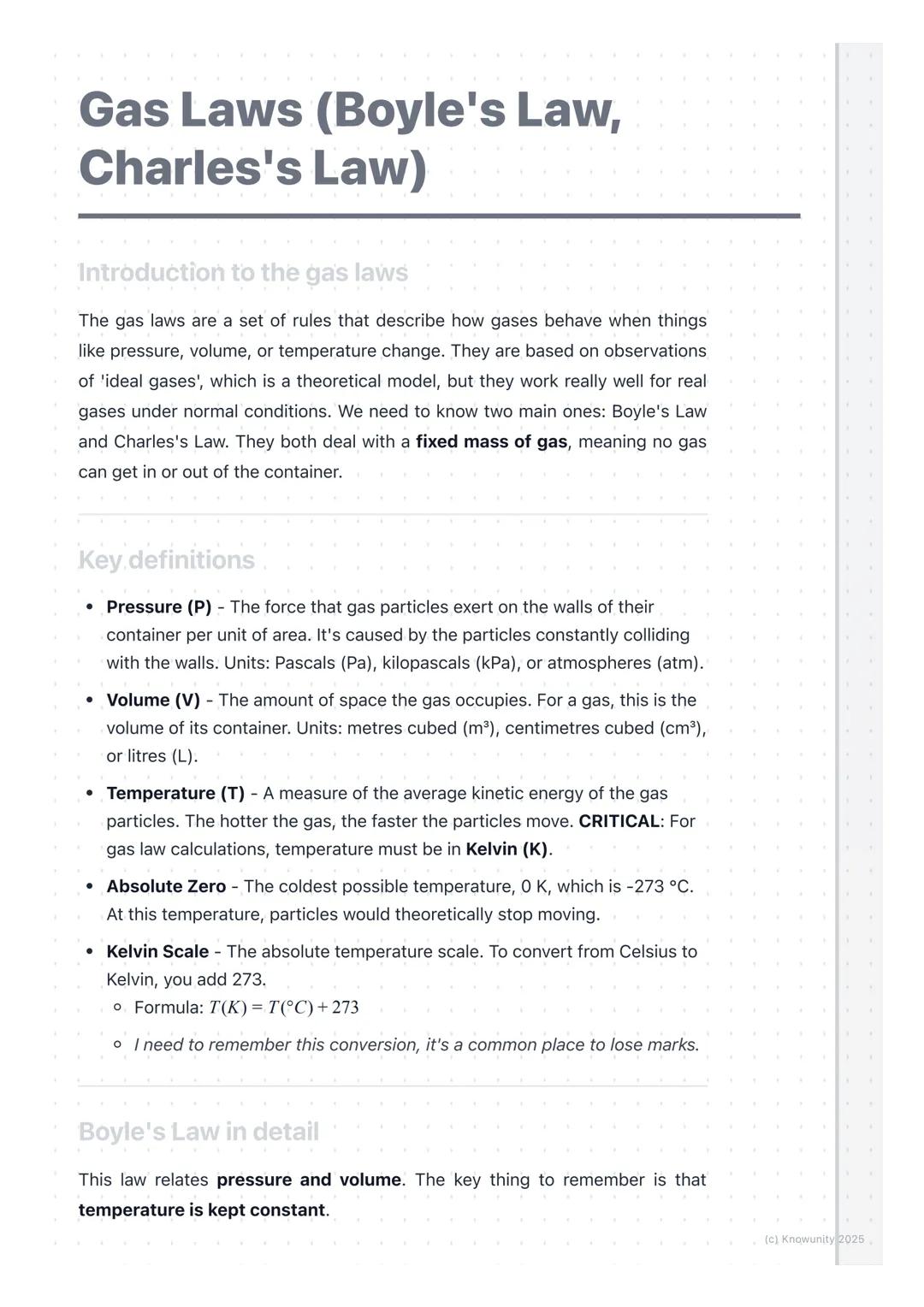
Understanding Gas Laws Basics
Gas laws are straightforward rules that predict how gases behave under different conditions. They're based on ideal gases - a theoretical model that works brilliantly for real gases under normal conditions.
The key thing to remember is that we're always dealing with a fixed mass of gas. This means no gas escapes or enters the container during our experiments.
You need to master some crucial definitions first. Pressure is the force gas particles exert on container walls through constant collisions. Volume is simply the space the gas occupies. Temperature measures the average kinetic energy of gas particles - faster particles mean higher temperature.
💡 Critical Point: For all gas law calculations, temperature MUST be in Kelvin. Convert by adding 273 to Celsius: K = °C + 273. This is where most students lose marks!
2
of 7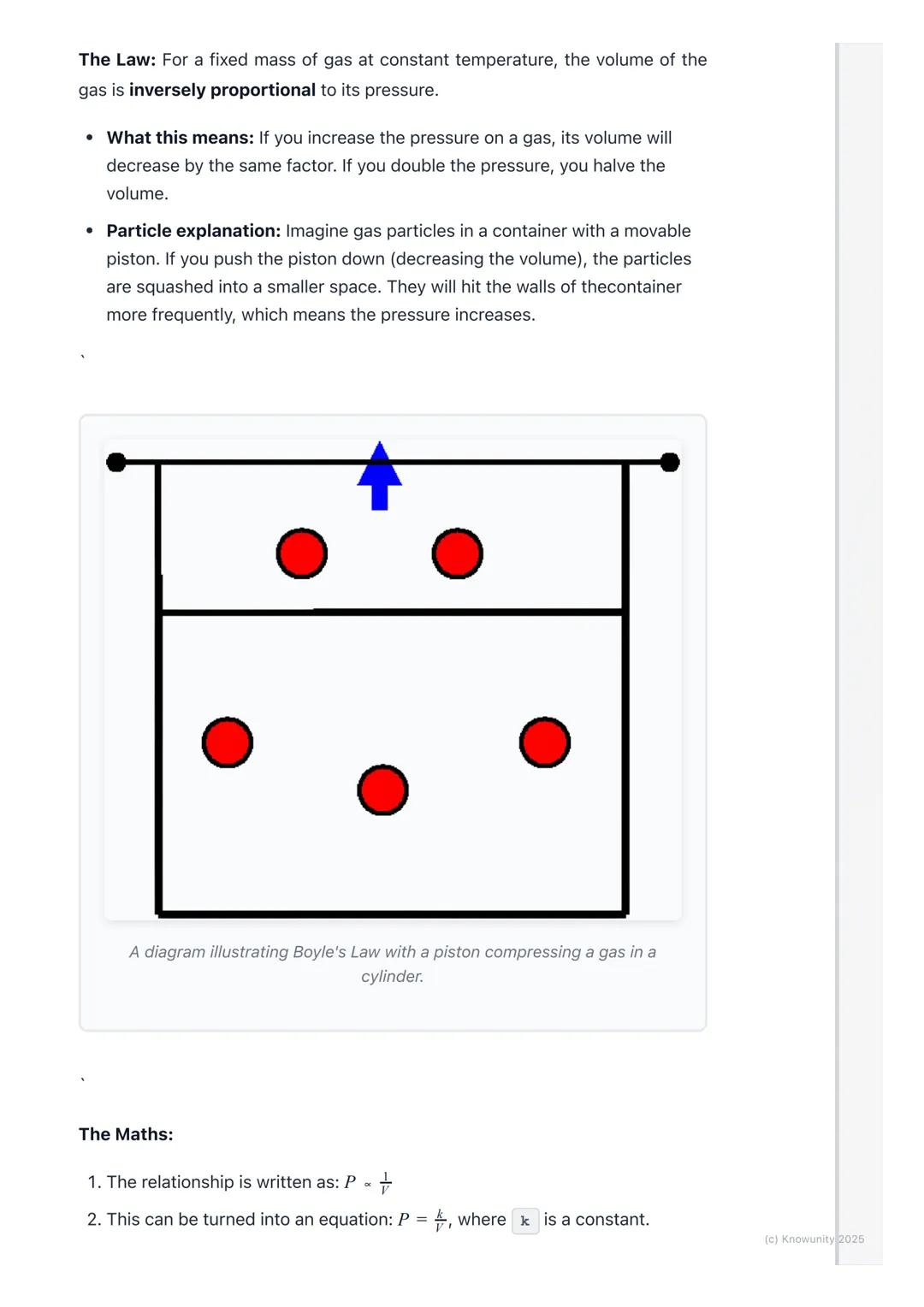
Boyle's Law - Pressure vs Volume
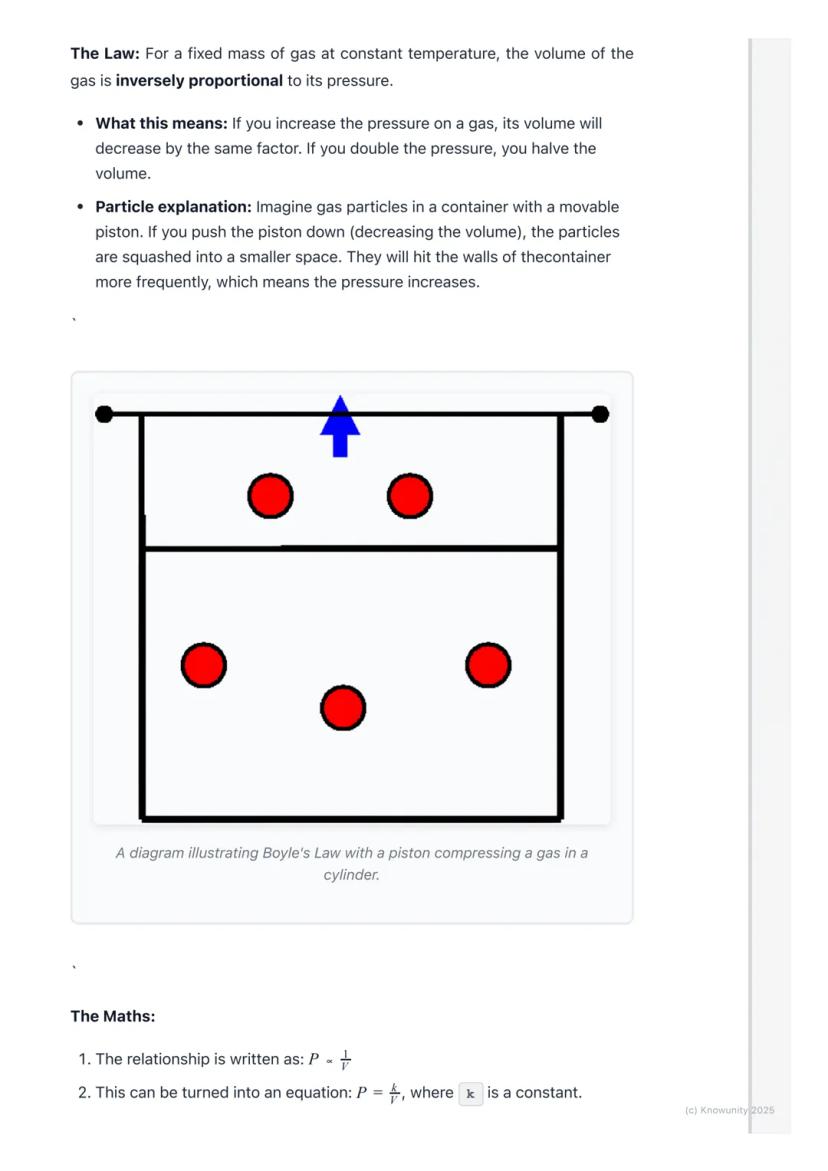
Boyle's Law is all about the relationship between pressure and volume whilst keeping temperature constant. Here's the key principle: volume is inversely proportional to pressure.
Double the pressure, and you'll halve the volume. It makes perfect sense when you think about particles - squeeze them into a smaller space (decrease volume), and they'll hit the walls more frequently, increasing pressure.
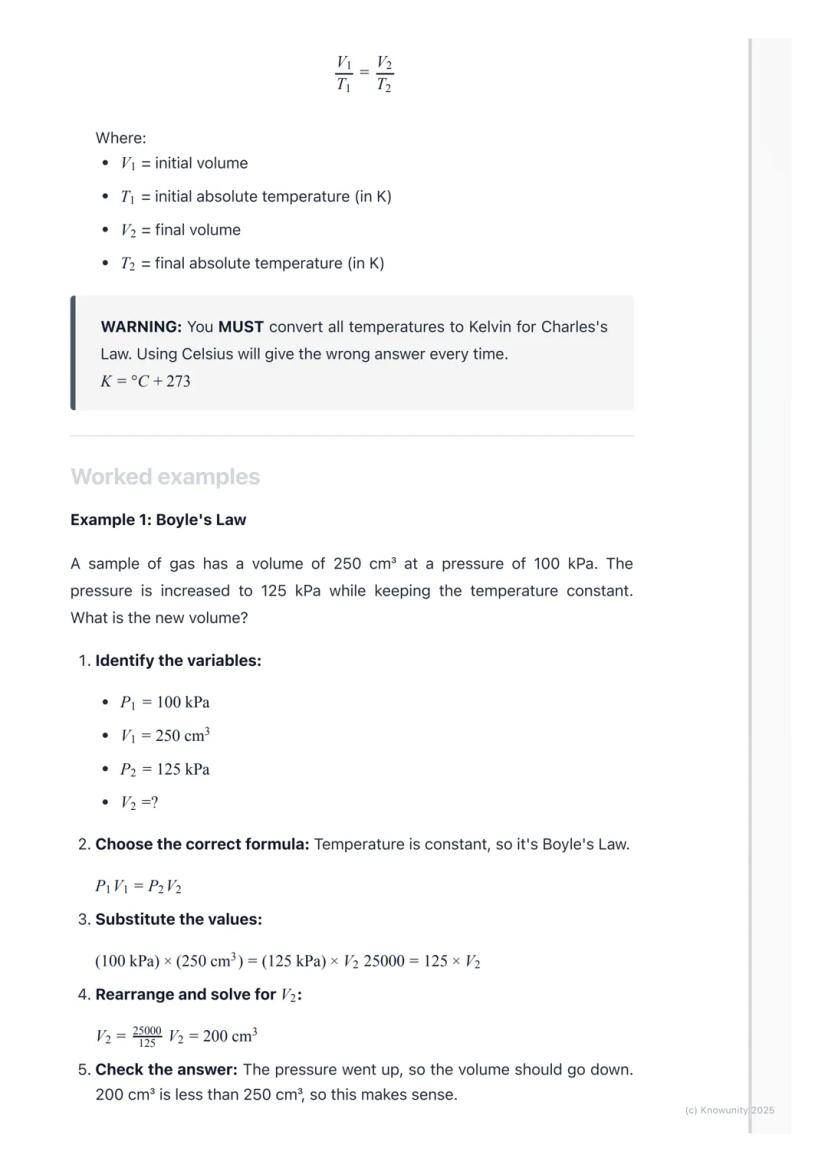
The mathematical relationship is beautifully simple: PV = constant. For calculations involving changes, use the formula: P₁V₁ = P₂V₂
Here's what's brilliant about this - your units just need to be consistent on both sides. If you start with cm³, your answer will be in cm³. No complicated conversions needed!
💡 Memory Trick: Boyle's Law = "Pressure squeezes" - higher pressure squeezes the volume smaller.
3
of 7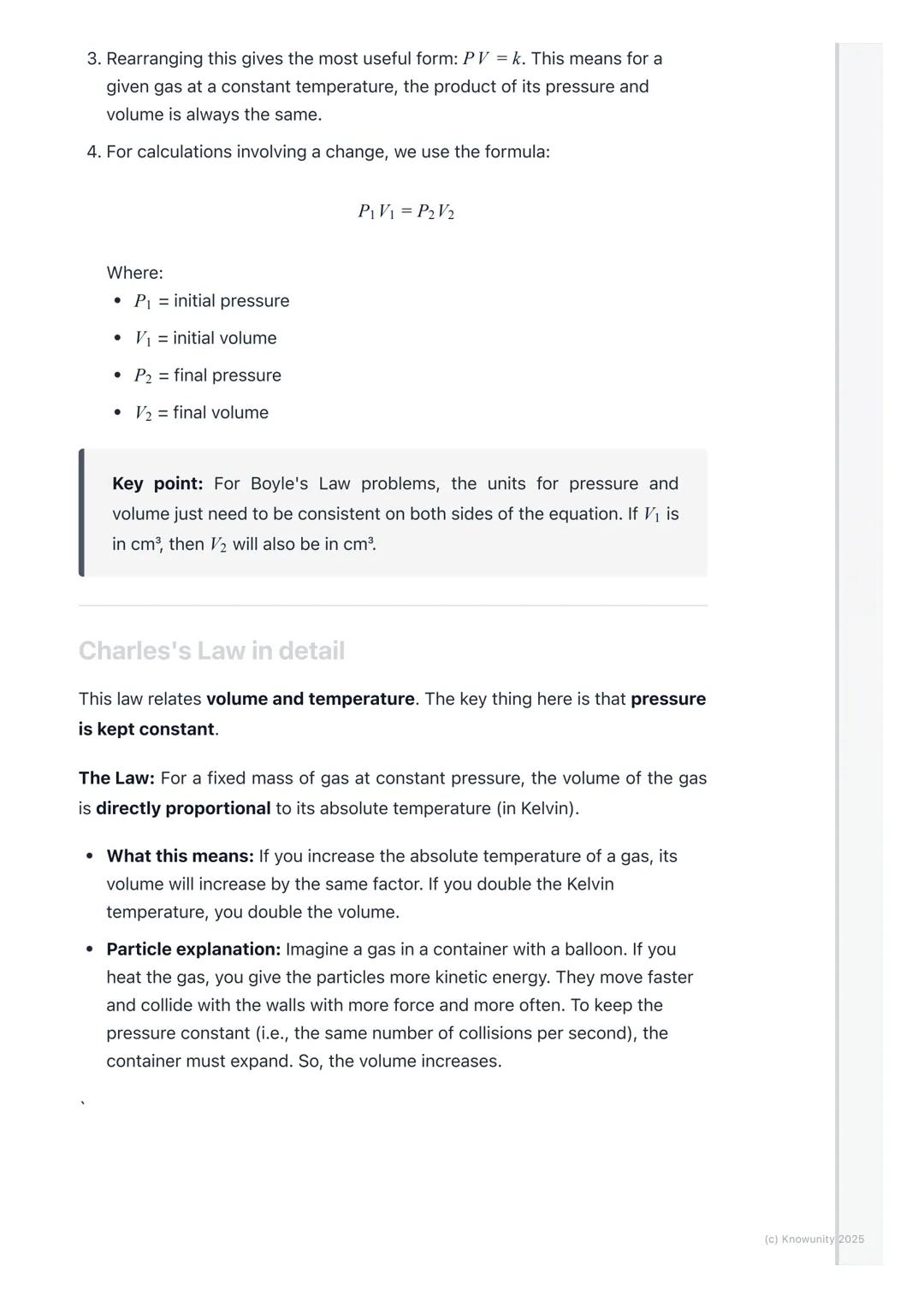
Charles's Law - Volume vs Temperature
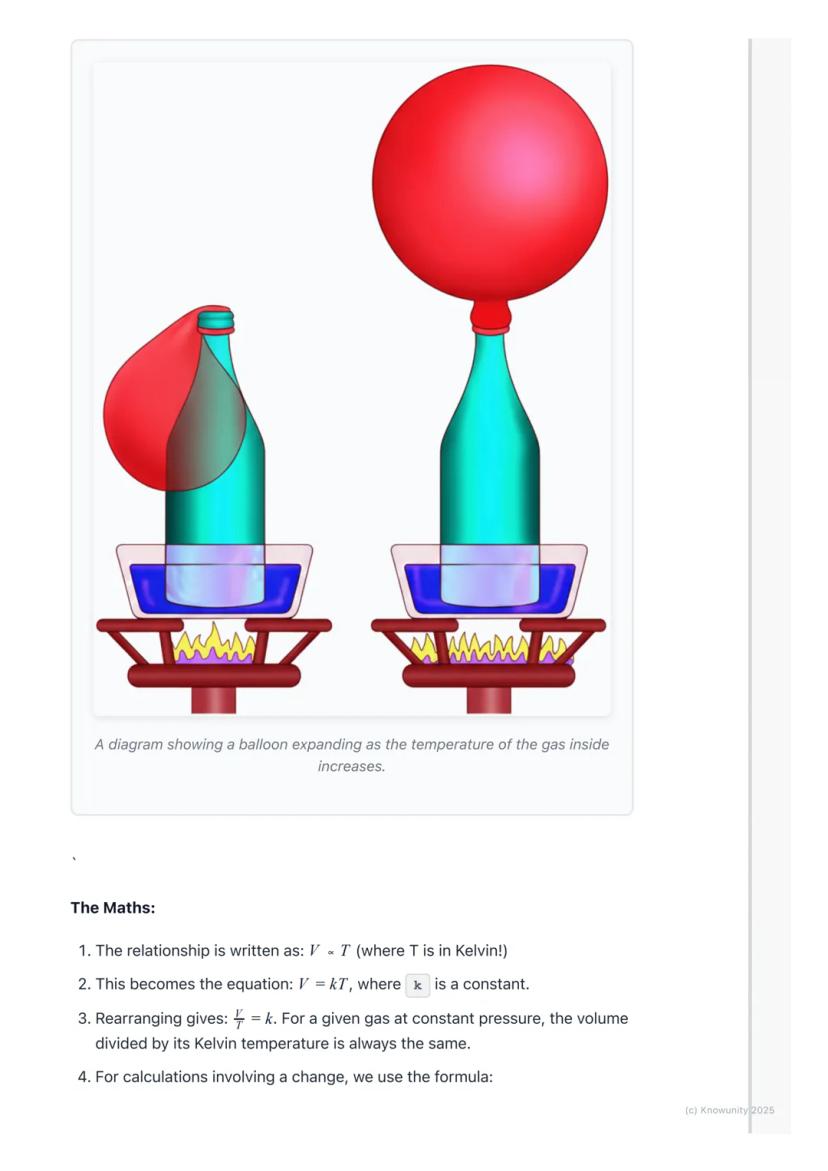
Charles's Law explores how volume changes with temperature whilst pressure stays constant. The relationship here is directly proportional - increase temperature, increase volume by the same factor.
Picture a balloon in your car on a hot day - it expands because heated gas particles move faster and need more space. The pressure stays the same, but the volume increases to accommodate the more energetic particles.
The formula for changes is: V₁/T₁ = V₂/T₂. But here's the absolute crucial bit - temperature MUST be in Kelvin. Using Celsius will guarantee the wrong answer.
Remember: K = °C + 273. Write this conversion at the start of every Charles's Law problem. It'll save you from the most common mistake in gas law questions.
💡 Warning: Never forget Kelvin conversion! It's the number one way students mess up Charles's Law calculations.
4
of 7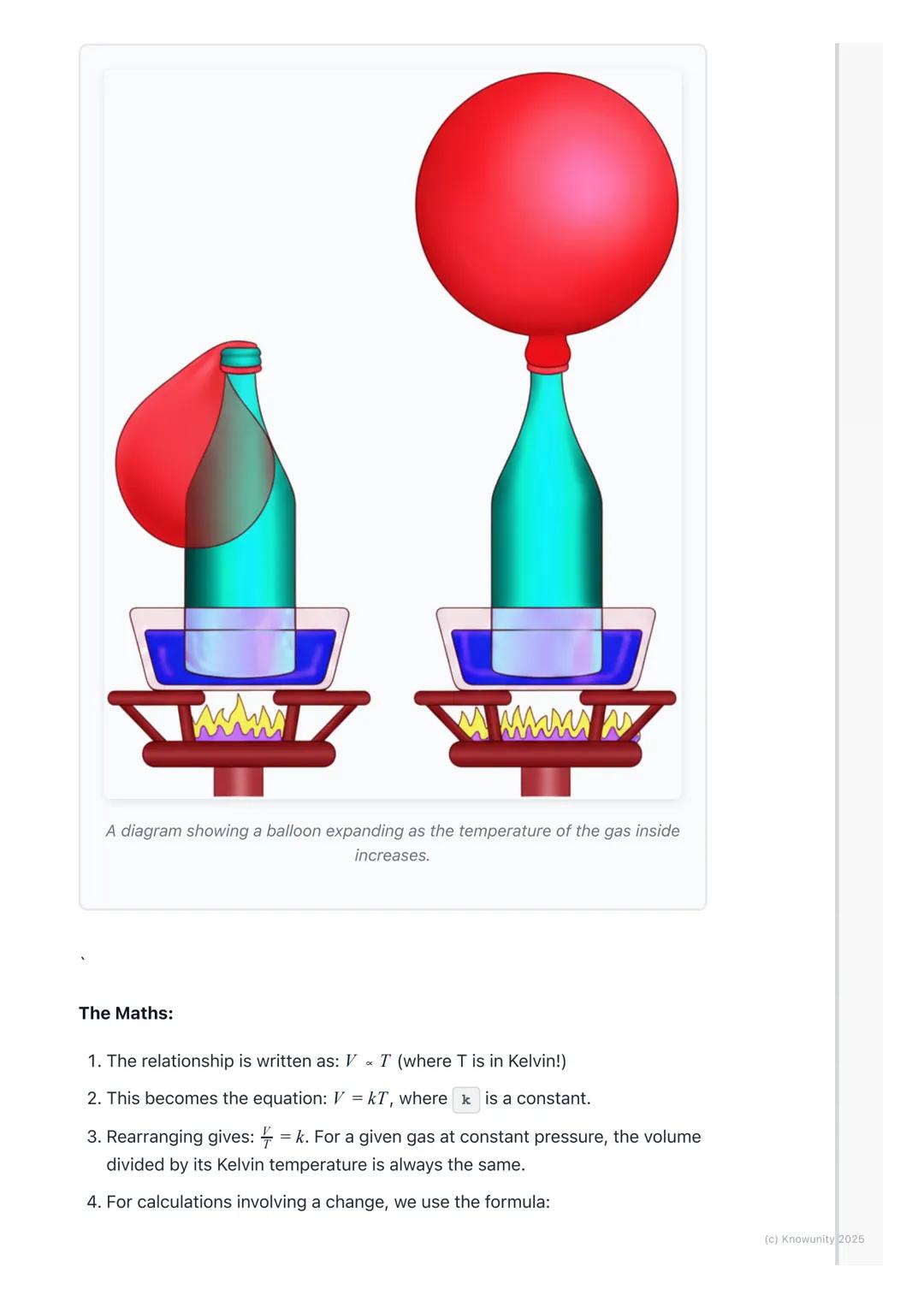
Worked Example - Boyle's Law
Let's tackle a typical exam question: A gas sample has 250 cm³ volume at 100 kPa pressure. Pressure increases to 125 kPa at constant temperature. What's the new volume?
First, identify your variables: P₁ = 100 kPa, V₁ = 250 cm³, P₂ = 125 kPa, V₂ = ?
Since temperature is constant, we use Boyle's Law: P₁V₁ = P₂V₂
Substitute: (100)(250) = (125)(V₂), so 25000 = 125V₂
Solving: V₂ = 25000 ÷ 125 = 200 cm³
Always check your answer makes sense - pressure increased, so volume should decrease. 200 cm³ is less than 250 cm³, so we're spot on!
💡 Pro Tip: Always do a sense check - if pressure goes up, volume goes down in Boyle's Law.
5
of 7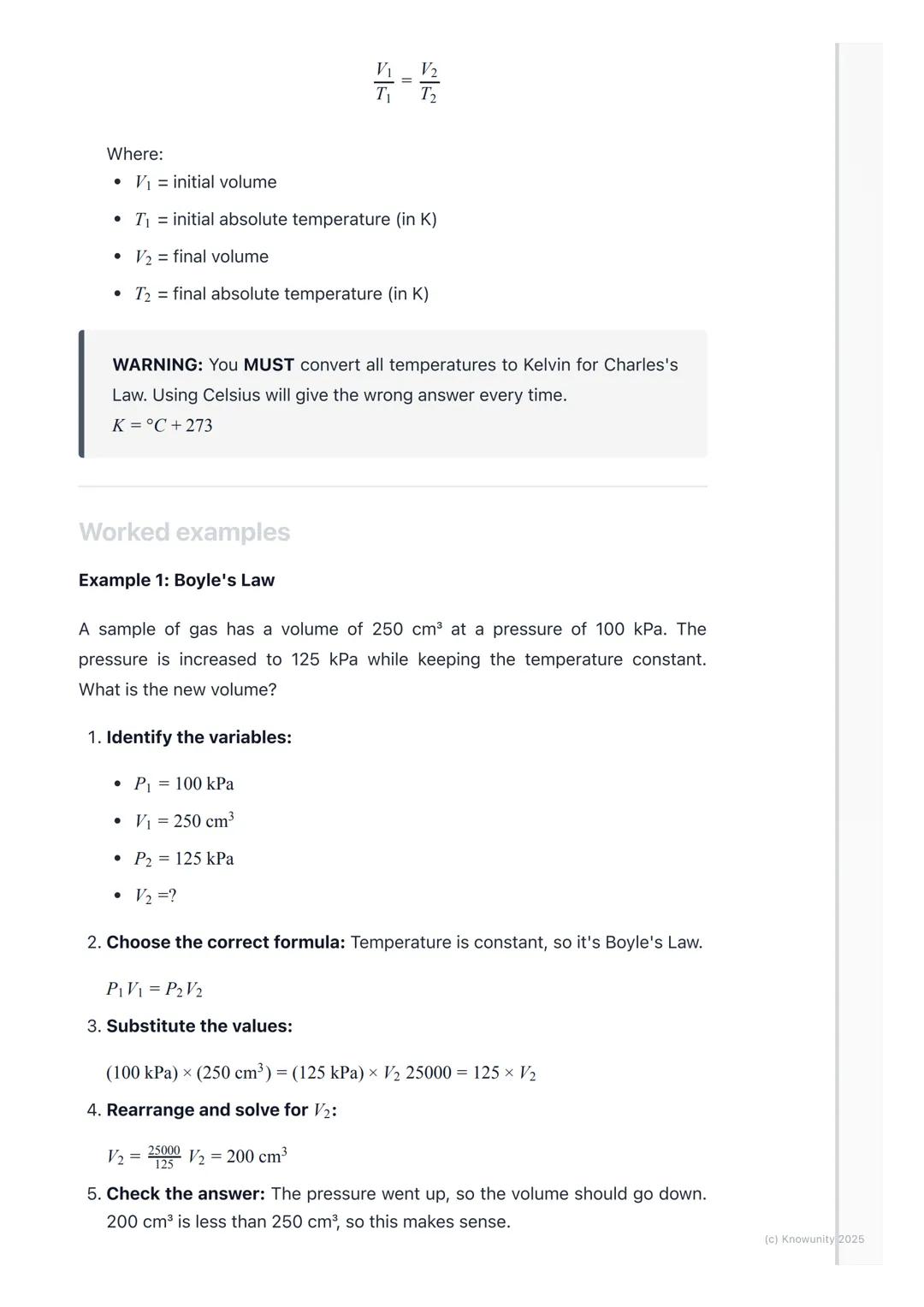
Worked Example - Charles's Law
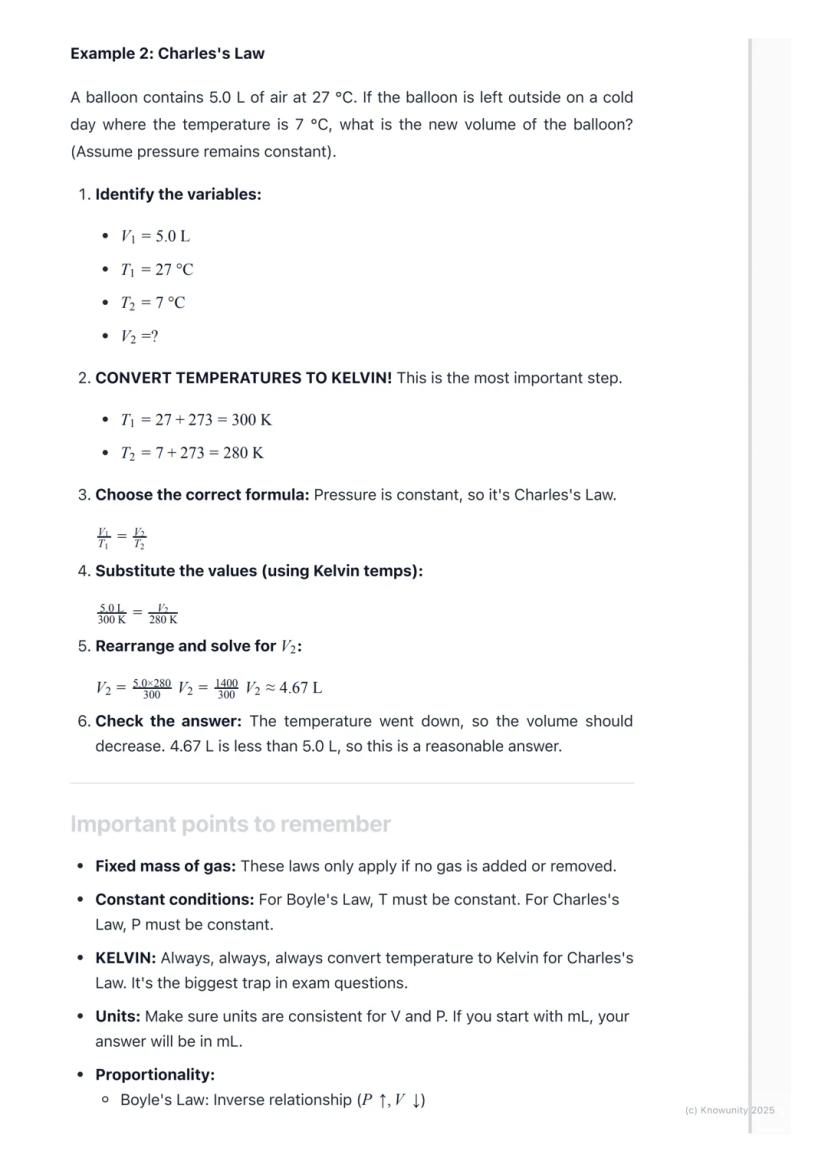
Here's a Charles's Law problem: A balloon contains 5.0 L of air at 27°C. On a cold day at 7°C, what's the new volume? (Pressure stays constant)
Step one is absolutely critical - convert to Kelvin immediately: T₁ = 27 + 273 = 300 K, T₂ = 7 + 273 = 280 K
Now identify variables: V₁ = 5.0 L, T₁ = 300 K, T₂ = 280 K, V₂ = ?
Use Charles's Law formula: V₁/T₁ = V₂/T₂
Substitute: 5.0/300 = V₂/280
Solving: V₂ = (5.0 × 280) ÷ 300 = 4.67 L
Sense check - temperature decreased, so volume should decrease. 4.67 L < 5.0 L ✓
💡 Success Strategy: Write "Convert to Kelvin!" at the top of every Charles's Law problem as a reminder.
6
of 7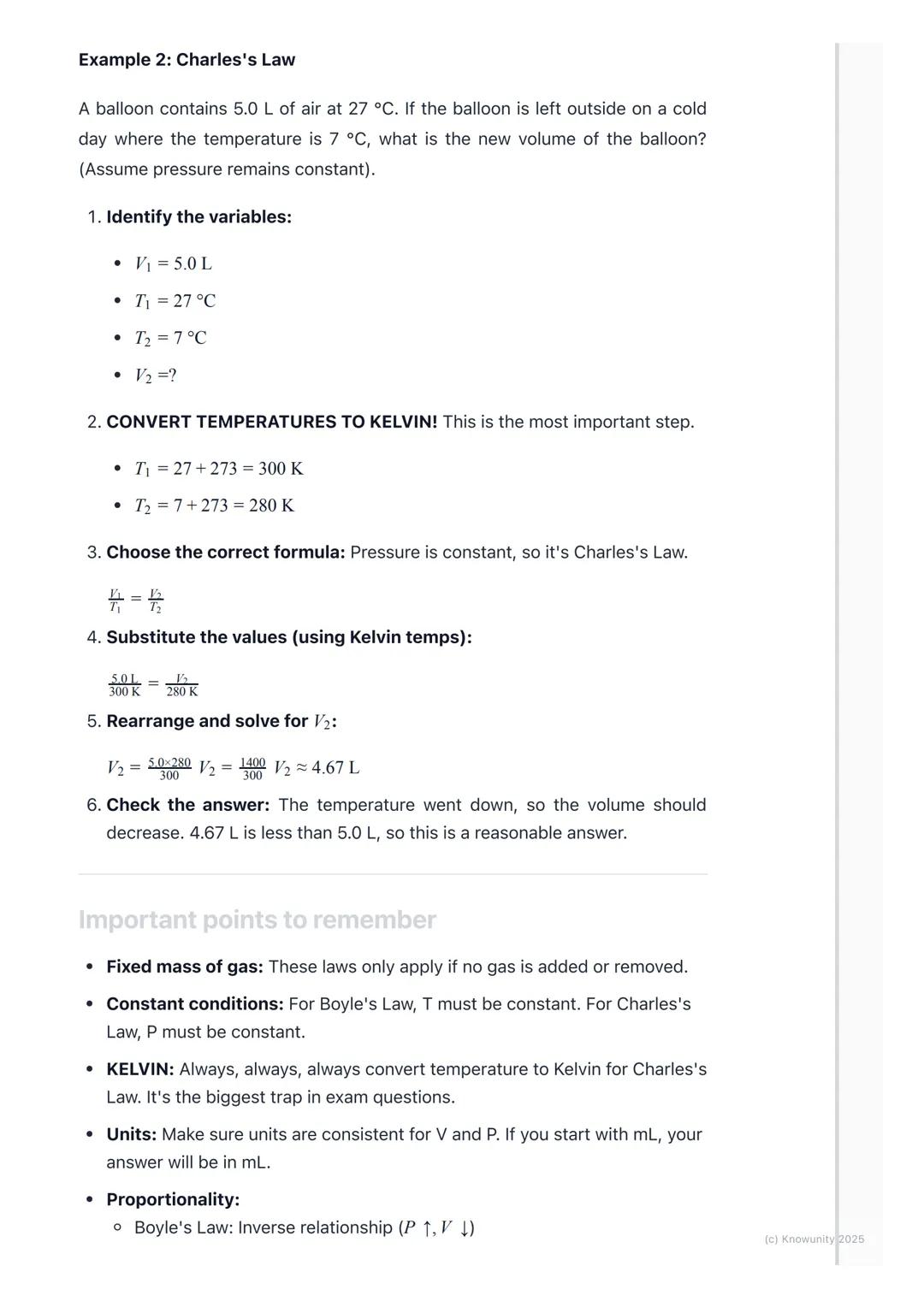
Quick Reference and Exam Tips
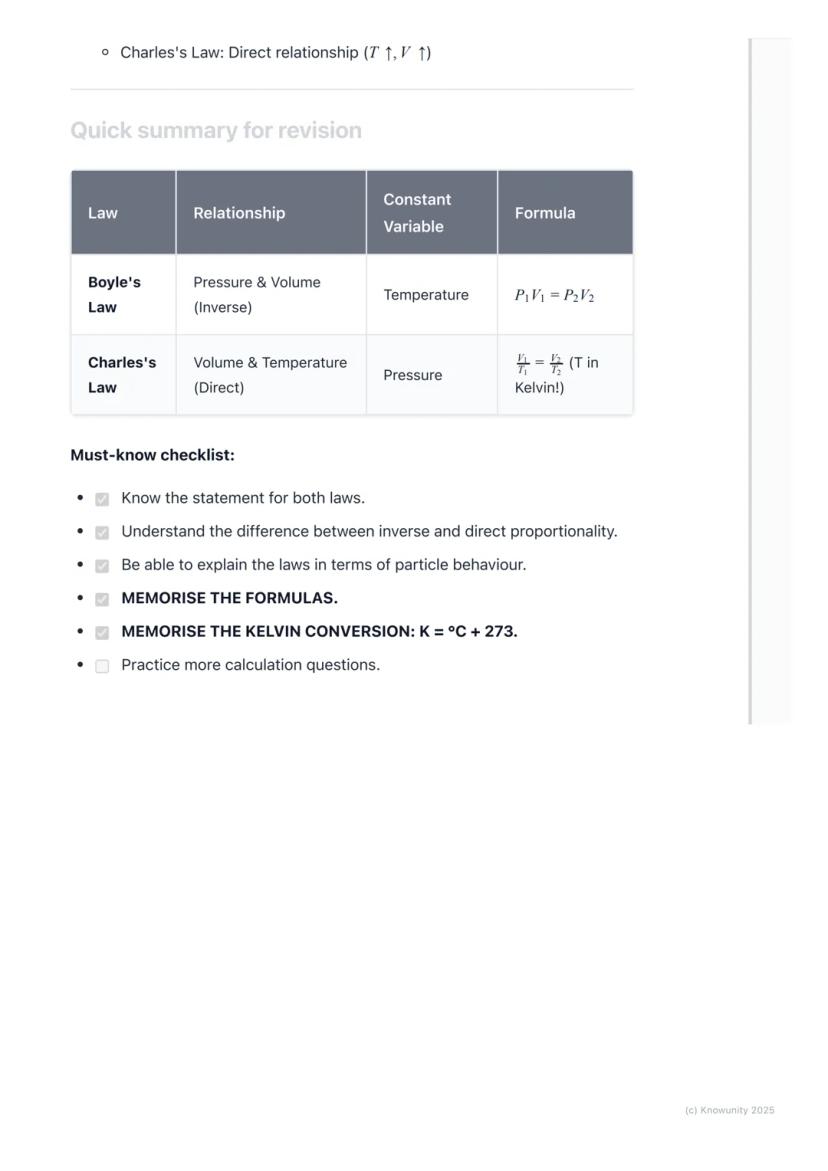
Here's your essential revision table:
| **Law** | **Relationship** | **Constant** | **Formula** |
|---|---|---|---|
| Boyle's | P & V (Inverse) | Temperature | P₁V₁ = P₂V₂ |
| Charles's | V & T (Direct) | Pressure | V₁/T₁ = V₂/T₂ |
Key exam strategies: Know both law statements perfectly. Understand that Boyle's shows inverse proportionality (one goes up, other goes down) whilst Charles's shows direct proportionality (both change in the same direction).
Practice explaining these laws using particle behaviour - it's a common exam question. Faster-moving particles need more space (Charles's), whilst squashing particles into smaller spaces increases collisions (Boyle's).
Master the formulas and that crucial Kelvin conversion. These are your bread-and-butter marks in gas law questions.
💡 Exam Success: Learn to spot which law applies by identifying which variable stays constant in the question.
7
of 7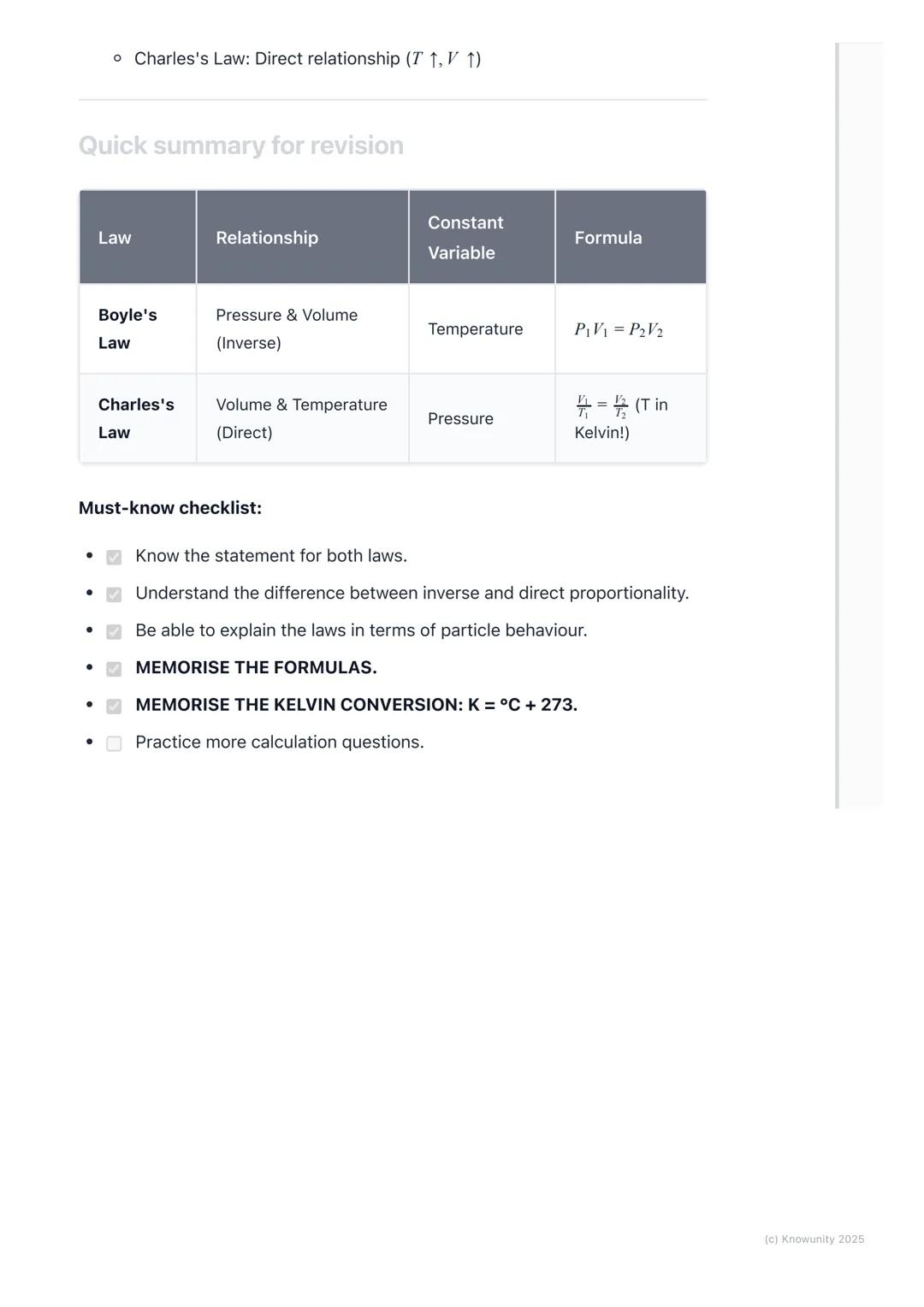
Mislili smo da nikad nećeš pitati...
Šta je Knowunity AI companion?
Naš AI Companion je AI alat fokusiran na učenike koji nudi više od samih odgovora. Napravljen na milionima Knowunity resursa, pruža relevantne informacije, personalizovane planove učenja, kvizove i sadržaj direktno u chatu, prilagođavajući se tvom individualnom putu učenja.
Gde mogu da preuzmem Knowunity aplikaciju?
Možeš preuzeti aplikaciju sa Google Play Store-a i Apple App Store-a.
Da li je Knowunity stvarno besplatan?
Tako je! Uživaj u besplatnom pristupu sadržaju za učenje, povezuj se sa drugim učenicima i dobijaj trenutnu pomoć – sve na dohvat ruke.
Ne možeš da nađeš ono što tražiš? Istražuj druge predmete.
Učenici nas obožavaju — i ti ćeš takođe.
4.6/5App Store
4.7/5Google Play
Aplikacija je super laka za korišćenje i odlično dizajnirana. Našao sam sve što mi je trebalo i dosta sam naučio iz prezentacija! Definitivno ću koristiti aplikaciju za školski zadatak! A naravno, pomaže i kao inspiracija.
Stefan SiOS korisnik
Ova aplikacija je stvarno odlična. Tu je toliko beleški za učenje i pomoći [...]. Na primer, problem mi je francuski, a aplikacija ima toliko opcija za pomoć. Zahvaljujući ovoj aplikaciji, poboljšao sam francuski. Preporučio bih je svima.
Samantha KlichAndroid korisnik
Vau, stvarno sam oduševljena. Probala sam aplikaciju jer sam je videla u reklamama mnogo puta i bila sam potpuno šokirana. Ova aplikacija je POMOĆ koju želiš za školu i pre svega, nudi toliko stvari, kao što su vežbe i sažeci, što mi je lično bilo VEOMA korisno.
AnaiOS korisnik
Chemistry6 pregledi·Ažurirano May 30, 2026·7 straniceUnderstanding Gas Laws: Boyle's and Charles's Principles Simplified
Ever wondered why a balloon shrinks in the cold or why your ears pop when you dive deep underwater? It's all about gas laws! These simple rules explain how gases behave when pressure, volume, or temperature changes - and they're...
1
of 7
Registruj se da vidiš sadržaj. Besplatno je!
- Pristup svim dokumentima
- Poboljšaj svoje ocene
- Pridruži se milionima učenika
Understanding Gas Laws Basics
Gas laws are straightforward rules that predict how gases behave under different conditions. They're based on ideal gases - a theoretical model that works brilliantly for real gases under normal conditions.
The key thing to remember is that we're always dealing with a fixed mass of gas. This means no gas escapes or enters the container during our experiments.
You need to master some crucial definitions first. Pressure is the force gas particles exert on container walls through constant collisions. Volume is simply the space the gas occupies. Temperature measures the average kinetic energy of gas particles - faster particles mean higher temperature.
💡 Critical Point: For all gas law calculations, temperature MUST be in Kelvin. Convert by adding 273 to Celsius: K = °C + 273. This is where most students lose marks!
2
of 7Registruj se da vidiš sadržaj. Besplatno je!
- Pristup svim dokumentima
- Poboljšaj svoje ocene
- Pridruži se milionima učenika
Boyle's Law - Pressure vs Volume
Boyle's Law is all about the relationship between pressure and volume whilst keeping temperature constant. Here's the key principle: volume is inversely proportional to pressure.
Double the pressure, and you'll halve the volume. It makes perfect sense when you think about particles - squeeze them into a smaller space (decrease volume), and they'll hit the walls more frequently, increasing pressure.
The mathematical relationship is beautifully simple: PV = constant. For calculations involving changes, use the formula: P₁V₁ = P₂V₂
Here's what's brilliant about this - your units just need to be consistent on both sides. If you start with cm³, your answer will be in cm³. No complicated conversions needed!
💡 Memory Trick: Boyle's Law = "Pressure squeezes" - higher pressure squeezes the volume smaller.
3
of 7Registruj se da vidiš sadržaj. Besplatno je!
- Pristup svim dokumentima
- Poboljšaj svoje ocene
- Pridruži se milionima učenika
Charles's Law - Volume vs Temperature
Charles's Law explores how volume changes with temperature whilst pressure stays constant. The relationship here is directly proportional - increase temperature, increase volume by the same factor.
Picture a balloon in your car on a hot day - it expands because heated gas particles move faster and need more space. The pressure stays the same, but the volume increases to accommodate the more energetic particles.
The formula for changes is: V₁/T₁ = V₂/T₂. But here's the absolute crucial bit - temperature MUST be in Kelvin. Using Celsius will guarantee the wrong answer.
Remember: K = °C + 273. Write this conversion at the start of every Charles's Law problem. It'll save you from the most common mistake in gas law questions.
💡 Warning: Never forget Kelvin conversion! It's the number one way students mess up Charles's Law calculations.
4
of 7Registruj se da vidiš sadržaj. Besplatno je!
- Pristup svim dokumentima
- Poboljšaj svoje ocene
- Pridruži se milionima učenika
Worked Example - Boyle's Law
Let's tackle a typical exam question: A gas sample has 250 cm³ volume at 100 kPa pressure. Pressure increases to 125 kPa at constant temperature. What's the new volume?
First, identify your variables: P₁ = 100 kPa, V₁ = 250 cm³, P₂ = 125 kPa, V₂ = ?
Since temperature is constant, we use Boyle's Law: P₁V₁ = P₂V₂
Substitute: (100)(250) = (125)(V₂), so 25000 = 125V₂
Solving: V₂ = 25000 ÷ 125 = 200 cm³
Always check your answer makes sense - pressure increased, so volume should decrease. 200 cm³ is less than 250 cm³, so we're spot on!
💡 Pro Tip: Always do a sense check - if pressure goes up, volume goes down in Boyle's Law.
5
of 7Registruj se da vidiš sadržaj. Besplatno je!
- Pristup svim dokumentima
- Poboljšaj svoje ocene
- Pridruži se milionima učenika
Worked Example - Charles's Law
Here's a Charles's Law problem: A balloon contains 5.0 L of air at 27°C. On a cold day at 7°C, what's the new volume? (Pressure stays constant)
Step one is absolutely critical - convert to Kelvin immediately: T₁ = 27 + 273 = 300 K, T₂ = 7 + 273 = 280 K
Now identify variables: V₁ = 5.0 L, T₁ = 300 K, T₂ = 280 K, V₂ = ?
Use Charles's Law formula: V₁/T₁ = V₂/T₂
Substitute: 5.0/300 = V₂/280
Solving: V₂ = (5.0 × 280) ÷ 300 = 4.67 L
Sense check - temperature decreased, so volume should decrease. 4.67 L < 5.0 L ✓
💡 Success Strategy: Write "Convert to Kelvin!" at the top of every Charles's Law problem as a reminder.
6
of 7Registruj se da vidiš sadržaj. Besplatno je!
- Pristup svim dokumentima
- Poboljšaj svoje ocene
- Pridruži se milionima učenika
Quick Reference and Exam Tips
Here's your essential revision table:
| **Law** | **Relationship** | **Constant** | **Formula** |
|---|---|---|---|
| Boyle's | P & V (Inverse) | Temperature | P₁V₁ = P₂V₂ |
| Charles's | V & T (Direct) | Pressure | V₁/T₁ = V₂/T₂ |
Key exam strategies: Know both law statements perfectly. Understand that Boyle's shows inverse proportionality (one goes up, other goes down) whilst Charles's shows direct proportionality (both change in the same direction).
Practice explaining these laws using particle behaviour - it's a common exam question. Faster-moving particles need more space (Charles's), whilst squashing particles into smaller spaces increases collisions (Boyle's).
Master the formulas and that crucial Kelvin conversion. These are your bread-and-butter marks in gas law questions.
💡 Exam Success: Learn to spot which law applies by identifying which variable stays constant in the question.
7
of 7Registruj se da vidiš sadržaj. Besplatno je!
- Pristup svim dokumentima
- Poboljšaj svoje ocene
- Pridruži se milionima učenika
Mislili smo da nikad nećeš pitati...
Šta je Knowunity AI companion?
Naš AI Companion je AI alat fokusiran na učenike koji nudi više od samih odgovora. Napravljen na milionima Knowunity resursa, pruža relevantne informacije, personalizovane planove učenja, kvizove i sadržaj direktno u chatu, prilagođavajući se tvom individualnom putu učenja.
Gde mogu da preuzmem Knowunity aplikaciju?
Možeš preuzeti aplikaciju sa Google Play Store-a i Apple App Store-a.
Da li je Knowunity stvarno besplatan?
Tako je! Uživaj u besplatnom pristupu sadržaju za učenje, povezuj se sa drugim učenicima i dobijaj trenutnu pomoć – sve na dohvat ruke.
Ne možeš da nađeš ono što tražiš? Istražuj druge predmete.
Učenici nas obožavaju — i ti ćeš takođe.
4.6/5App Store
4.7/5Google Play
Aplikacija je super laka za korišćenje i odlično dizajnirana. Našao sam sve što mi je trebalo i dosta sam naučio iz prezentacija! Definitivno ću koristiti aplikaciju za školski zadatak! A naravno, pomaže i kao inspiracija.
Stefan SiOS korisnik
Ova aplikacija je stvarno odlična. Tu je toliko beleški za učenje i pomoći [...]. Na primer, problem mi je francuski, a aplikacija ima toliko opcija za pomoć. Zahvaljujući ovoj aplikaciji, poboljšao sam francuski. Preporučio bih je svima.
Samantha KlichAndroid korisnik
Vau, stvarno sam oduševljena. Probala sam aplikaciju jer sam je videla u reklamama mnogo puta i bila sam potpuno šokirana. Ova aplikacija je POMOĆ koju želiš za školu i pre svega, nudi toliko stvari, kao što su vežbe i sažeci, što mi je lično bilo VEOMA korisno.
AnaiOS korisnik