
Learning French numbers might seem tricky at first, but it's... Prikaži više
 French10 pregledi·Ažurirano May 19, 2026·5 stranice
Master French Numbers: Count from 1 to 50
1 / 5
1
of 5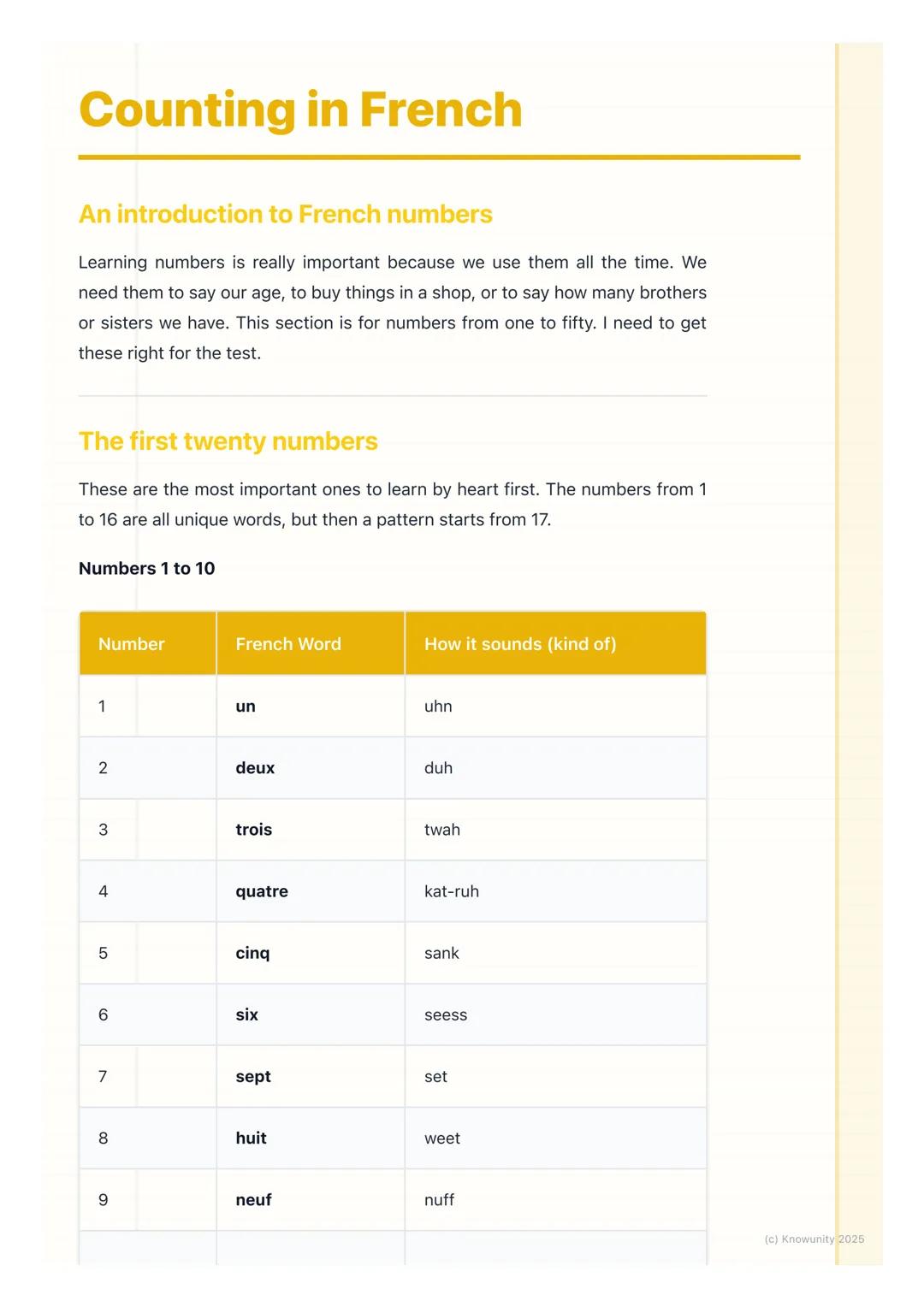
Getting Started with French Numbers 1-20
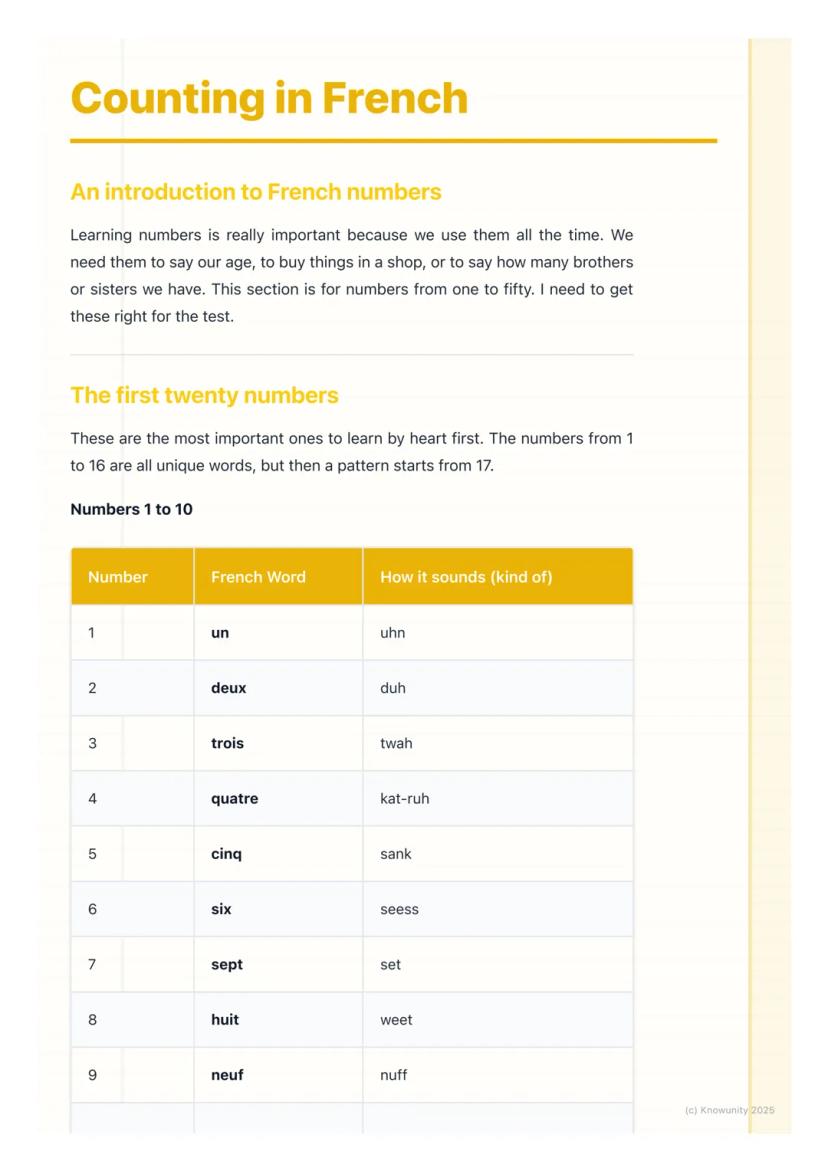
French numbers from 1-10 are completely unique words that you'll need to memorise properly. Think of them as your building blocks - once you've got these down, everything else becomes much easier!
The key ones to nail first are: un (1), deux (2), trois (3), quatre (4), cinq (5), six (6), sept (7), huit (8), neuf (9), and dix (10). Don't worry about perfect pronunciation yet - just get familiar with how they look.
Numbers 11-16 are special cases that you'll have to learn separately: onze, douze, treize, quatorze, quinze, seize. There's no pattern here, so it's just memorisation time!
Quick Tip: Practice writing out numbers 1-16 from memory. Once you can do this without looking, you're ready for the clever bit that comes next!
2
of 5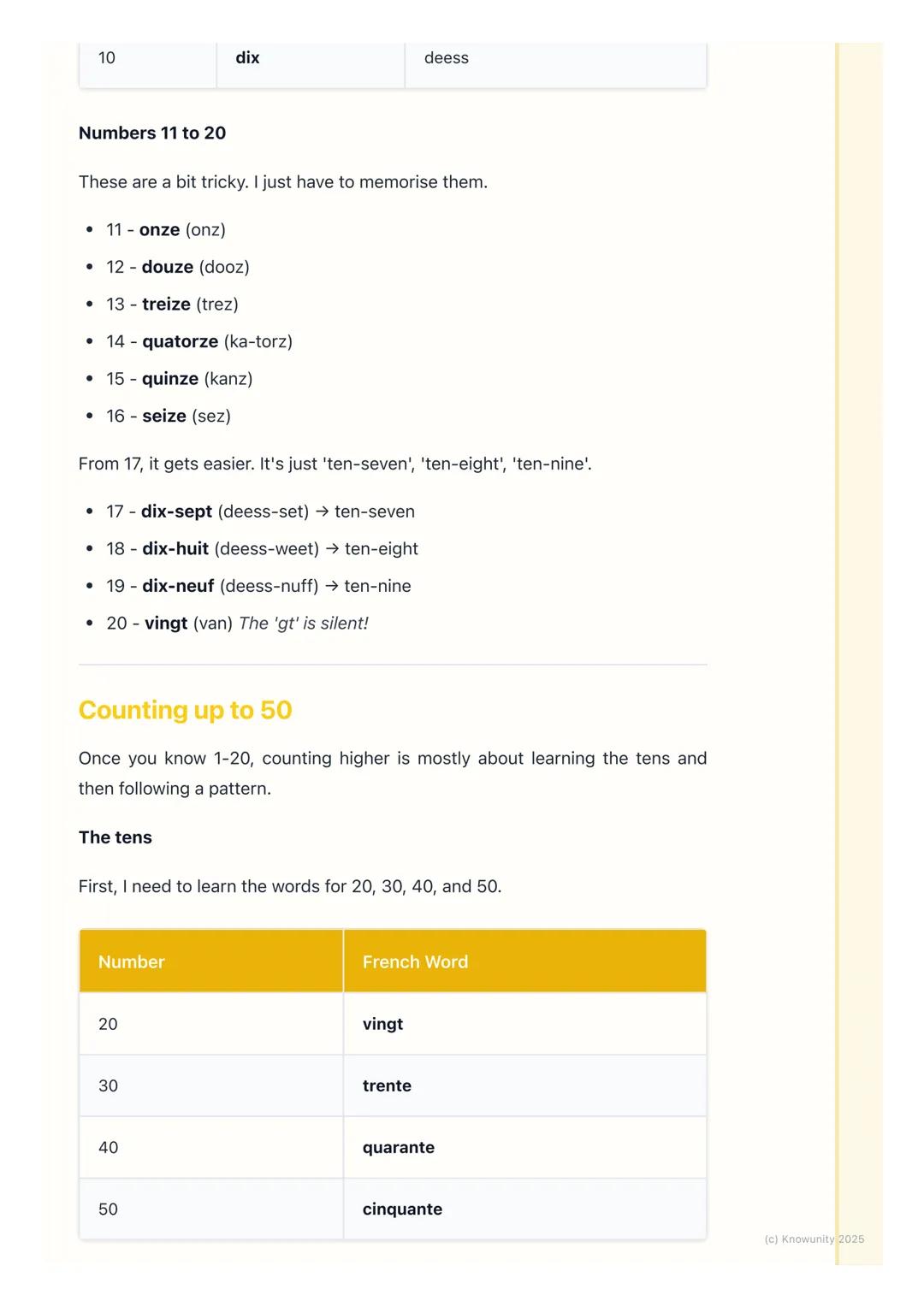
The Clever Pattern from 17-20 and Beyond
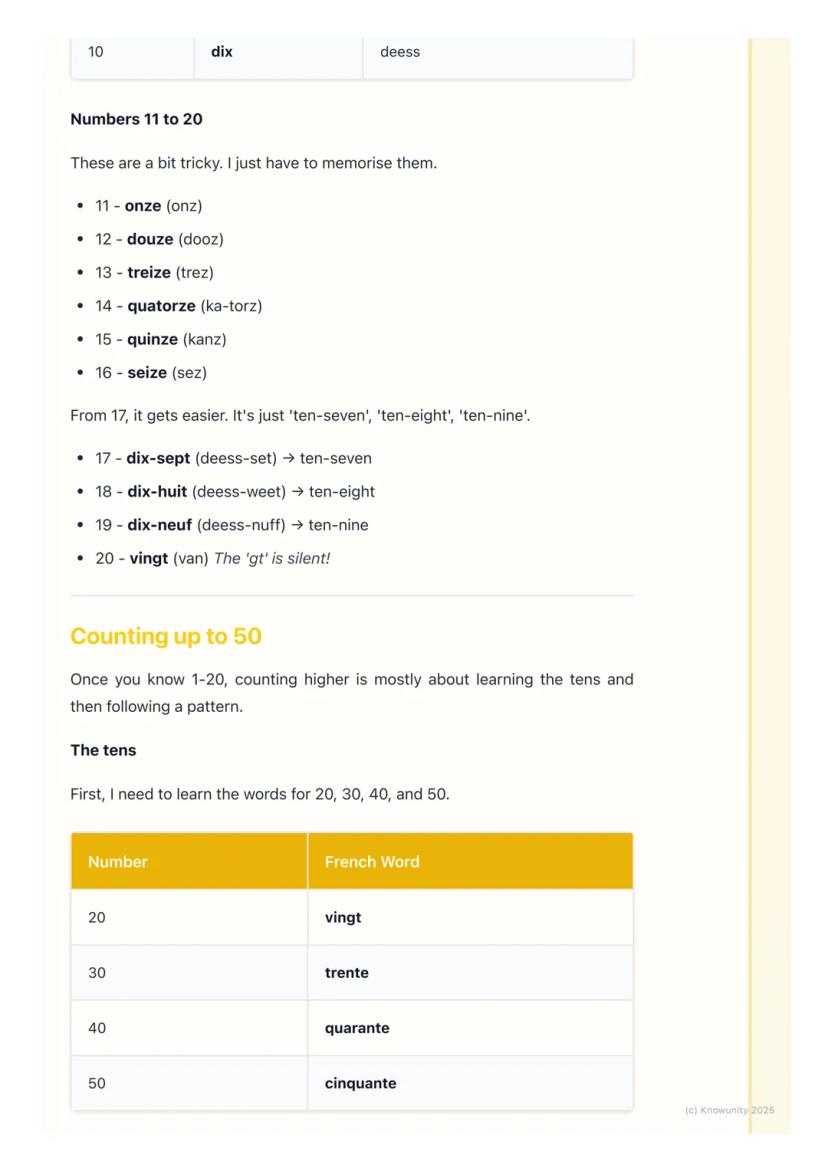
Here's where French gets really smart! Numbers 17-19 follow a simple pattern: they're literally "ten-seven", "ten-eight", "ten-nine". So you get dix-sept (17), dix-huit (18), and dix-neuf (19). Brilliant, right?
Twenty is "vingt" - and watch out because the 'gt' at the end is silent! This trips up loads of people, so remember it sounds like "van", not "vingt".
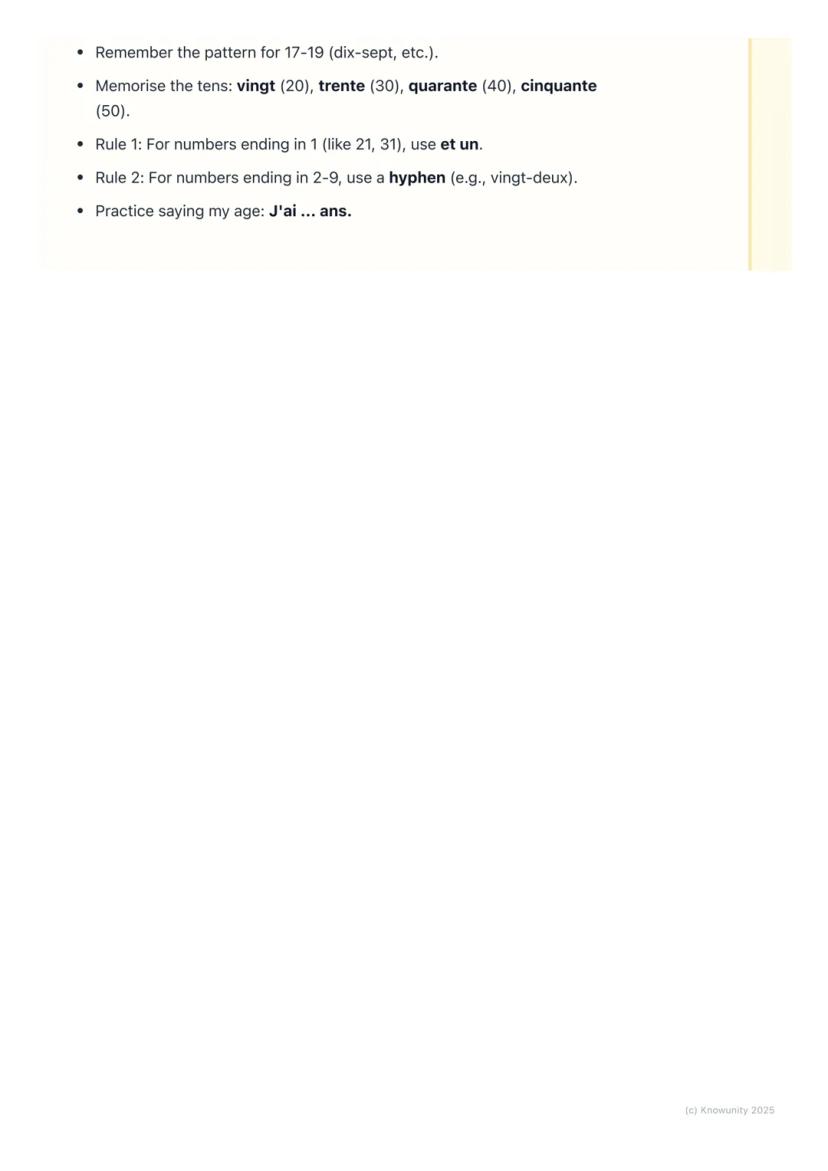
Now you need to learn the tens: vingt (20), trente (30), quarante (40), and cinquante (50). These are your next building blocks for making bigger numbers.
Remember: The teens from 11-16 are weird, but 17-19 follow the "dix-" pattern. After that, it's all about combining tens with units!
3
of 5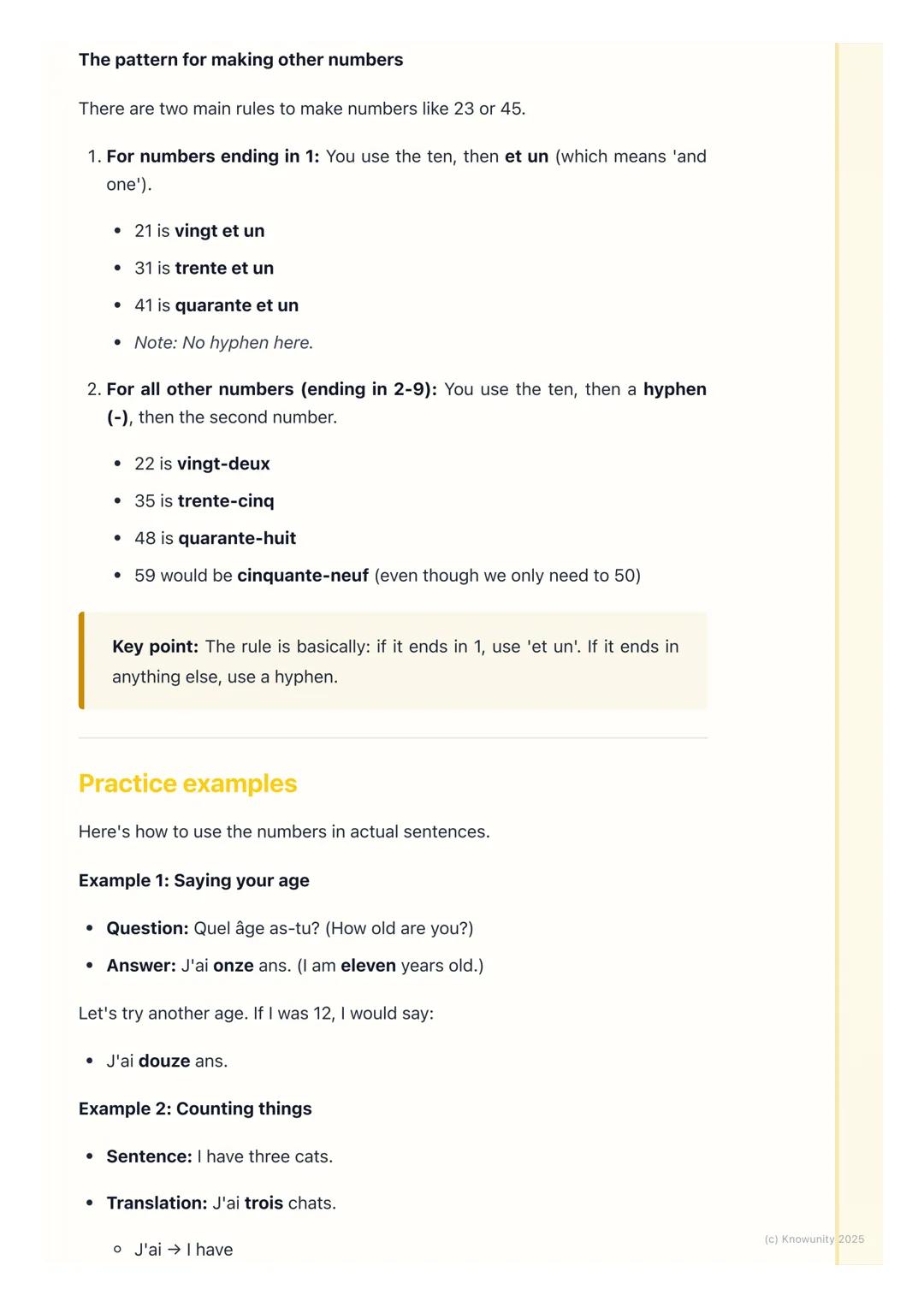
The Two Golden Rules for Making Numbers
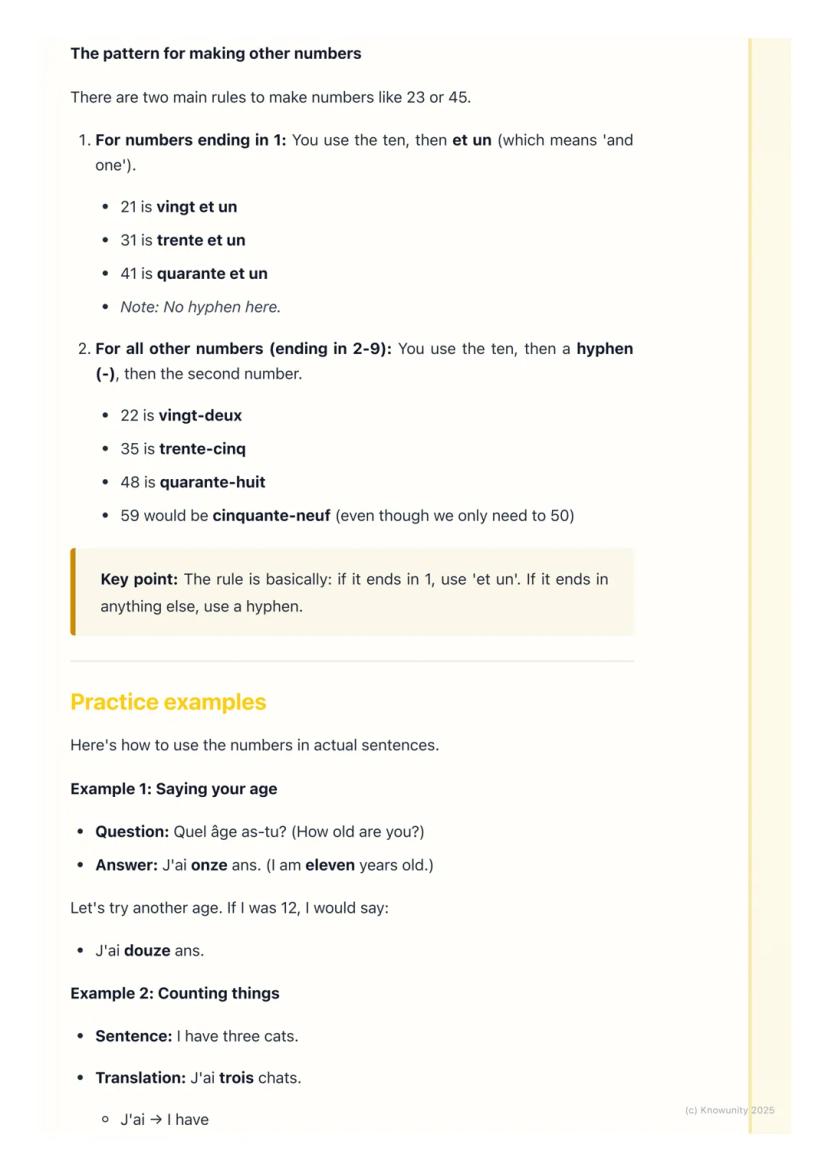
Right, this is the game-changer! There are only two rules you need to make any number up to 50, and they're dead simple once you get them.
Rule 1: Numbers ending in 1 use "et un" (meaning "and one"). So 21 becomes vingt et un, 31 becomes trente et un, and 41 becomes quarante et un. Notice there's no hyphen here - just the words flowing together.
Rule 2: All other numbers use a hyphen between the ten and the unit. So 22 is vingt-deux, 35 is trente-cinq, and 48 is quarante-huit. The hyphen keeps everything tidy!
Memory Trick: If it ends in 1, think "and one" (et un). If it ends in anything else, think "hyphen time"!
4
of 5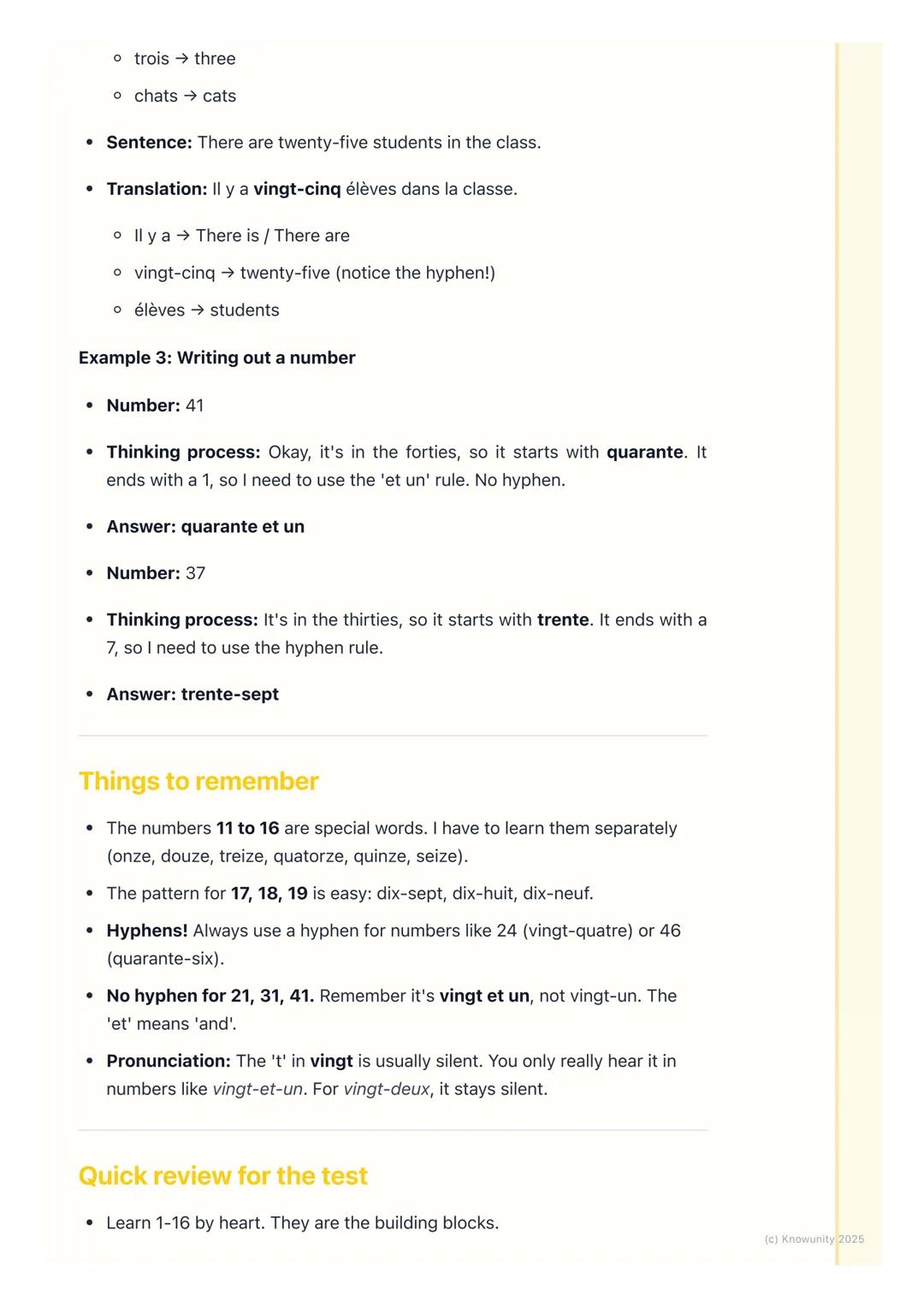
Using Numbers in Real French Sentences
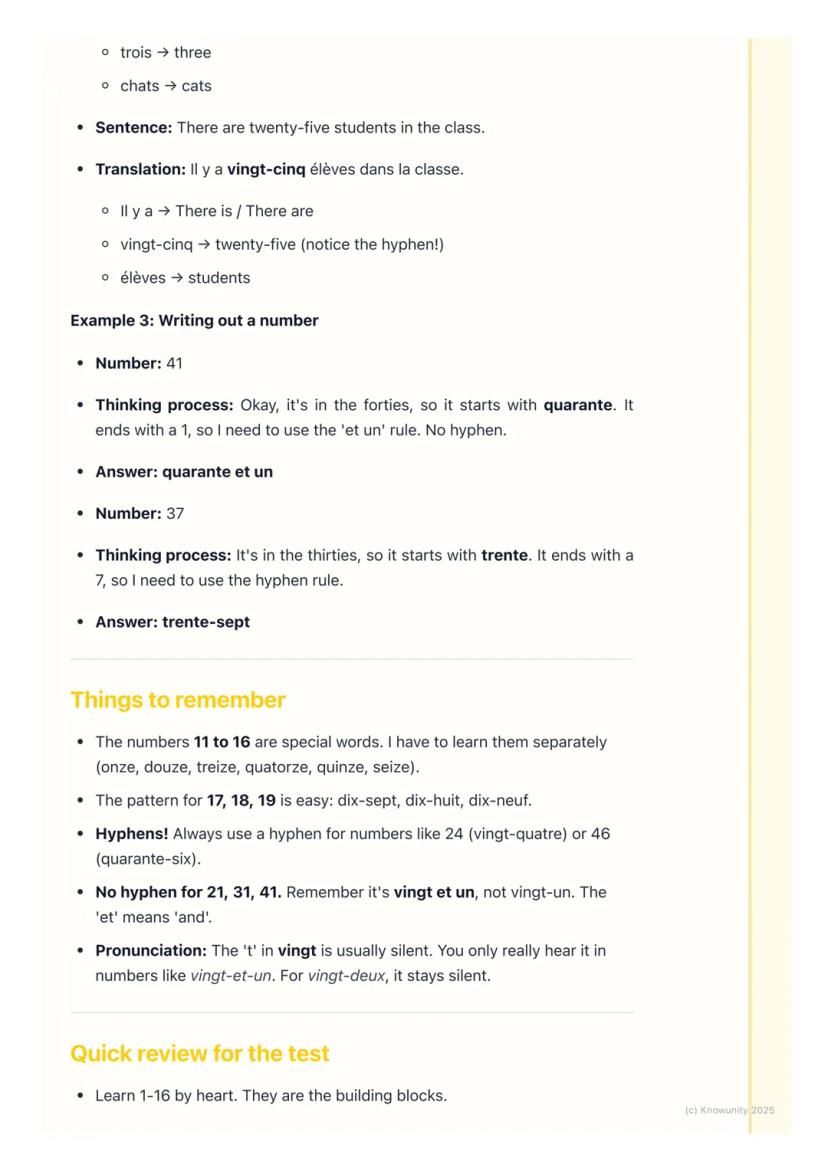
Time to put these numbers to work! Saying your age is probably the most useful thing you'll do with French numbers. The question "Quel âge as-tu?" means "How old are you?"
Your answer always starts with "J'ai" (I have) followed by the number and "ans" (years). So if you're 12, you'd say "J'ai douze ans." Easy!
Counting objects works similarly. "J'ai trois chats" means "I have three cats." For bigger groups, like "There are twenty-five students in the class," you'd say "Il y a vingt-cinq élèves dans la classe." Notice that hyphen in vingt-cinq!
When you're writing out numbers, just think through the process: Is it in the twenties, thirties, or forties? Does it end in 1 (use et un) or something else (use a hyphen)?
Practice Tip: Try saying your real age, your family members' ages, and count objects around your room. The more you use these numbers, the more automatic they become!
5
of 5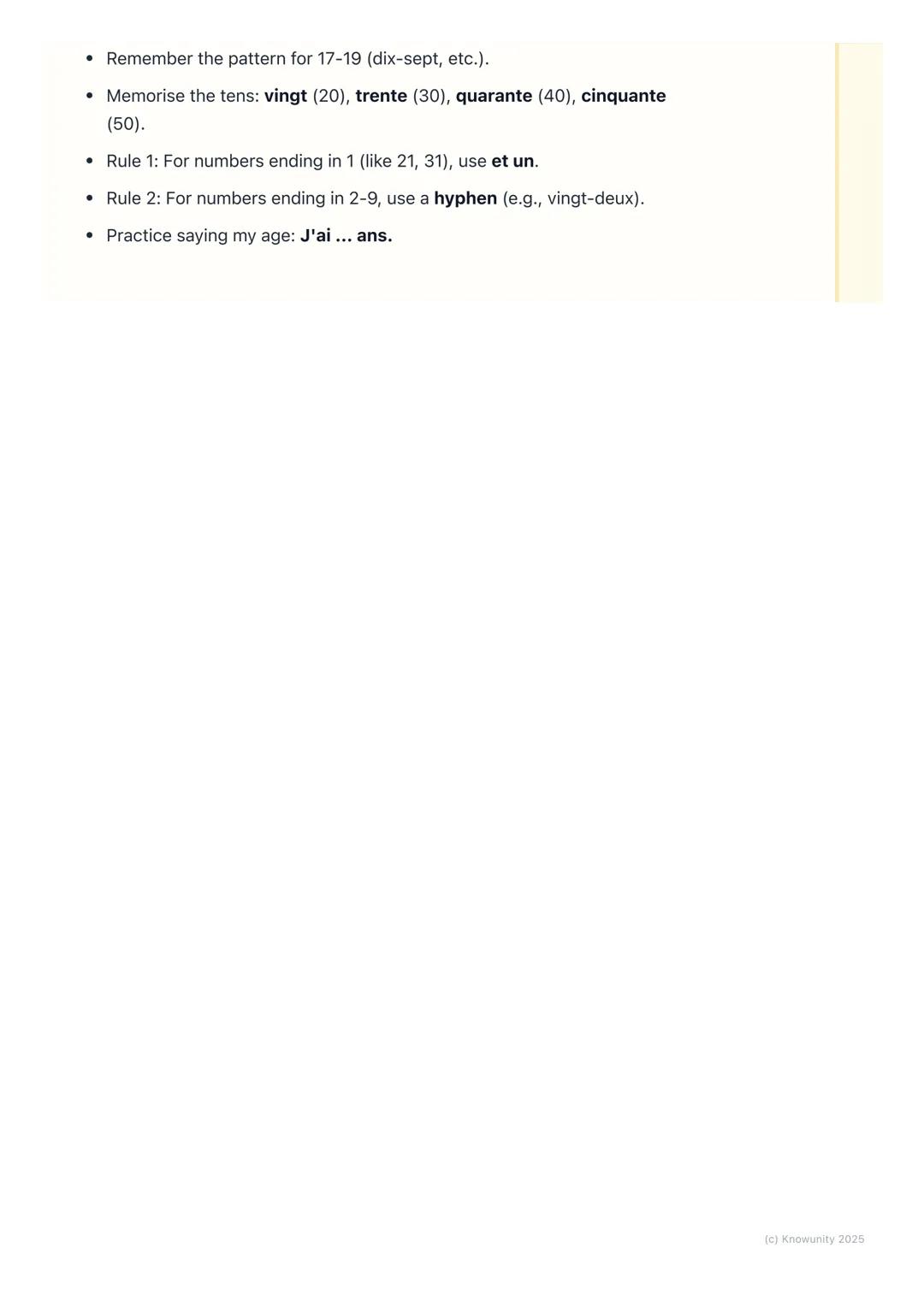
Quick Review and Test Prep
Master the foundation first: numbers 1-16 are your absolute essentials. If you know these cold, you can build everything else. The pattern for 17-19 is your bridge to the bigger numbers.
Don't forget the silent letters! The 't' in vingt is usually silent - it sounds like "van", not "vingt". This catches out loads of students in speaking tests.
Practice the two rules until they're automatic: "et un" for numbers ending in 1 (no hyphen), and hyphens for everything else. Try making random numbers like 23, 37, or 44 and see if you can write them out correctly.
The brilliant thing about French numbers is that once you've cracked this system up to 50, you've basically got the pattern for counting much higher too!
Final Check: Can you write your age in French? Can you count to 20 without looking? If yes, you're absolutely ready for that test!
Mislili smo da nikad nećeš pitati...
Šta je Knowunity AI companion?
Naš AI Companion je AI alat fokusiran na učenike koji nudi više od samih odgovora. Napravljen na milionima Knowunity resursa, pruža relevantne informacije, personalizovane planove učenja, kvizove i sadržaj direktno u chatu, prilagođavajući se tvom individualnom putu učenja.
Gde mogu da preuzmem Knowunity aplikaciju?
Možeš preuzeti aplikaciju sa Google Play Store-a i Apple App Store-a.
Da li je Knowunity stvarno besplatan?
Tako je! Uživaj u besplatnom pristupu sadržaju za učenje, povezuj se sa drugim učenicima i dobijaj trenutnu pomoć – sve na dohvat ruke.
Najpopularniji sadržaj u French
1Najpopularniji sadržaj
9 Irish
IrishIrish oral questions and answers
Questions and answers for the leaving cert oral
5th Year4254
IrishIrish oral questions
Outline of oral questions
5th Year2055
IrishIníon- le hÁine Durkin
Aine Durkin’s poem, Iníon: Themes & summary
5th Year850
 English
Key Quotes : Sive
Key Quotes and explanations: Sive
6th Year2402
IrishIrish poetry 2027
Iníon + Dínit an Bhróin
5th Year1133
IrishLC HL notes- Iníon (poem)
Includes poem in English and Irish, theme, key words & phrases
5th Year2284
IrishGaeilge Grammar Office
All the basics you need to know on Irish grammar.
6th Year913
IrishMo Ghrá-sa (Idir Lúibíní)
Notes on mo ghrá-sa
5th Year350
IrishAn Gaeilge Aiste
Irish Language essay
6th Year1250
Ne možeš da nađeš ono što tražiš? Istražuj druge predmete.
Učenici nas obožavaju — i ti ćeš takođe.
4.6/5App Store
4.7/5Google Play
Aplikacija je super laka za korišćenje i odlično dizajnirana. Našao sam sve što mi je trebalo i dosta sam naučio iz prezentacija! Definitivno ću koristiti aplikaciju za školski zadatak! A naravno, pomaže i kao inspiracija.
Stefan SiOS korisnik
Ova aplikacija je stvarno odlična. Tu je toliko beleški za učenje i pomoći [...]. Na primer, problem mi je francuski, a aplikacija ima toliko opcija za pomoć. Zahvaljujući ovoj aplikaciji, poboljšao sam francuski. Preporučio bih je svima.
Samantha KlichAndroid korisnik
Vau, stvarno sam oduševljena. Probala sam aplikaciju jer sam je videla u reklamama mnogo puta i bila sam potpuno šokirana. Ova aplikacija je POMOĆ koju želiš za školu i pre svega, nudi toliko stvari, kao što su vežbe i sažeci, što mi je lično bilo VEOMA korisno.
AnaiOS korisnik
French10 pregledi·Ažurirano May 19, 2026·5 straniceMaster French Numbers: Count from 1 to 50
Learning French numbers might seem tricky at first, but it's actually quite brilliant once you spot the patterns! You'll use these numbers constantly - for your age, buying things, or talking about your family - so getting them right is... Prikaži više
1
of 5Registruj se da vidiš sadržaj. Besplatno je!
- Pristup svim dokumentima
- Poboljšaj svoje ocene
- Pridruži se milionima učenika
Getting Started with French Numbers 1-20
French numbers from 1-10 are completely unique words that you'll need to memorise properly. Think of them as your building blocks - once you've got these down, everything else becomes much easier!
The key ones to nail first are: un (1), deux (2), trois (3), quatre (4), cinq (5), six (6), sept (7), huit (8), neuf (9), and dix (10). Don't worry about perfect pronunciation yet - just get familiar with how they look.
Numbers 11-16 are special cases that you'll have to learn separately: onze, douze, treize, quatorze, quinze, seize. There's no pattern here, so it's just memorisation time!
Quick Tip: Practice writing out numbers 1-16 from memory. Once you can do this without looking, you're ready for the clever bit that comes next!
2
of 5Registruj se da vidiš sadržaj. Besplatno je!
- Pristup svim dokumentima
- Poboljšaj svoje ocene
- Pridruži se milionima učenika
The Clever Pattern from 17-20 and Beyond
Here's where French gets really smart! Numbers 17-19 follow a simple pattern: they're literally "ten-seven", "ten-eight", "ten-nine". So you get dix-sept (17), dix-huit (18), and dix-neuf (19). Brilliant, right?
Twenty is "vingt" - and watch out because the 'gt' at the end is silent! This trips up loads of people, so remember it sounds like "van", not "vingt".
Now you need to learn the tens: vingt (20), trente (30), quarante (40), and cinquante (50). These are your next building blocks for making bigger numbers.
Remember: The teens from 11-16 are weird, but 17-19 follow the "dix-" pattern. After that, it's all about combining tens with units!
3
of 5Registruj se da vidiš sadržaj. Besplatno je!
- Pristup svim dokumentima
- Poboljšaj svoje ocene
- Pridruži se milionima učenika
The Two Golden Rules for Making Numbers
Right, this is the game-changer! There are only two rules you need to make any number up to 50, and they're dead simple once you get them.
Rule 1: Numbers ending in 1 use "et un" (meaning "and one"). So 21 becomes vingt et un, 31 becomes trente et un, and 41 becomes quarante et un. Notice there's no hyphen here - just the words flowing together.
Rule 2: All other numbers use a hyphen between the ten and the unit. So 22 is vingt-deux, 35 is trente-cinq, and 48 is quarante-huit. The hyphen keeps everything tidy!
Memory Trick: If it ends in 1, think "and one" (et un). If it ends in anything else, think "hyphen time"!
4
of 5Registruj se da vidiš sadržaj. Besplatno je!
- Pristup svim dokumentima
- Poboljšaj svoje ocene
- Pridruži se milionima učenika
Using Numbers in Real French Sentences
Time to put these numbers to work! Saying your age is probably the most useful thing you'll do with French numbers. The question "Quel âge as-tu?" means "How old are you?"
Your answer always starts with "J'ai" (I have) followed by the number and "ans" (years). So if you're 12, you'd say "J'ai douze ans." Easy!
Counting objects works similarly. "J'ai trois chats" means "I have three cats." For bigger groups, like "There are twenty-five students in the class," you'd say "Il y a vingt-cinq élèves dans la classe." Notice that hyphen in vingt-cinq!
When you're writing out numbers, just think through the process: Is it in the twenties, thirties, or forties? Does it end in 1 (use et un) or something else (use a hyphen)?
Practice Tip: Try saying your real age, your family members' ages, and count objects around your room. The more you use these numbers, the more automatic they become!
5
of 5Registruj se da vidiš sadržaj. Besplatno je!
- Pristup svim dokumentima
- Poboljšaj svoje ocene
- Pridruži se milionima učenika
Quick Review and Test Prep
Master the foundation first: numbers 1-16 are your absolute essentials. If you know these cold, you can build everything else. The pattern for 17-19 is your bridge to the bigger numbers.
Don't forget the silent letters! The 't' in vingt is usually silent - it sounds like "van", not "vingt". This catches out loads of students in speaking tests.
Practice the two rules until they're automatic: "et un" for numbers ending in 1 (no hyphen), and hyphens for everything else. Try making random numbers like 23, 37, or 44 and see if you can write them out correctly.
The brilliant thing about French numbers is that once you've cracked this system up to 50, you've basically got the pattern for counting much higher too!
Final Check: Can you write your age in French? Can you count to 20 without looking? If yes, you're absolutely ready for that test!
Mislili smo da nikad nećeš pitati...
Šta je Knowunity AI companion?
Naš AI Companion je AI alat fokusiran na učenike koji nudi više od samih odgovora. Napravljen na milionima Knowunity resursa, pruža relevantne informacije, personalizovane planove učenja, kvizove i sadržaj direktno u chatu, prilagođavajući se tvom individualnom putu učenja.
Gde mogu da preuzmem Knowunity aplikaciju?
Možeš preuzeti aplikaciju sa Google Play Store-a i Apple App Store-a.
Da li je Knowunity stvarno besplatan?
Tako je! Uživaj u besplatnom pristupu sadržaju za učenje, povezuj se sa drugim učenicima i dobijaj trenutnu pomoć – sve na dohvat ruke.
Najpopularniji sadržaj u French
1Najpopularniji sadržaj
9IrishIrish oral questions and answers
Questions and answers for the leaving cert oral
5th Year4254
IrishIrish oral questions
Outline of oral questions
5th Year2055
IrishIníon- le hÁine Durkin
Aine Durkin’s poem, Iníon: Themes & summary
5th Year850
EnglishKey Quotes : Sive
Key Quotes and explanations: Sive
6th Year2402
IrishIrish poetry 2027
Iníon + Dínit an Bhróin
5th Year1133
IrishLC HL notes- Iníon (poem)
Includes poem in English and Irish, theme, key words & phrases
5th Year2284
IrishGaeilge Grammar Office
All the basics you need to know on Irish grammar.
6th Year913
IrishMo Ghrá-sa (Idir Lúibíní)
Notes on mo ghrá-sa
5th Year350
IrishAn Gaeilge Aiste
Irish Language essay
6th Year1250
Ne možeš da nađeš ono što tražiš? Istražuj druge predmete.
Učenici nas obožavaju — i ti ćeš takođe.
4.6/5App Store
4.7/5Google Play
Aplikacija je super laka za korišćenje i odlično dizajnirana. Našao sam sve što mi je trebalo i dosta sam naučio iz prezentacija! Definitivno ću koristiti aplikaciju za školski zadatak! A naravno, pomaže i kao inspiracija.
Stefan SiOS korisnik
Ova aplikacija je stvarno odlična. Tu je toliko beleški za učenje i pomoći [...]. Na primer, problem mi je francuski, a aplikacija ima toliko opcija za pomoć. Zahvaljujući ovoj aplikaciji, poboljšao sam francuski. Preporučio bih je svima.
Samantha KlichAndroid korisnik
Vau, stvarno sam oduševljena. Probala sam aplikaciju jer sam je videla u reklamama mnogo puta i bila sam potpuno šokirana. Ova aplikacija je POMOĆ koju želiš za školu i pre svega, nudi toliko stvari, kao što su vežbe i sažeci, što mi je lično bilo VEOMA korisno.
AnaiOS korisnik