
Ever wondered how to order food in a German restaurant...
 German1 pregledi·Ažurirano Jun 14, 2026·5 stranice
Essential Phrases for Dining in a German Restaurant
1 / 5
1
of 5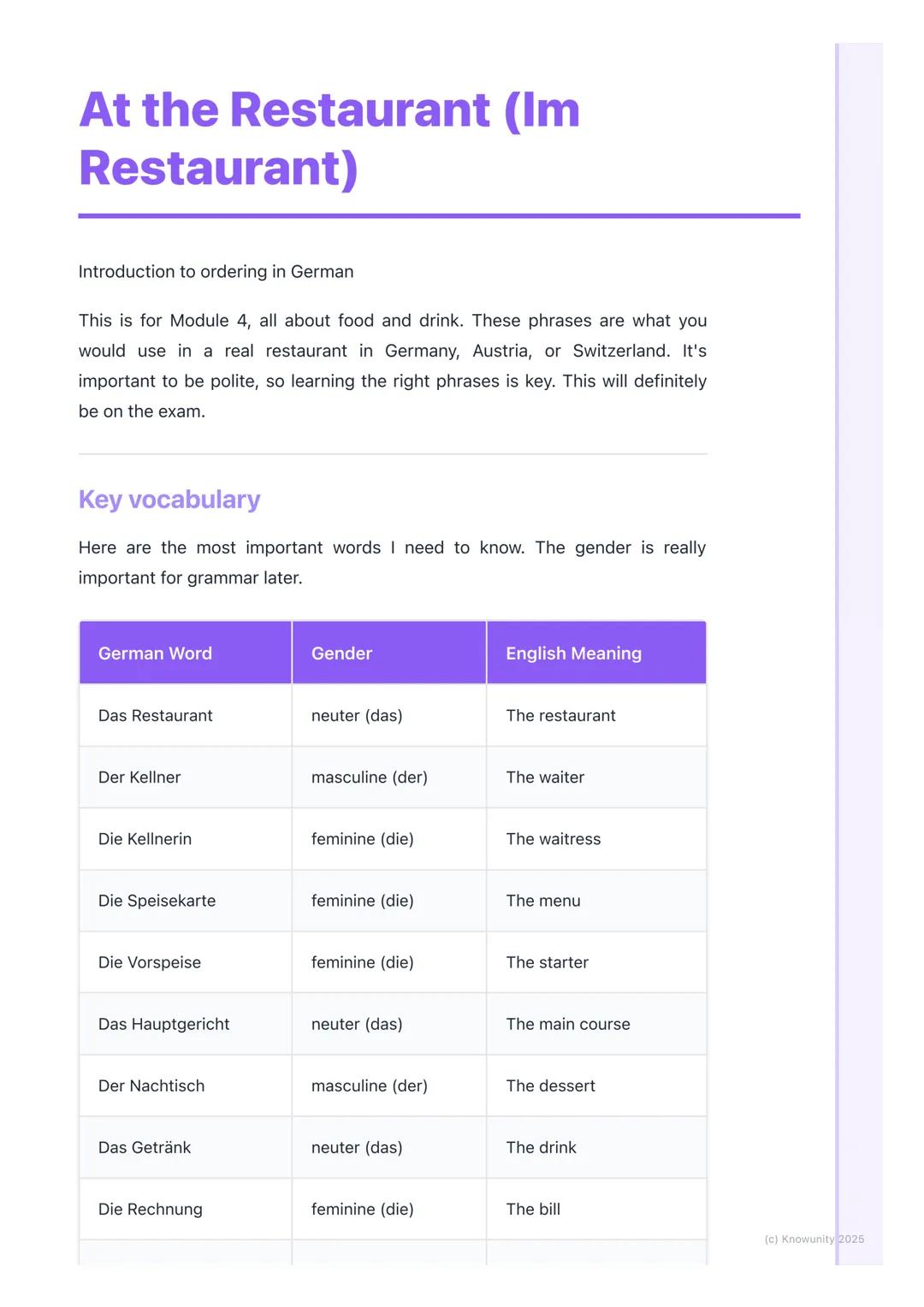
Restaurant Vocabulary Essentials
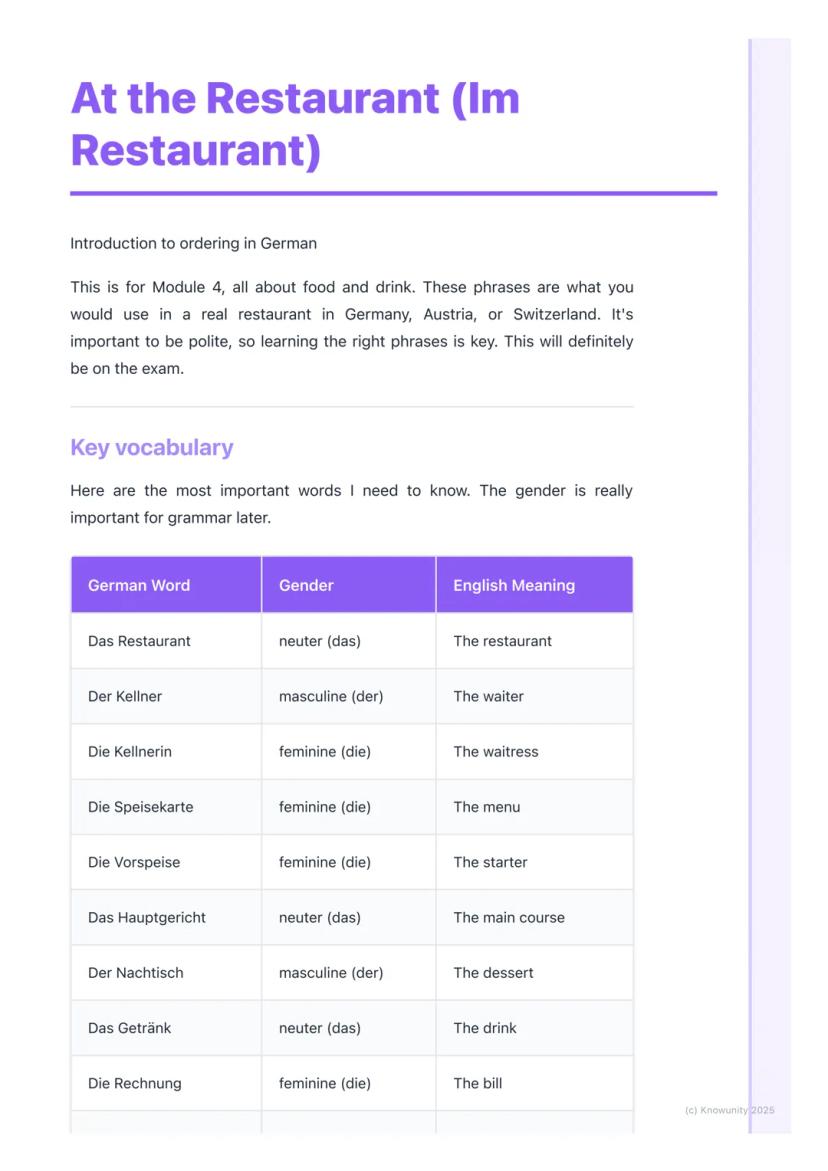
Learning restaurant vocabulary is like having a secret weapon for your German speaking tests. The most important thing to remember is that every German noun has a gender - der (masculine), die (feminine), or das (neuter).
Here are the words you absolutely need to know: das Restaurant (restaurant), der Kellner/die Kellnerin , die Speisekarte (menu), and die Rechnung (bill). Don't forget das Hauptgericht (main course) and der Nachtisch (dessert) - these will definitely appear in your exams.
The key verbs that'll save your life include bestellen (to order), möchten (would like), and bezahlen (to pay). Master these and you're halfway there!
Top Tip: Always learn German nouns with their gender articles - it makes ordering food much easier later on!
2
of 5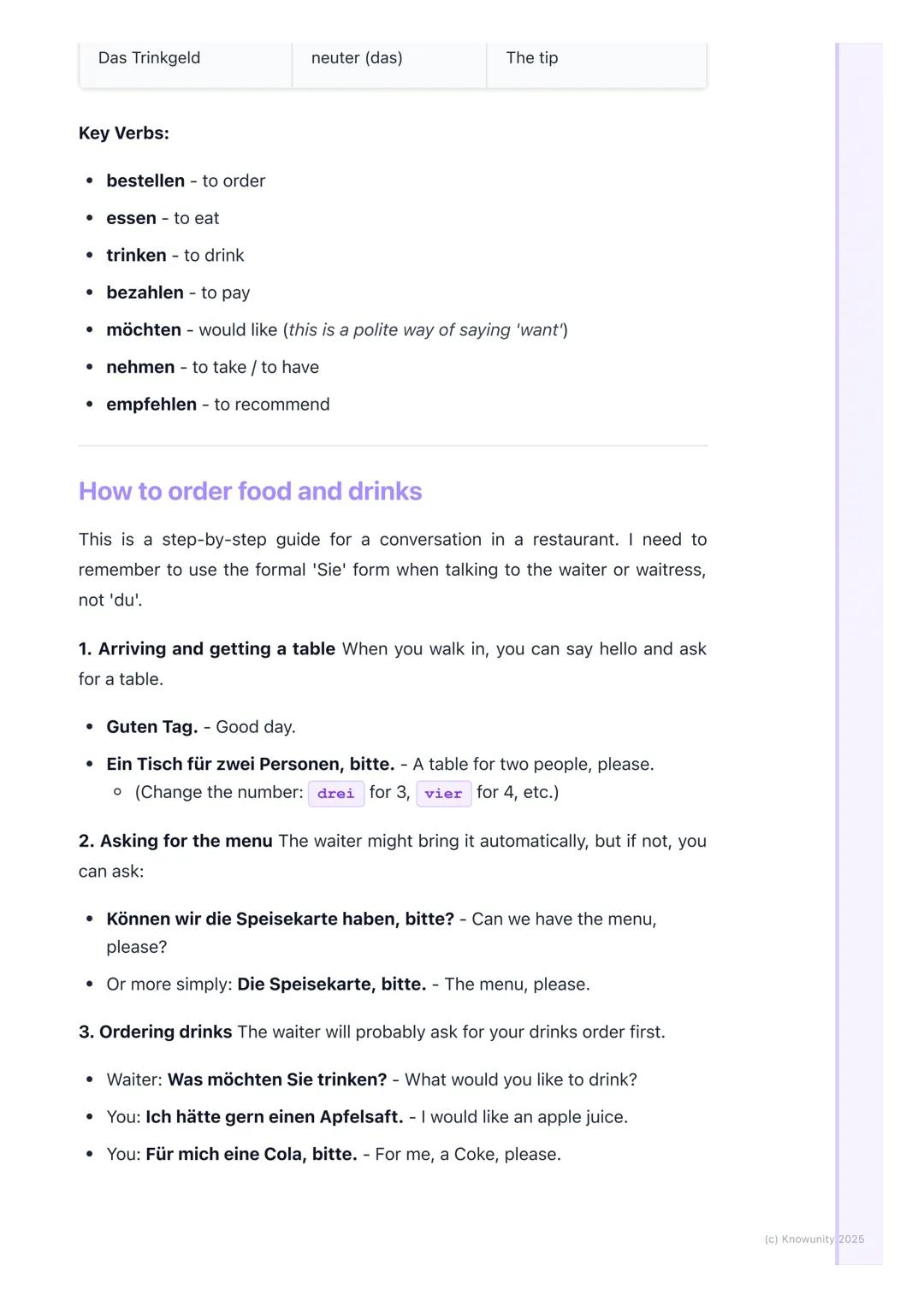
Getting Started: Arriving and Ordering
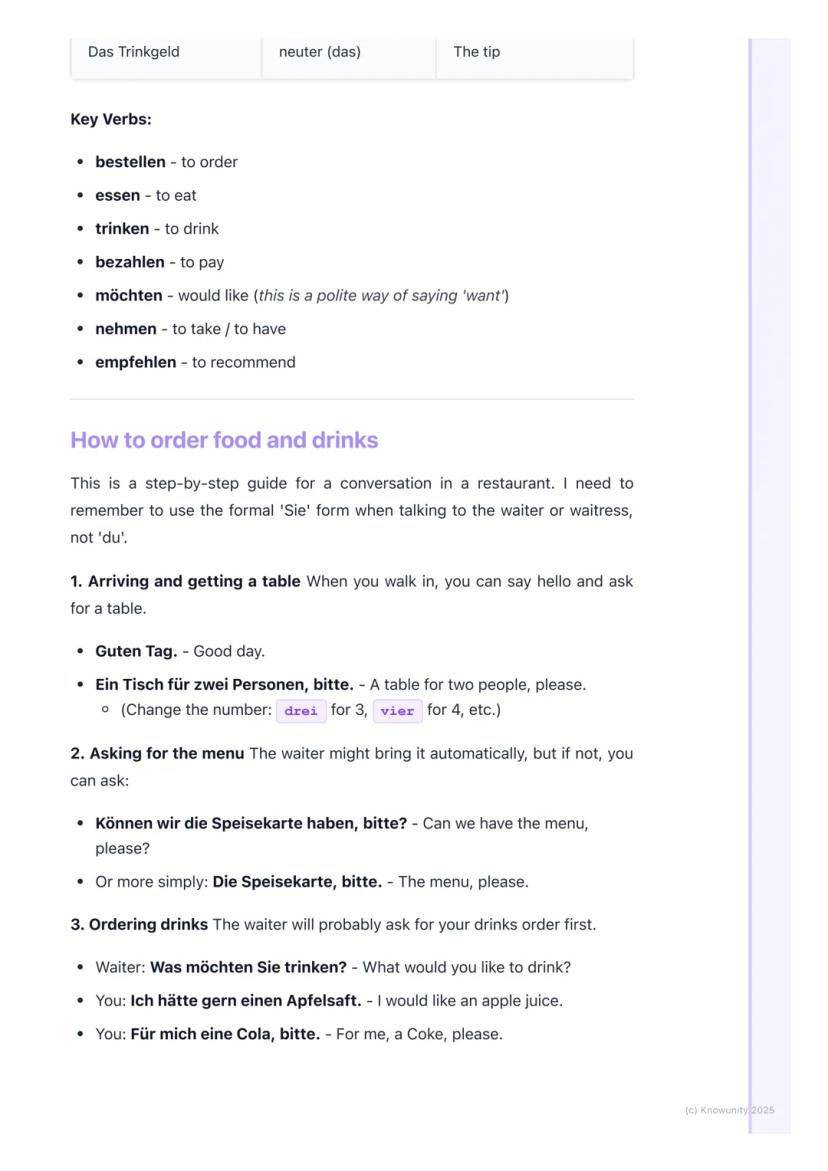
Walking into a German restaurant doesn't have to be scary - just remember a few key phrases and you'll sound like a pro. Start with "Guten Tag" (good day) and ask for "Ein Tisch für zwei Personen, bitte" (a table for two people, please).
When you're ready to see what's on offer, simply say "Die Speisekarte, bitte" (the menu, please). The waiter will usually ask "Was möchten Sie trinken?" (what would you like to drink?) first, so be ready with your drink order.
The magic phrase for polite ordering is "Ich hätte gern..." (I would like to have...). This sounds much more polite than saying "Ich will" (I want), which can come across as rude. You can also use "Ich nehme..." (I'll take...) which is perfectly acceptable.
Remember: Always use the formal "Sie" when speaking to restaurant staff - never use "du"!
3
of 5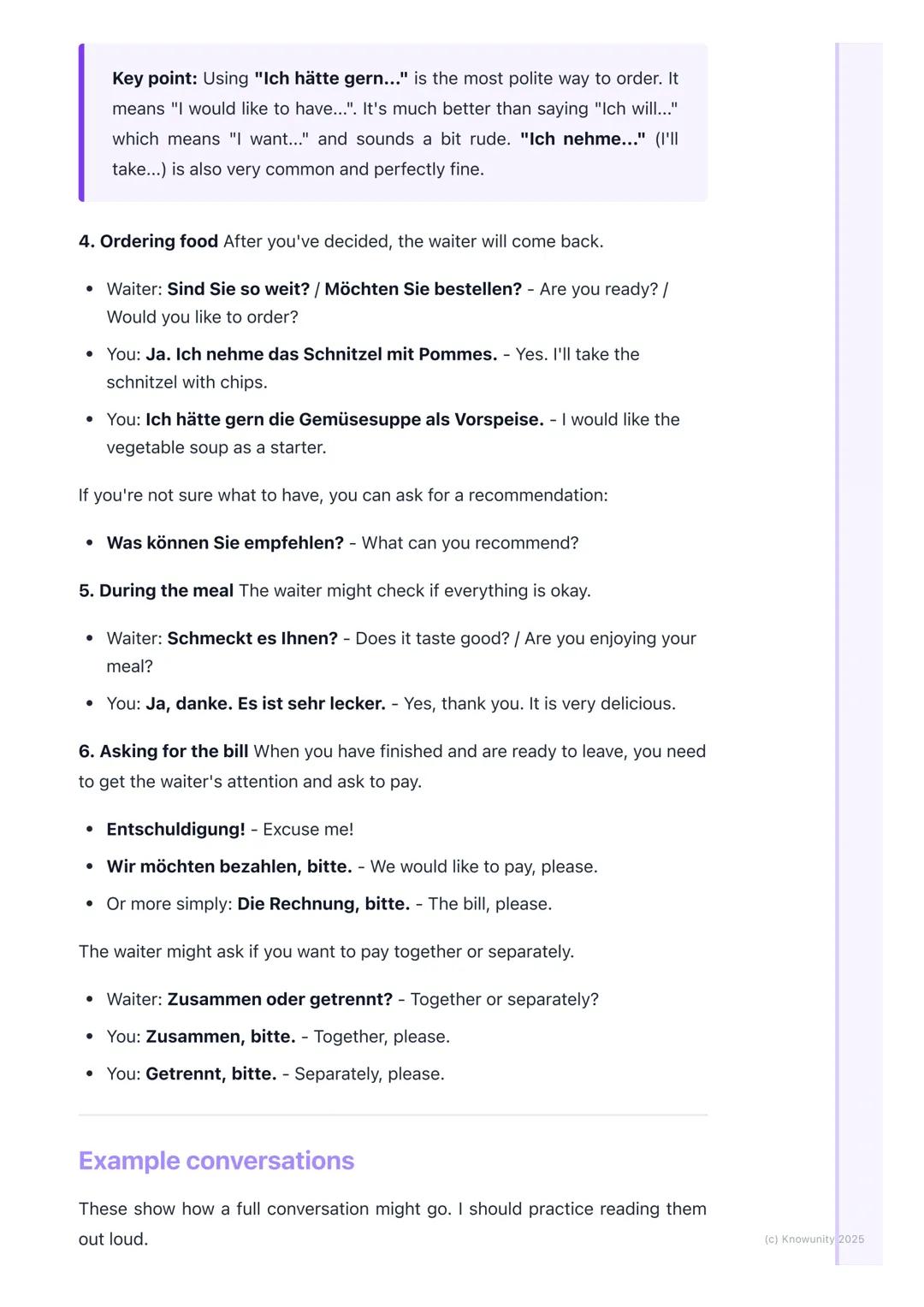
Ordering Food and Handling the Meal
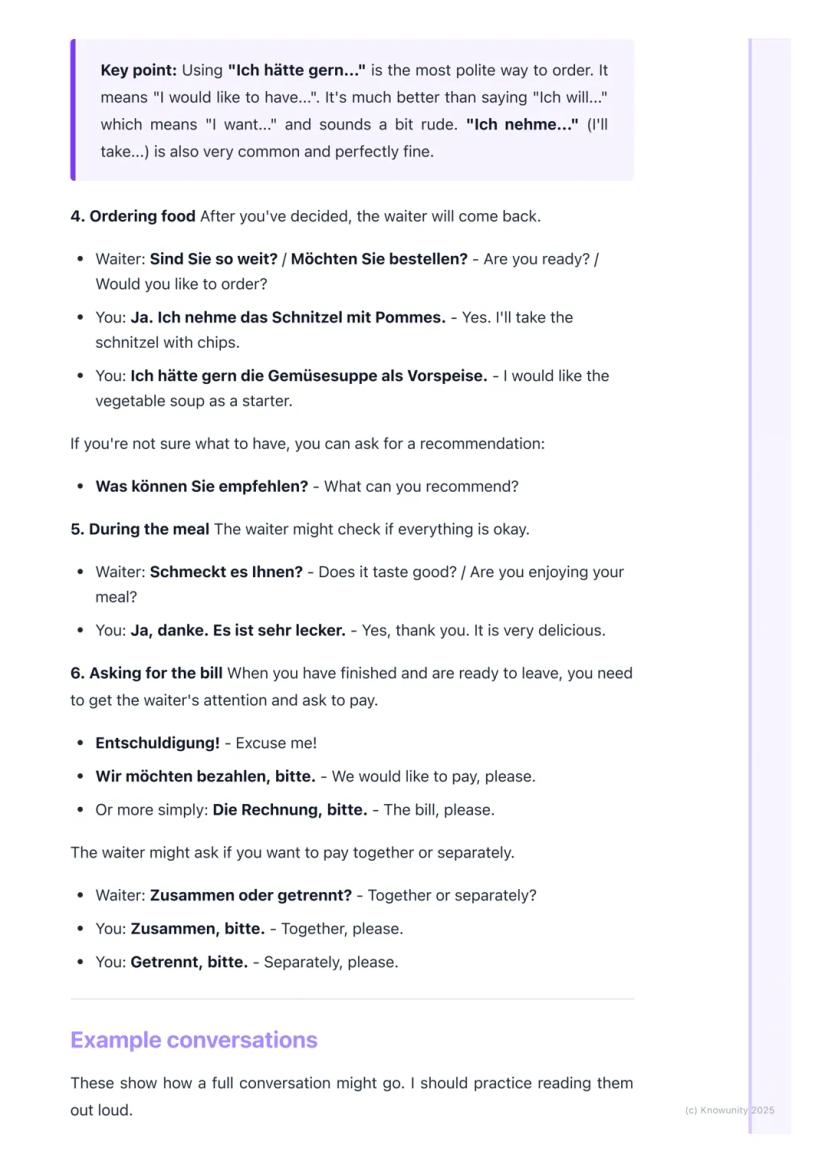
When the waiter asks "Sind Sie so weit?" (are you ready?), you can confidently say "Ja. Ich nehme das Schnitzel mit Pommes" (Yes, I'll take the schnitzel with chips). If you're feeling adventurous but unsure, ask "Was können Sie empfehlen?" (what can you recommend?).
During your meal, the waiter might check on you with "Schmeckt es Ihnen?" (does it taste good?). A simple "Ja, danke. Es ist sehr lecker" (yes, thank you, it's very delicious) will do the trick.
Getting the bill is straightforward - just catch the waiter's attention with "Entschuldigung!" (excuse me!) and say "Die Rechnung, bitte" (the bill, please). They might ask if you want to pay "zusammen oder getrennt?" (together or separately?).
Cultural Note: In Germany, you usually pay at your table, not at a till like in some other countries!
4
of 5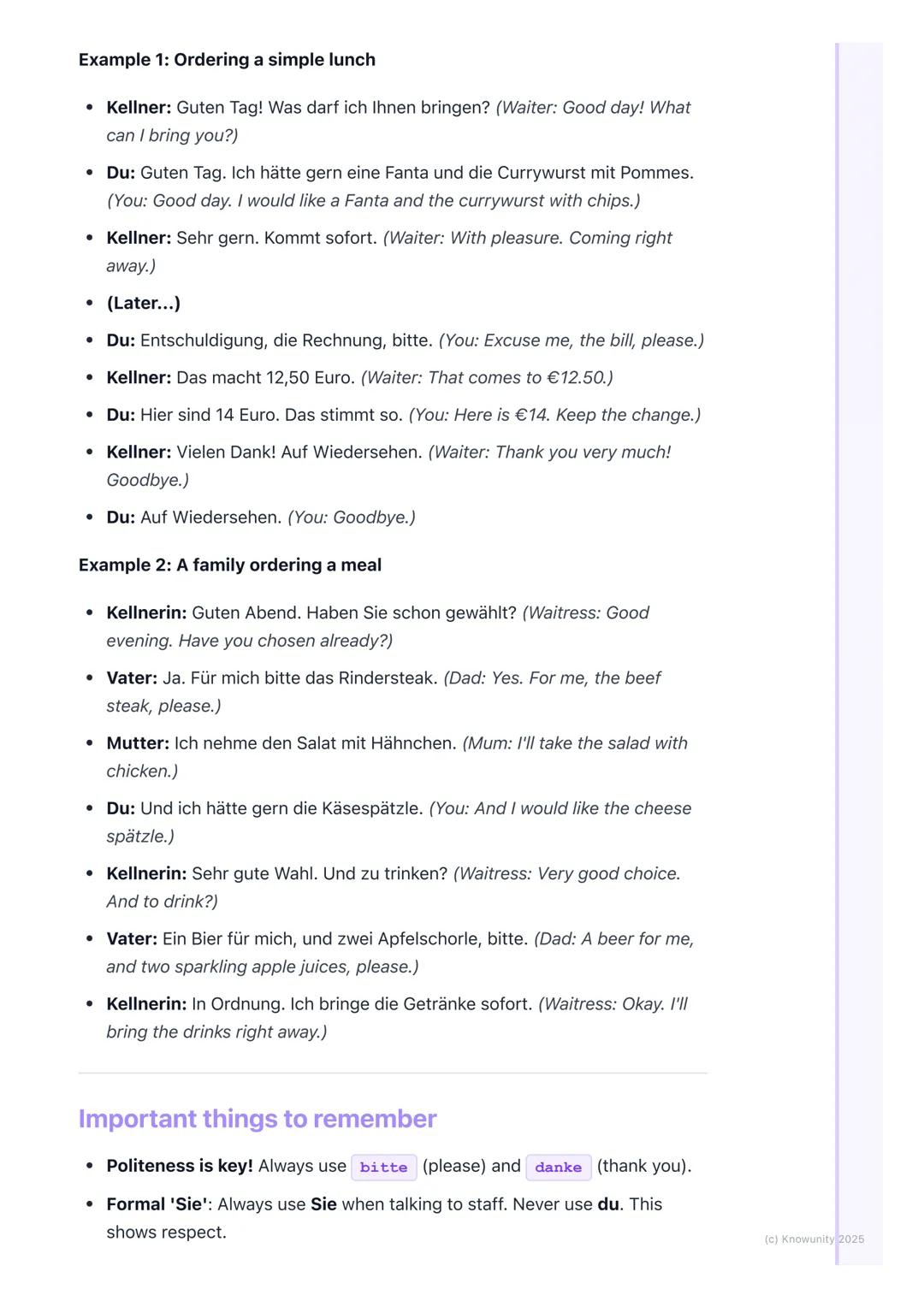
Real Conversation Examples
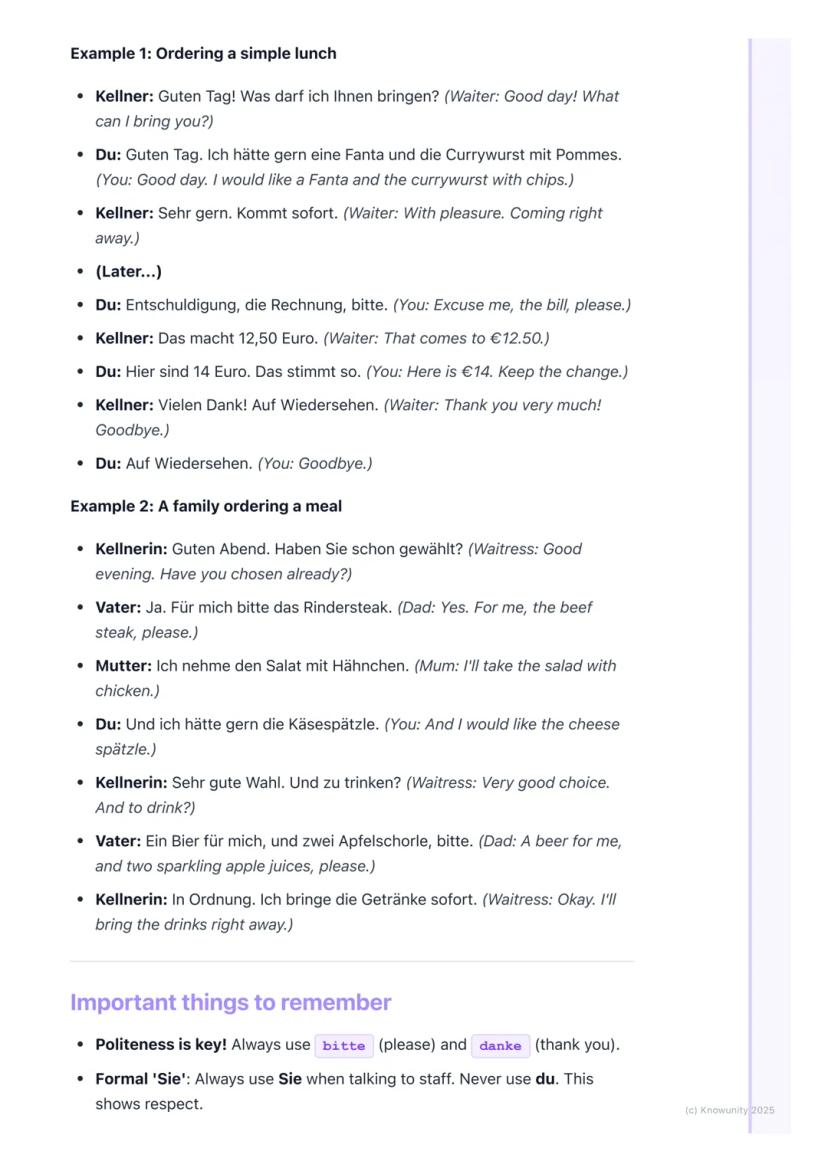
Let's see how these phrases work in real situations. A typical lunch order might go: "Guten Tag. Ich hätte gern eine Fanta und die Currywurst mit Pommes" followed by "Die Rechnung, bitte" when you're finished.
For family meals, each person can order using the same polite phrases. Dad might say "Für mich bitte das Rindersteak" (for me, the beef steak please), while you could say "Ich hätte gern die Käsespätzle" (I'd like the cheese spätzle).
The key is staying polite throughout the entire interaction. Always use "bitte" (please) and "danke" (thank you), and remember that "Sie" form shows proper respect to the staff.
Pro Tip: Practice these conversations out loud - it'll boost your confidence when speaking German in real situations!
5
of 5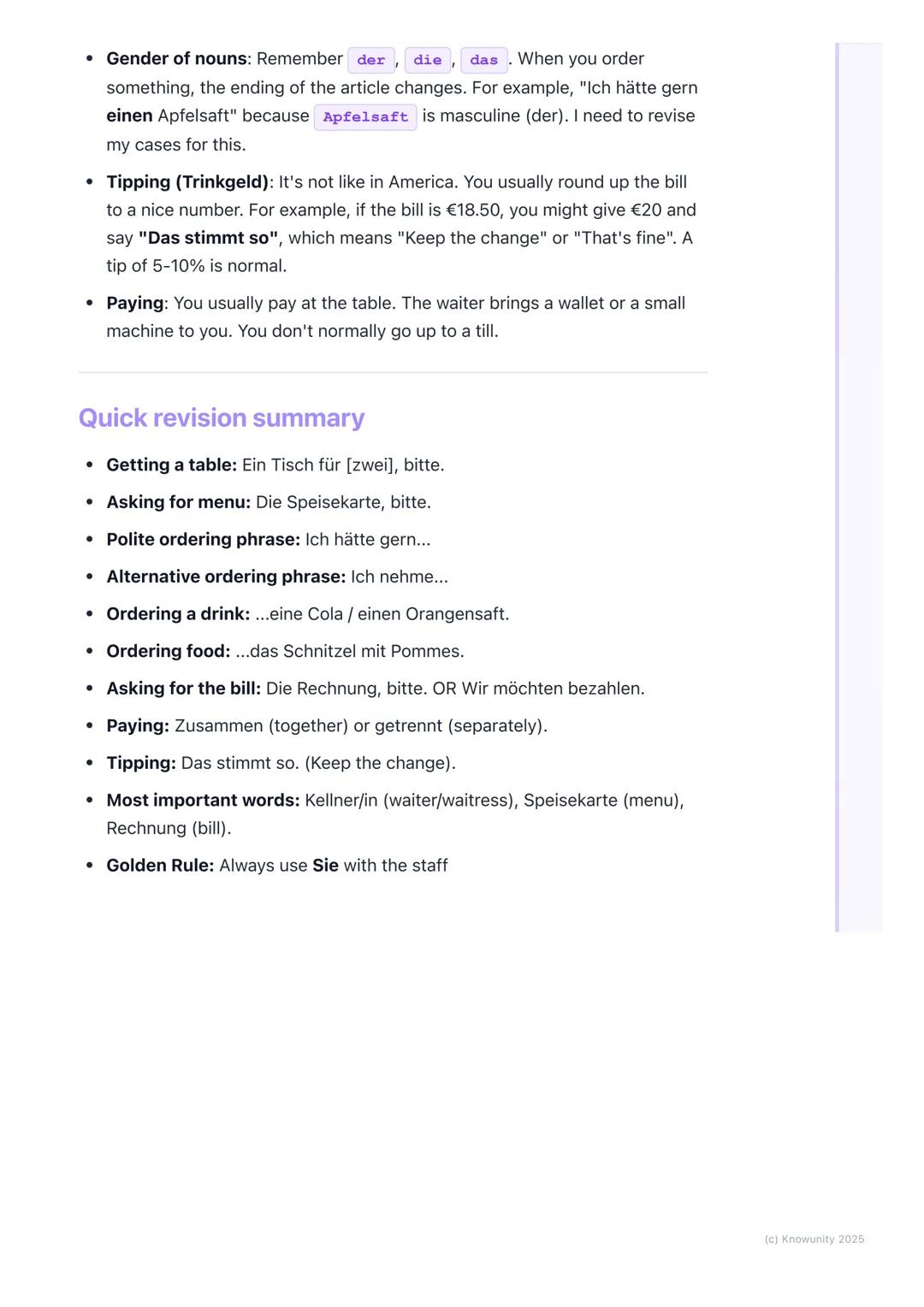
Important Details and Quick Revision
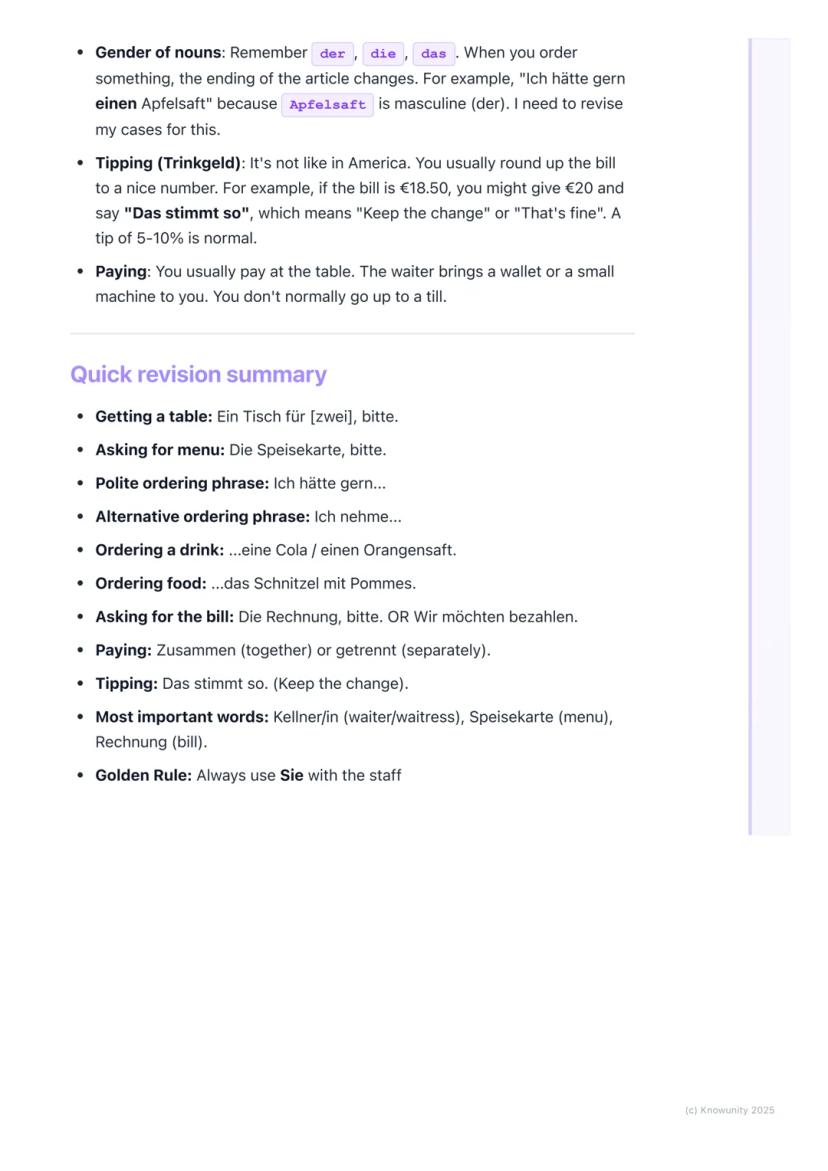
German restaurant etiquette has some quirks you need to know. Tipping isn't like in America - just round up to a nice number and say "Das stimmt so" (keep the change). A 5-10% tip is perfectly normal.
Don't forget about noun genders when ordering! You'll say "einen Apfelsaft" (an apple juice) because Apfelsaft is masculine, but "eine Cola" because Cola is feminine. This is where learning those articles really pays off.
Your exam essentials are: "Ein Tisch für [number], bitte" (getting a table), "Ich hätte gern..." (polite ordering), "Die Rechnung, bitte" (asking for the bill), and always using "Sie" with staff.
Golden Rule: Politeness opens doors in German-speaking countries - master these respectful phrases and you'll impress everyone!
Mislili smo da nikad nećeš pitati...
Šta je Knowunity AI companion?
Naš AI Companion je AI alat fokusiran na učenike koji nudi više od samih odgovora. Napravljen na milionima Knowunity resursa, pruža relevantne informacije, personalizovane planove učenja, kvizove i sadržaj direktno u chatu, prilagođavajući se tvom individualnom putu učenja.
Gde mogu da preuzmem Knowunity aplikaciju?
Možeš preuzeti aplikaciju sa Google Play Store-a i Apple App Store-a.
Da li je Knowunity stvarno besplatan?
Tako je! Uživaj u besplatnom pristupu sadržaju za učenje, povezuj se sa drugim učenicima i dobijaj trenutnu pomoć – sve na dohvat ruke.
Najpopularniji sadržaj u German
2Najpopularniji sadržaj
9 Irish
IrishIrish oral questions and answers
Questions and answers for the leaving cert oral
5th Year4264
 English
Key Quotes : Sive
Key Quotes and explanations: Sive
6th Year2842
IrishIrish oral questions
Outline of oral questions
5th Year2055
IrishIníon- le hÁine Durkin
Aine Durkin’s poem, Iníon: Themes & summary
5th Year850
IrishIrish poetry 2027
Iníon + Dínit an Bhróin
5th Year1133
IrishLC HL notes- Iníon (poem)
Includes poem in English and Irish, theme, key words & phrases
5th Year2284
EnglishCultural Context : Shawshank Redemption : Sive : Small Things Like These
Comparative Study : Cultural Context : Shawshank Redemption, Sive and Small Things Like These
6th Year1430
IrishMo Ghrá-sa (Idir Lúibíní)
Notes on mo ghrá-sa
5th Year380
IrishAn Gaeilge Aiste
Irish Language essay
6th Year1320
Ne možeš da nađeš ono što tražiš? Istražuj druge predmete.
Učenici nas obožavaju — i ti ćeš takođe.
4.6/5App Store
4.7/5Google Play
Aplikacija je super laka za korišćenje i odlično dizajnirana. Našao sam sve što mi je trebalo i dosta sam naučio iz prezentacija! Definitivno ću koristiti aplikaciju za školski zadatak! A naravno, pomaže i kao inspiracija.
Stefan SiOS korisnik
Ova aplikacija je stvarno odlična. Tu je toliko beleški za učenje i pomoći [...]. Na primer, problem mi je francuski, a aplikacija ima toliko opcija za pomoć. Zahvaljujući ovoj aplikaciji, poboljšao sam francuski. Preporučio bih je svima.
Samantha KlichAndroid korisnik
Vau, stvarno sam oduševljena. Probala sam aplikaciju jer sam je videla u reklamama mnogo puta i bila sam potpuno šokirana. Ova aplikacija je POMOĆ koju želiš za školu i pre svega, nudi toliko stvari, kao što su vežbe i sažeci, što mi je lično bilo VEOMA korisno.
AnaiOS korisnik
German1 pregledi·Ažurirano Jun 14, 2026·5 straniceEssential Phrases for Dining in a German Restaurant
Ever wondered how to order food in a German restaurant without looking like a complete tourist? This guide covers all the essential phrases and polite expressions you'll need for dining out in Germany, Austria, or Switzerland - and it's definitely...
1
of 5
Registruj se da vidiš sadržaj. Besplatno je!
- Pristup svim dokumentima
- Poboljšaj svoje ocene
- Pridruži se milionima učenika
Restaurant Vocabulary Essentials
Learning restaurant vocabulary is like having a secret weapon for your German speaking tests. The most important thing to remember is that every German noun has a gender - der (masculine), die (feminine), or das (neuter).
Here are the words you absolutely need to know: das Restaurant (restaurant), der Kellner/die Kellnerin , die Speisekarte (menu), and die Rechnung (bill). Don't forget das Hauptgericht (main course) and der Nachtisch (dessert) - these will definitely appear in your exams.
The key verbs that'll save your life include bestellen (to order), möchten (would like), and bezahlen (to pay). Master these and you're halfway there!
Top Tip: Always learn German nouns with their gender articles - it makes ordering food much easier later on!
2
of 5Registruj se da vidiš sadržaj. Besplatno je!
- Pristup svim dokumentima
- Poboljšaj svoje ocene
- Pridruži se milionima učenika
Getting Started: Arriving and Ordering
Walking into a German restaurant doesn't have to be scary - just remember a few key phrases and you'll sound like a pro. Start with "Guten Tag" (good day) and ask for "Ein Tisch für zwei Personen, bitte" (a table for two people, please).
When you're ready to see what's on offer, simply say "Die Speisekarte, bitte" (the menu, please). The waiter will usually ask "Was möchten Sie trinken?" (what would you like to drink?) first, so be ready with your drink order.
The magic phrase for polite ordering is "Ich hätte gern..." (I would like to have...). This sounds much more polite than saying "Ich will" (I want), which can come across as rude. You can also use "Ich nehme..." (I'll take...) which is perfectly acceptable.
Remember: Always use the formal "Sie" when speaking to restaurant staff - never use "du"!
3
of 5Registruj se da vidiš sadržaj. Besplatno je!
- Pristup svim dokumentima
- Poboljšaj svoje ocene
- Pridruži se milionima učenika
Ordering Food and Handling the Meal
When the waiter asks "Sind Sie so weit?" (are you ready?), you can confidently say "Ja. Ich nehme das Schnitzel mit Pommes" (Yes, I'll take the schnitzel with chips). If you're feeling adventurous but unsure, ask "Was können Sie empfehlen?" (what can you recommend?).
During your meal, the waiter might check on you with "Schmeckt es Ihnen?" (does it taste good?). A simple "Ja, danke. Es ist sehr lecker" (yes, thank you, it's very delicious) will do the trick.
Getting the bill is straightforward - just catch the waiter's attention with "Entschuldigung!" (excuse me!) and say "Die Rechnung, bitte" (the bill, please). They might ask if you want to pay "zusammen oder getrennt?" (together or separately?).
Cultural Note: In Germany, you usually pay at your table, not at a till like in some other countries!
4
of 5Registruj se da vidiš sadržaj. Besplatno je!
- Pristup svim dokumentima
- Poboljšaj svoje ocene
- Pridruži se milionima učenika
Real Conversation Examples
Let's see how these phrases work in real situations. A typical lunch order might go: "Guten Tag. Ich hätte gern eine Fanta und die Currywurst mit Pommes" followed by "Die Rechnung, bitte" when you're finished.
For family meals, each person can order using the same polite phrases. Dad might say "Für mich bitte das Rindersteak" (for me, the beef steak please), while you could say "Ich hätte gern die Käsespätzle" (I'd like the cheese spätzle).
The key is staying polite throughout the entire interaction. Always use "bitte" (please) and "danke" (thank you), and remember that "Sie" form shows proper respect to the staff.
Pro Tip: Practice these conversations out loud - it'll boost your confidence when speaking German in real situations!
5
of 5Registruj se da vidiš sadržaj. Besplatno je!
- Pristup svim dokumentima
- Poboljšaj svoje ocene
- Pridruži se milionima učenika
Important Details and Quick Revision
German restaurant etiquette has some quirks you need to know. Tipping isn't like in America - just round up to a nice number and say "Das stimmt so" (keep the change). A 5-10% tip is perfectly normal.
Don't forget about noun genders when ordering! You'll say "einen Apfelsaft" (an apple juice) because Apfelsaft is masculine, but "eine Cola" because Cola is feminine. This is where learning those articles really pays off.
Your exam essentials are: "Ein Tisch für [number], bitte" (getting a table), "Ich hätte gern..." (polite ordering), "Die Rechnung, bitte" (asking for the bill), and always using "Sie" with staff.
Golden Rule: Politeness opens doors in German-speaking countries - master these respectful phrases and you'll impress everyone!
Mislili smo da nikad nećeš pitati...
Šta je Knowunity AI companion?
Naš AI Companion je AI alat fokusiran na učenike koji nudi više od samih odgovora. Napravljen na milionima Knowunity resursa, pruža relevantne informacije, personalizovane planove učenja, kvizove i sadržaj direktno u chatu, prilagođavajući se tvom individualnom putu učenja.
Gde mogu da preuzmem Knowunity aplikaciju?
Možeš preuzeti aplikaciju sa Google Play Store-a i Apple App Store-a.
Da li je Knowunity stvarno besplatan?
Tako je! Uživaj u besplatnom pristupu sadržaju za učenje, povezuj se sa drugim učenicima i dobijaj trenutnu pomoć – sve na dohvat ruke.
Najpopularniji sadržaj u German
2Najpopularniji sadržaj
9IrishIrish oral questions and answers
Questions and answers for the leaving cert oral
5th Year4264
EnglishKey Quotes : Sive
Key Quotes and explanations: Sive
6th Year2842
IrishIrish oral questions
Outline of oral questions
5th Year2055
IrishIníon- le hÁine Durkin
Aine Durkin’s poem, Iníon: Themes & summary
5th Year850
IrishIrish poetry 2027
Iníon + Dínit an Bhróin
5th Year1133
IrishLC HL notes- Iníon (poem)
Includes poem in English and Irish, theme, key words & phrases
5th Year2284
EnglishCultural Context : Shawshank Redemption : Sive : Small Things Like These
Comparative Study : Cultural Context : Shawshank Redemption, Sive and Small Things Like These
6th Year1430
IrishMo Ghrá-sa (Idir Lúibíní)
Notes on mo ghrá-sa
5th Year380
IrishAn Gaeilge Aiste
Irish Language essay
6th Year1320
Ne možeš da nađeš ono što tražiš? Istražuj druge predmete.
Učenici nas obožavaju — i ti ćeš takođe.
4.6/5App Store
4.7/5Google Play
Aplikacija je super laka za korišćenje i odlično dizajnirana. Našao sam sve što mi je trebalo i dosta sam naučio iz prezentacija! Definitivno ću koristiti aplikaciju za školski zadatak! A naravno, pomaže i kao inspiracija.
Stefan SiOS korisnik
Ova aplikacija je stvarno odlična. Tu je toliko beleški za učenje i pomoći [...]. Na primer, problem mi je francuski, a aplikacija ima toliko opcija za pomoć. Zahvaljujući ovoj aplikaciji, poboljšao sam francuski. Preporučio bih je svima.
Samantha KlichAndroid korisnik
Vau, stvarno sam oduševljena. Probala sam aplikaciju jer sam je videla u reklamama mnogo puta i bila sam potpuno šokirana. Ova aplikacija je POMOĆ koju želiš za školu i pre svega, nudi toliko stvari, kao što su vežbe i sažeci, što mi je lično bilo VEOMA korisno.
AnaiOS korisnik