
Learning to write diary entries (dialann) in Irish is essential...
 Irish6 pregledi·Ažurirano Jun 5, 2026·6 stranice
Dialann: Ag Scríobh faoin gCéadfaí laethúil
1 / 6
1
of 6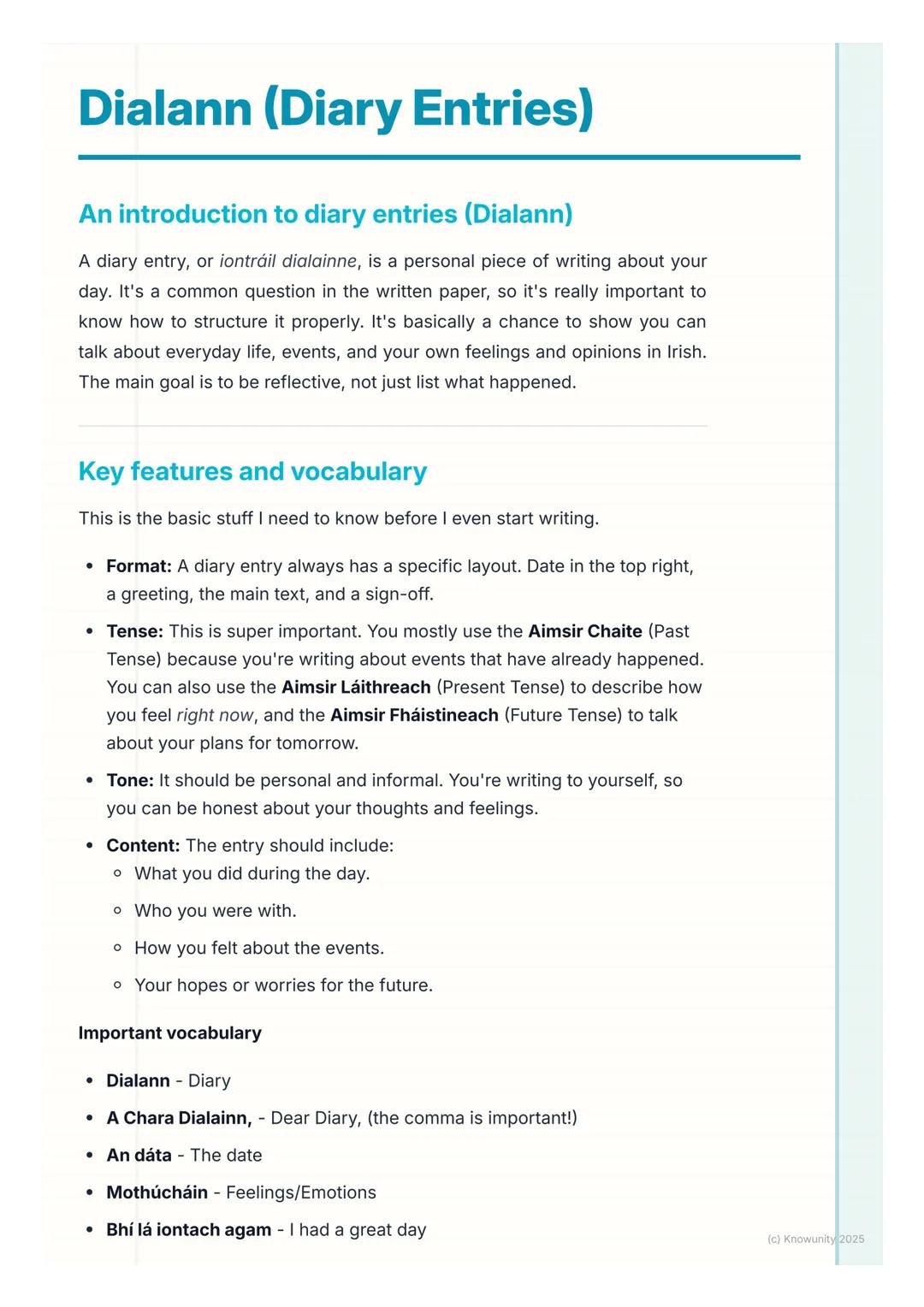
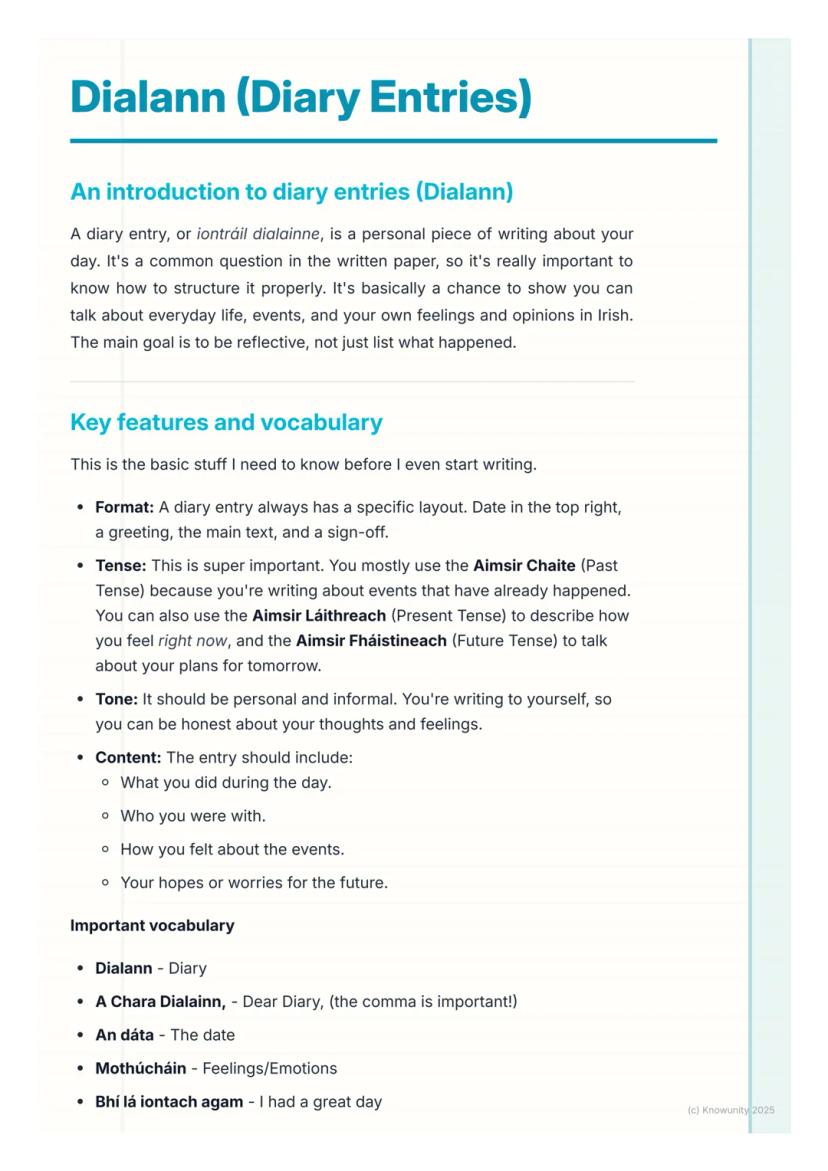
What is a Dialann?
Think of diary entries as your personal chat with yourself about the day - but in Irish! They're dead common in exams, so getting the hang of them is crucial for your marks.
The whole point isn't just listing what you did (that's boring). You need to be reflective and share your feelings about events. It's like having a proper conversation with your diary about what mattered to you.
Key things to remember: You'll mainly use the Aimsir Chaite (past tense) for events that happened, but you can switch to present tense for current feelings and future tense for tomorrow's plans. Keep it personal and informal - you're writing to yourself, so be honest!
Pro tip: Always include how you felt about events, not just what happened. This is where you'll pick up extra marks!
2
of 6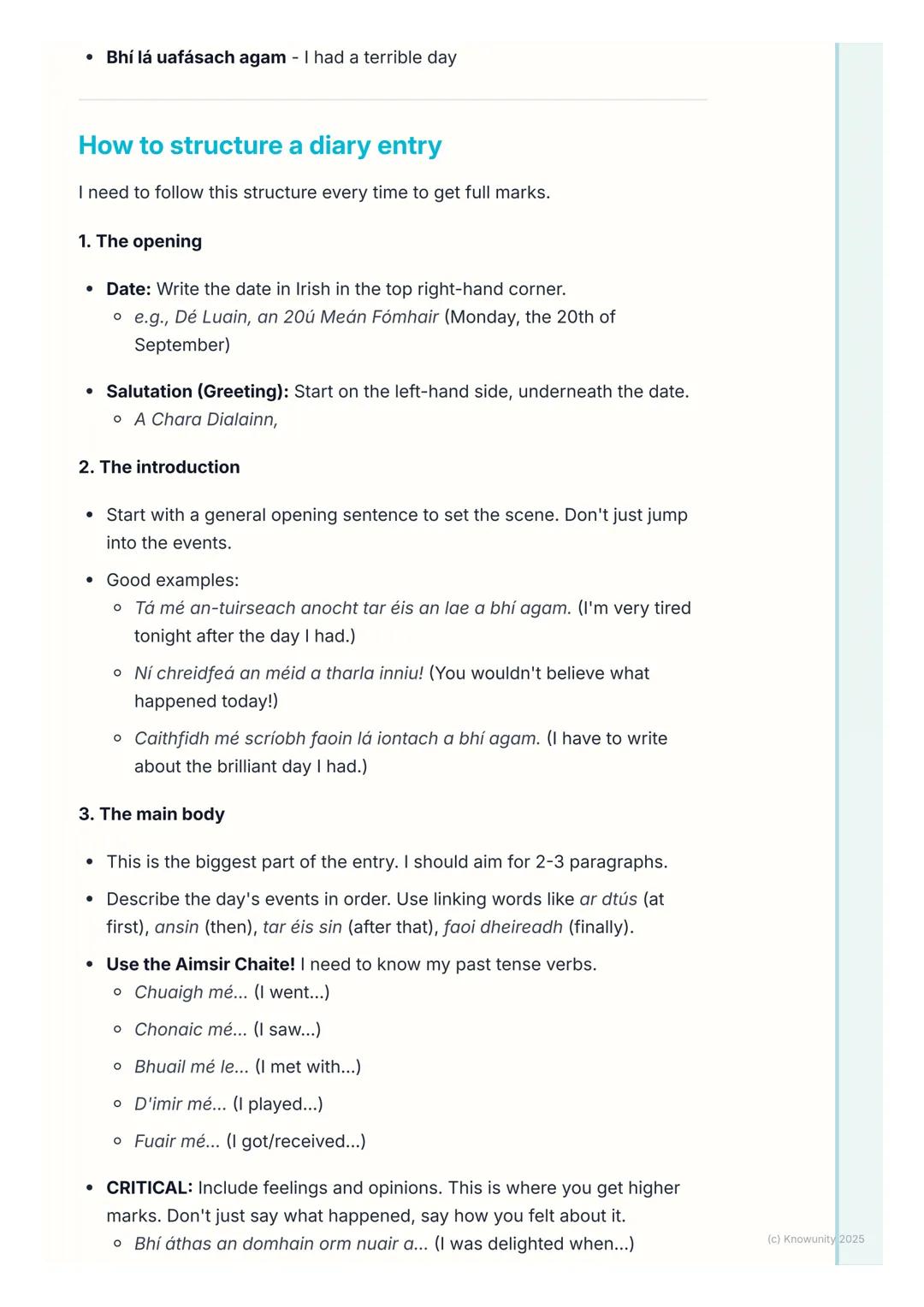
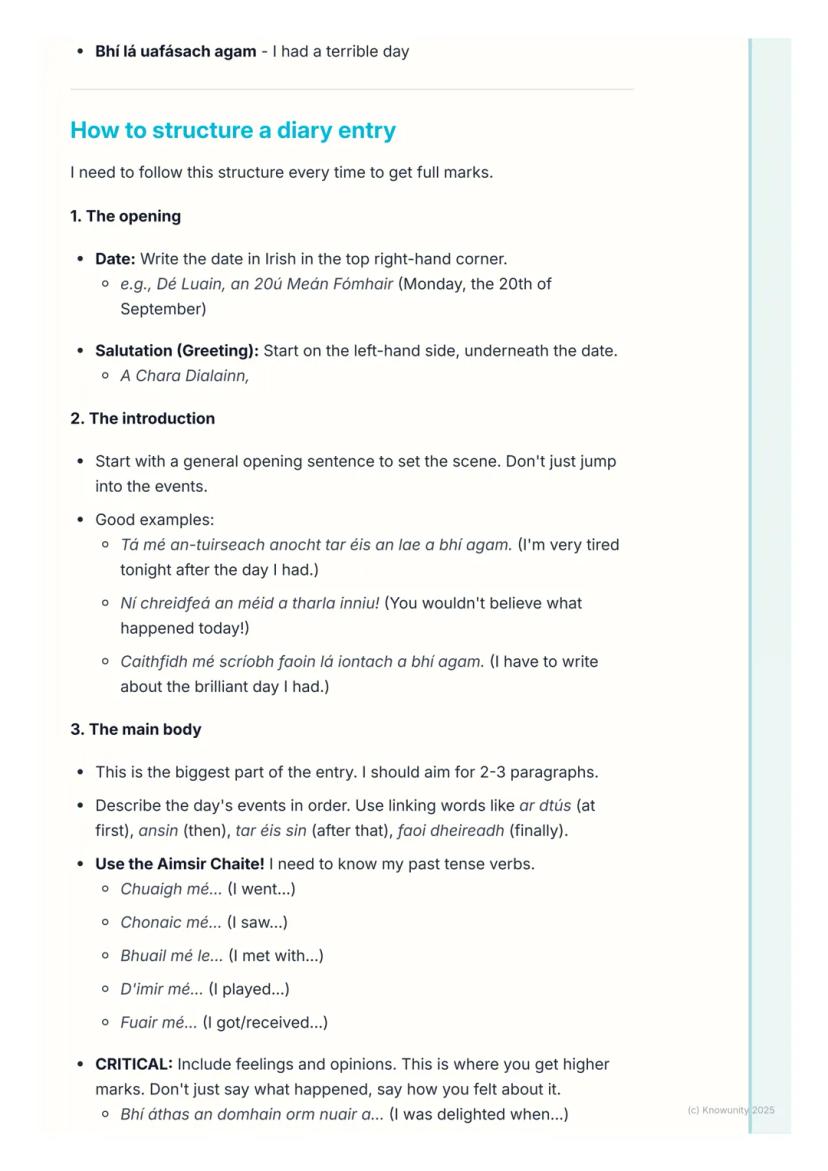
Essential Structure You Must Follow
Every diary entry needs the exact same layout - miss any part and you'll lose marks straight away!
The opening starts with the date in Irish (top right corner) like "Dé Luain, an 20ú Meán Fómhair", then your greeting "A Chara Dialainn," on the left underneath.
Your introduction should grab attention immediately. Don't dive straight into events - set the scene first! Try something like "Ní chreidfeá an méid a tharla inniu!" (You wouldn't believe what happened today!)
The main body is where you shine. Use 2-3 paragraphs describing your day in order with linking words like ar dtús, ansin, tar éis sin. Most importantly, master your Aimsir Chaite verbs: chuaigh mé, chonaic mé, bhuail mé le.
Critical point: For every event you mention, add how it made you feel. "Bhí áthas an domhain orm nuair a..." shows much better Irish than just listing facts!
3
of 6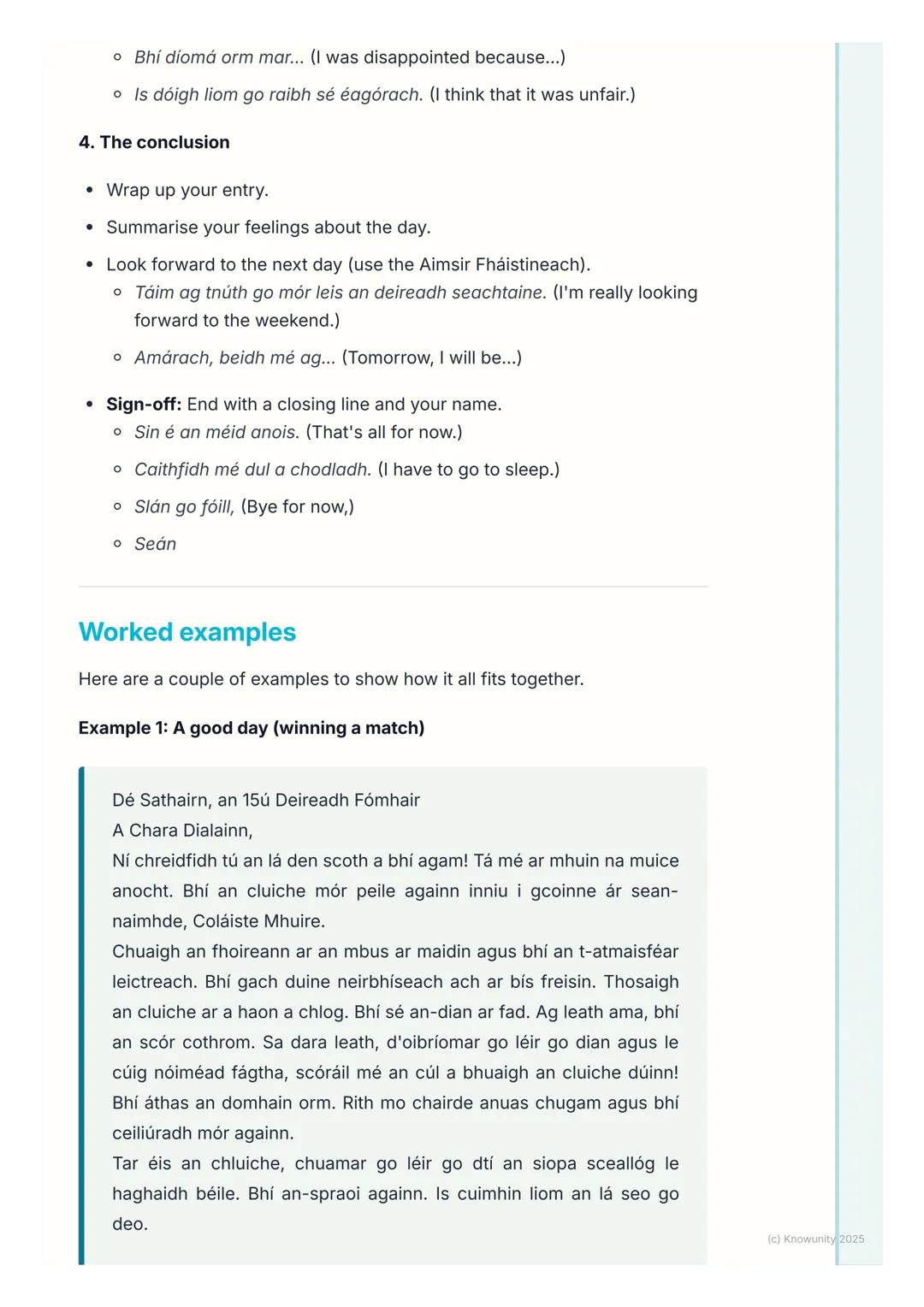
Nailing Your Conclusion and Examples
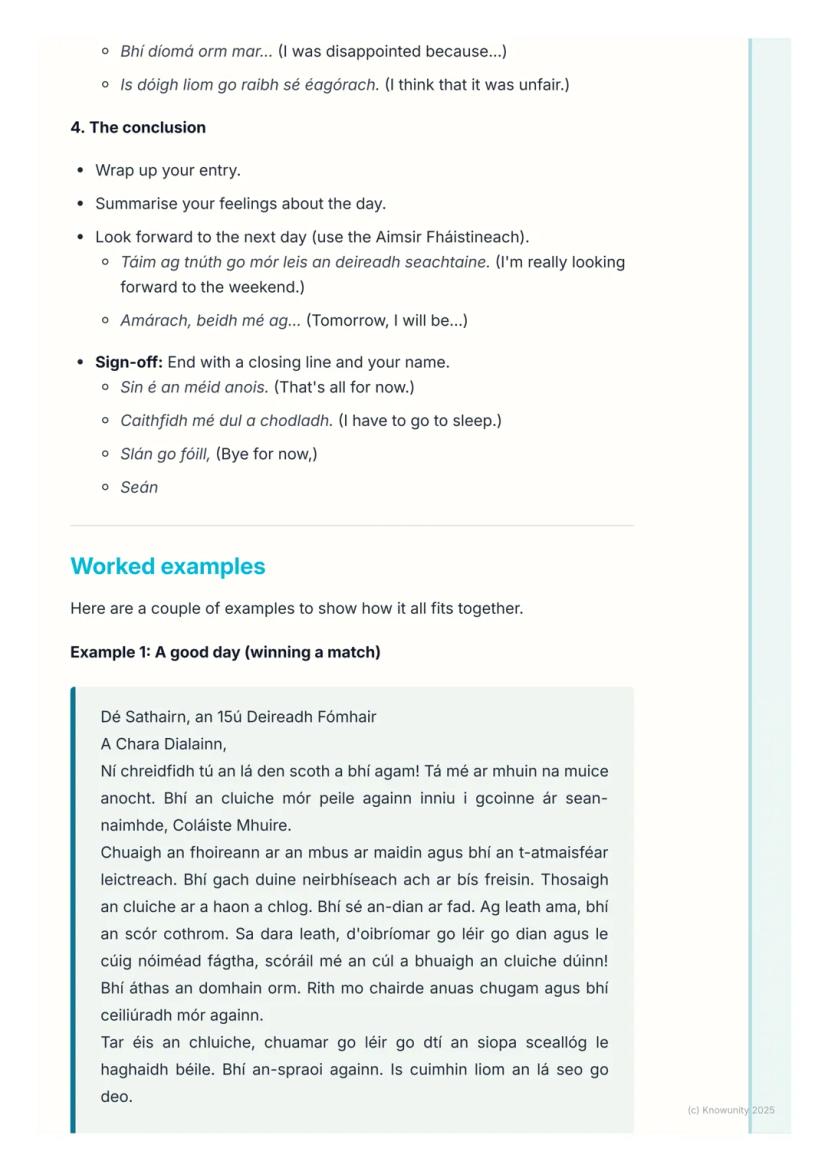
Wrap up your diary entry by summarising your feelings about the day and looking ahead. Use the Aimsir Fháistineach here: "Amárach, beidh mé ag..." or "Táim ag tnúth go mór leis an deireadh seachtaine."
Always end with a proper sign-off like "Sin é an méid anois" followed by "Slán go fóill," and your name. Simple but essential!
Looking at the examples, notice how the good day entry flows naturally from events to feelings. The football match example doesn't just say "we won" - it captures the electric atmosphere, the nervousness, and that pure joy of scoring the winning goal.
The stressful day example works brilliantly too because it's honest about feelings. Failed maths exam, dropped dinner, everyone laughing - we've all been there! The key is showing how these events affected the writer emotionally.
4
of 6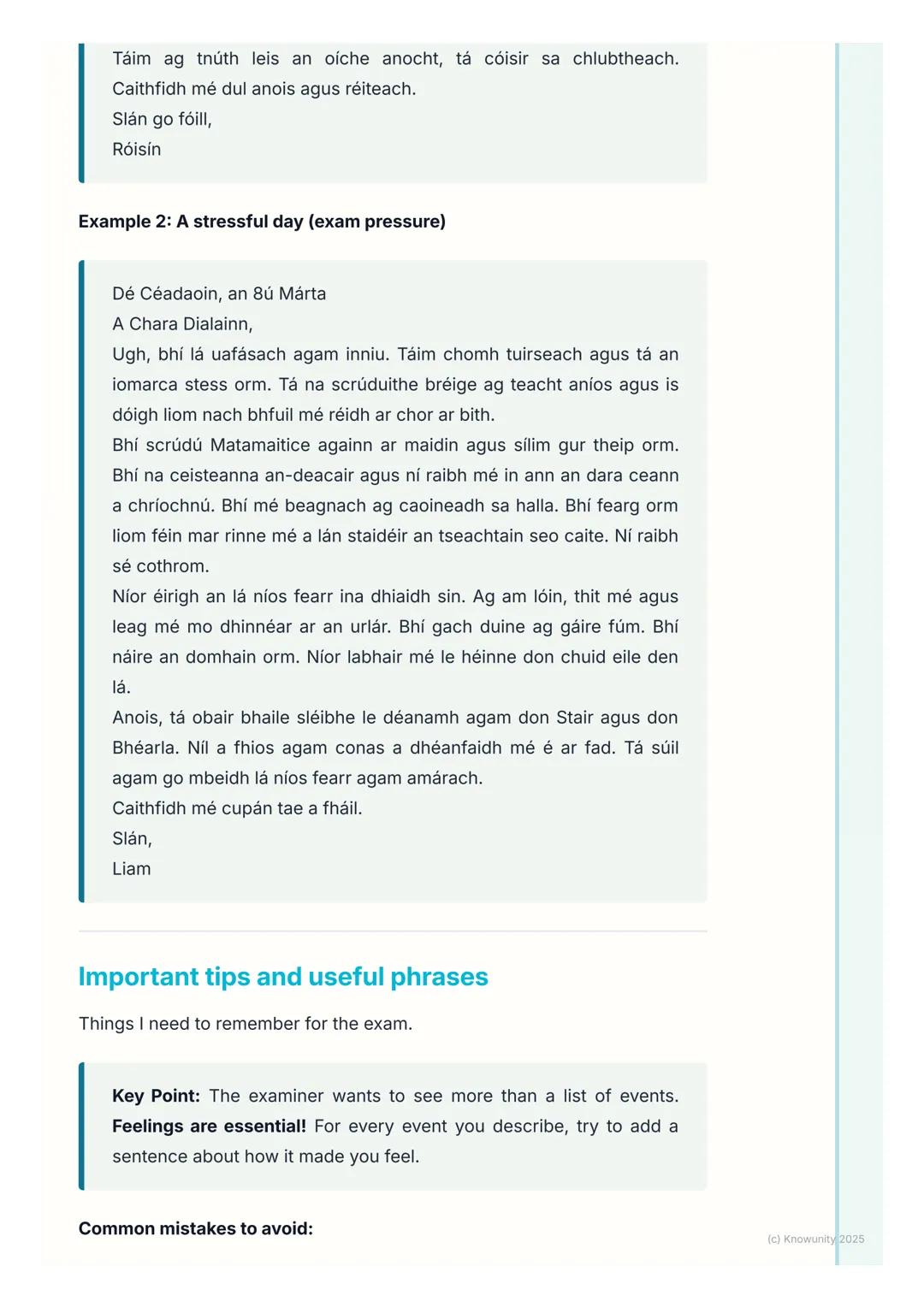
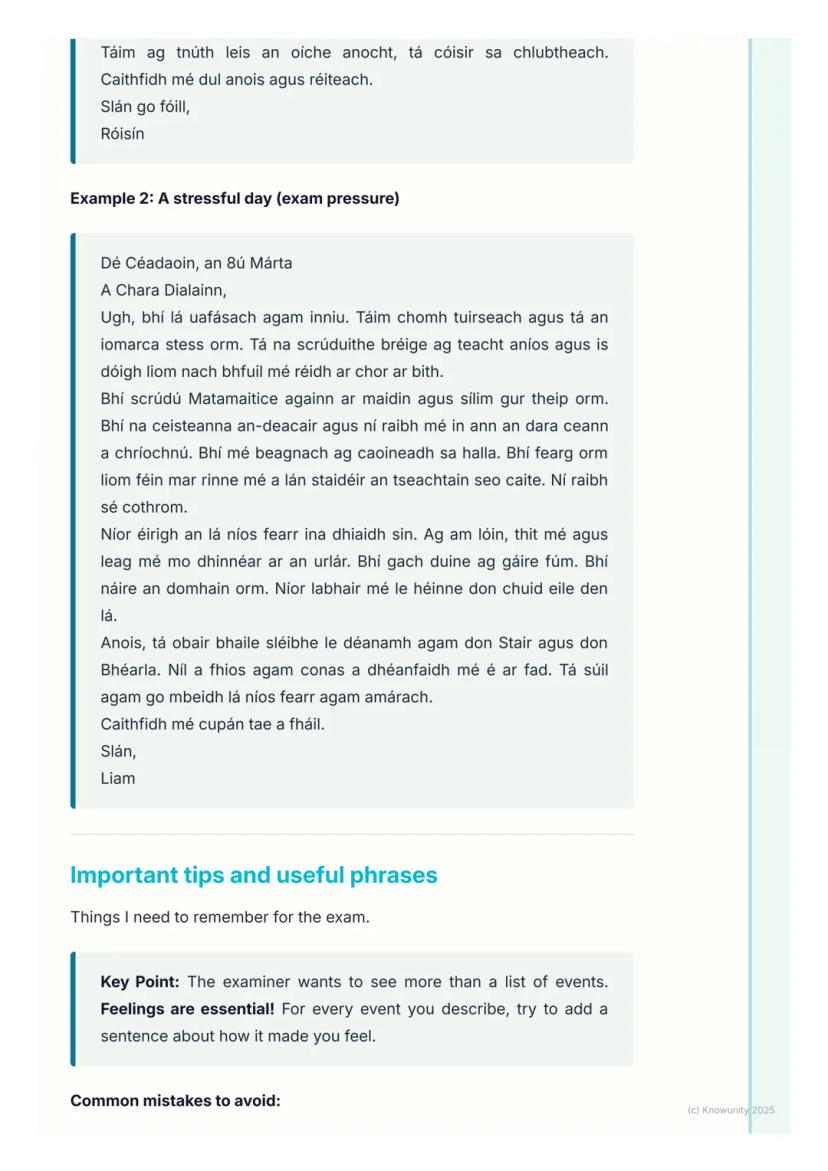
Common Mistakes and Winning Phrases
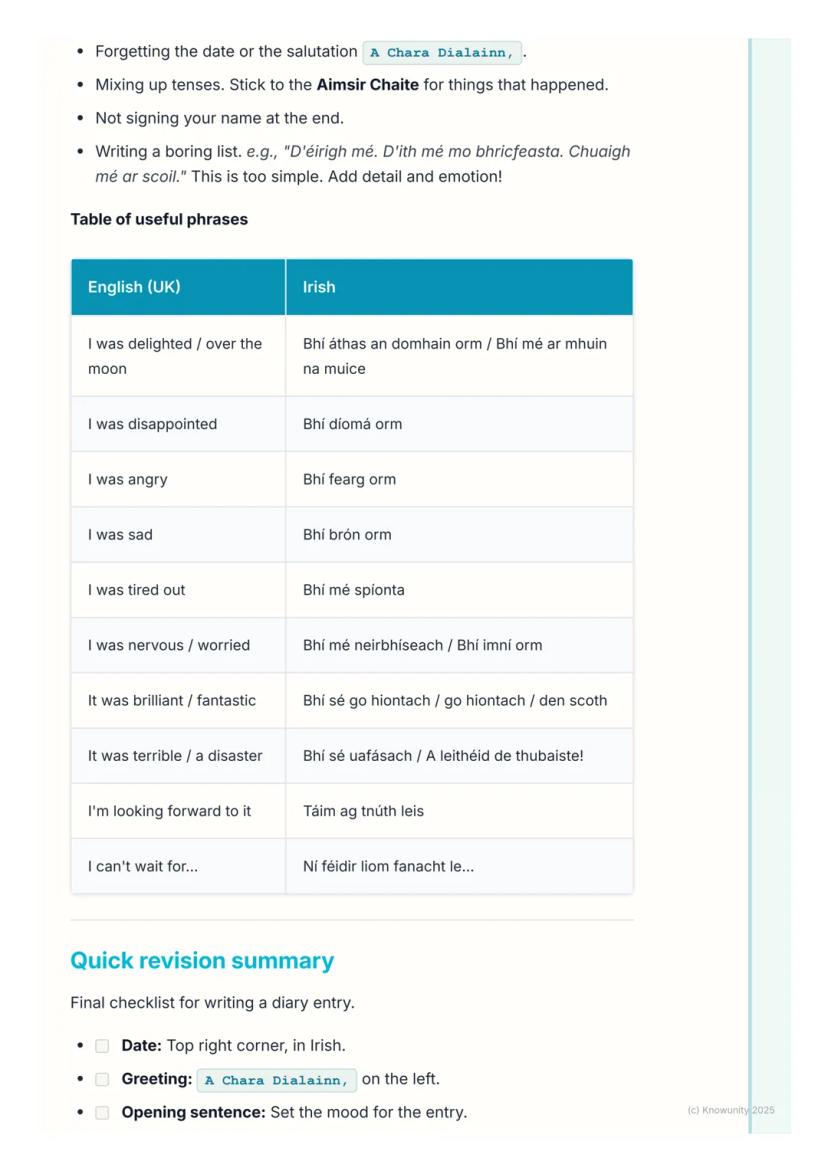
Avoid these exam disasters: forgetting your date or "A Chara Dialainn," mixing up your tenses, not signing your name, or writing boring lists like "D'éirigh mé. D'ith mé. Chuaigh mé." Add detail and emotion instead!
Essential feeling phrases you need to memorise: "Bhí áthas an domhain orm" (I was over the moon), "Bhí díomá orm" (I was disappointed), "Bhí mé spíonta" (I was tired out). These will instantly improve your writing.
Time and mood phrases like "Bhí sé go hiontach" (It was brilliant) or "A leithéid de thubaiste!" (What a disaster!) add personality to your entries. Don't just tell what happened - show how you felt about it.
The examiner wants to see you can express complex emotions, not just describe events. Think of it as telling your best mate about your day rather than writing a boring report.
Game changer: Every event needs an emotional reaction. This single tip will boost your marks significantly!
5
of 6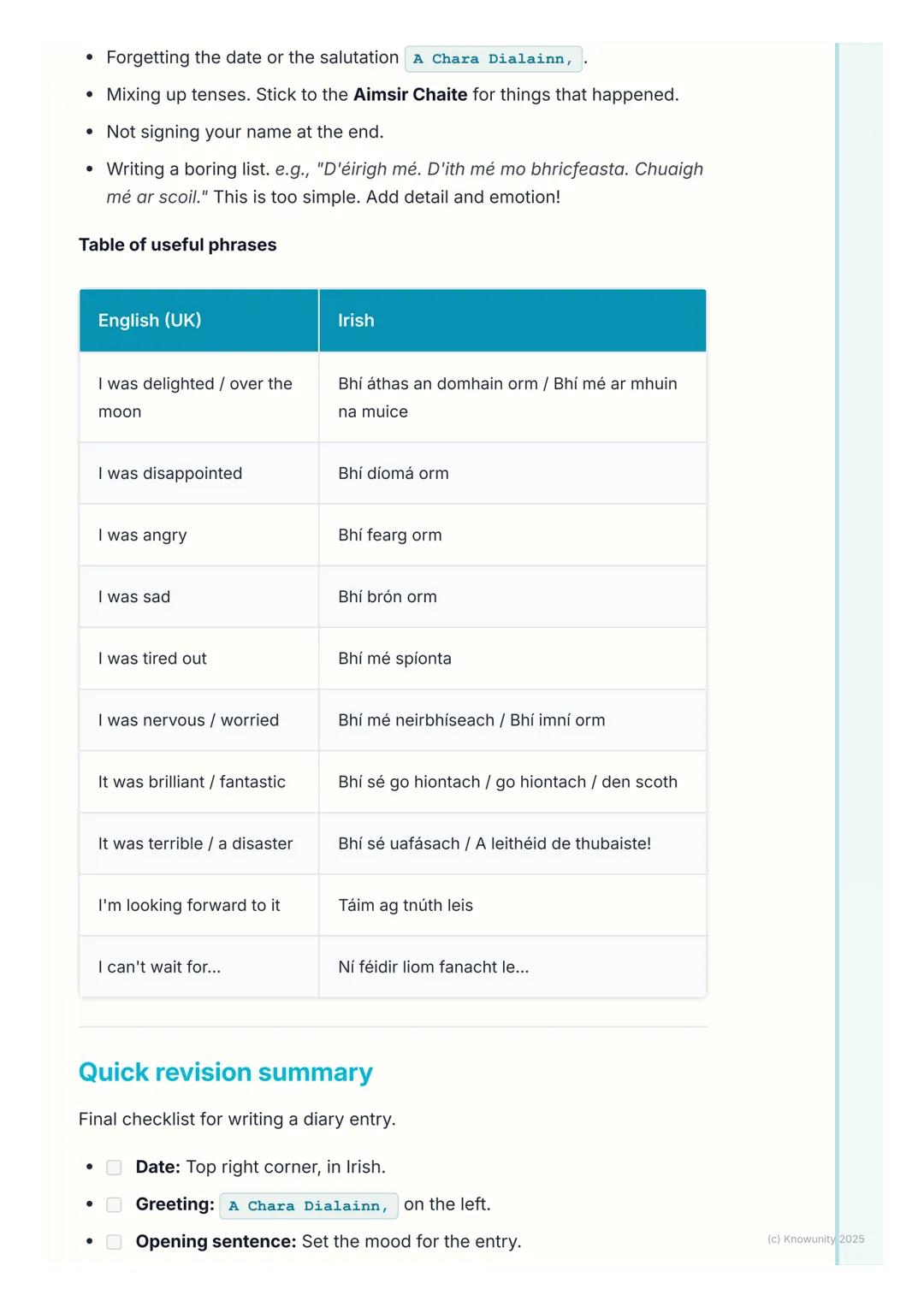
Your Final Exam Checklist
Before you hand in any diary entry, run through this essential checklist to guarantee you haven't missed anything crucial.
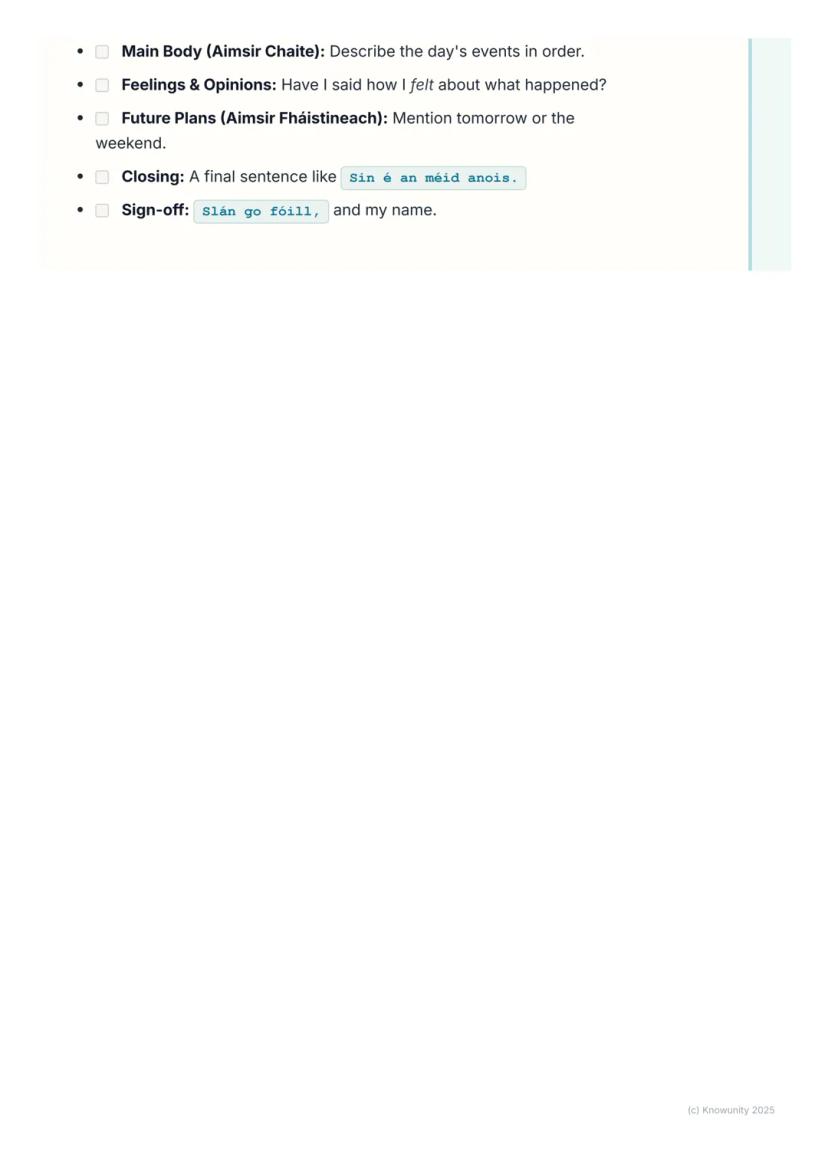
Format basics: Date in Irish (top right), "A Chara Dialainn," (left side), engaging opening sentence that sets the mood for your entire entry.
Content structure: Main body using Aimsir Chaite, clear feelings and opinions expressed throughout, future plans mentioned using Aimsir Fháistineach.
Proper ending: Closing sentence like "Sin é an méid anois," sign-off "Slán go fóill," and your name. Dead simple but absolutely essential.
Remember, diary entries are about showing you can use Irish naturally to express real thoughts and feelings. The more genuine and detailed your emotions, the better your marks will be. You've got this!
Final reminder: Practice writing about both good and bad days - exams love testing your range of emotional vocabulary!
6
of 6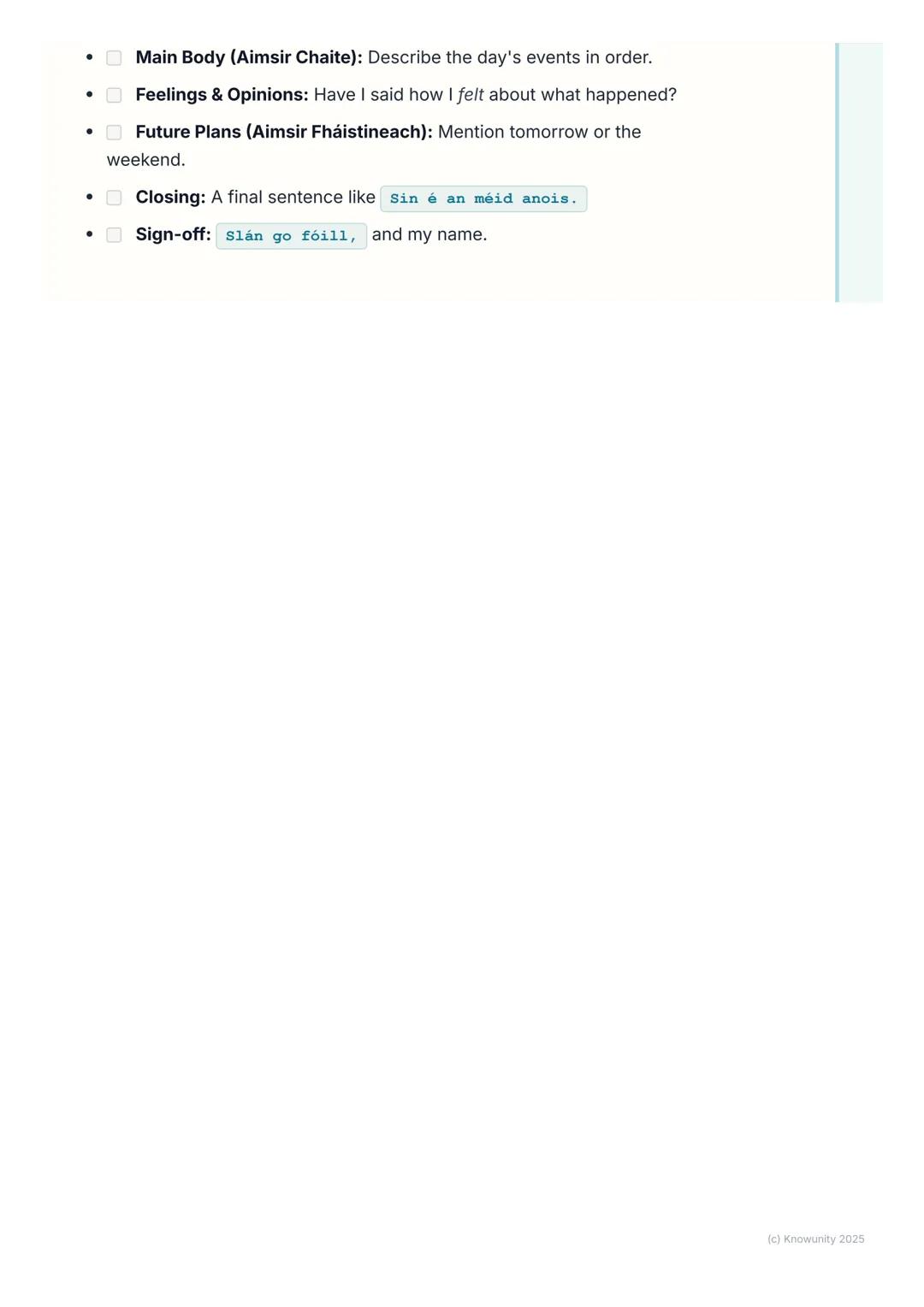
Mislili smo da nikad nećeš pitati...
Šta je Knowunity AI companion?
Naš AI Companion je AI alat fokusiran na učenike koji nudi više od samih odgovora. Napravljen na milionima Knowunity resursa, pruža relevantne informacije, personalizovane planove učenja, kvizove i sadržaj direktno u chatu, prilagođavajući se tvom individualnom putu učenja.
Gde mogu da preuzmem Knowunity aplikaciju?
Možeš preuzeti aplikaciju sa Google Play Store-a i Apple App Store-a.
Da li je Knowunity stvarno besplatan?
Tako je! Uživaj u besplatnom pristupu sadržaju za učenje, povezuj se sa drugim učenicima i dobijaj trenutnu pomoć – sve na dohvat ruke.
Najpopularniji sadržaj u Irish
9IrishIrish oral questions and answers
Questions and answers for the leaving cert oral
5th Year4264
IrishIrish oral questions
Outline of oral questions
5th Year2055
IrishIrish poetry 2027
Iníon + Dínit an Bhróin
5th Year1133
IrishIníon- le hÁine Durkin
Aine Durkin’s poem, Iníon: Themes & summary
5th Year850
IrishLC HL notes- Iníon (poem)
Includes poem in English and Irish, theme, key words & phrases
5th Year2284
IrishMo Ghrá-sa (Idir Lúibíní)
Notes on mo ghrá-sa
5th Year380
IrishGaeilge Grammar Office
All the basics you need to know on Irish grammar.
6th Year1063
IrishAn Gaeilge Aiste
Irish Language essay
6th Year1320
IrishMé Féin & Mo Chlann (Myself & My Family)
Students will learn vocabulary to describe themselves, their family members, and daily routines. This helps in personal introductions and discussions.
TY291
Najpopularniji sadržaj
9IrishIrish oral questions and answers
Questions and answers for the leaving cert oral
5th Year4264
 English
Key Quotes : Sive
Key Quotes and explanations: Sive
6th Year2842
IrishIrish oral questions
Outline of oral questions
5th Year2055
IrishIníon- le hÁine Durkin
Aine Durkin’s poem, Iníon: Themes & summary
5th Year850
IrishIrish poetry 2027
Iníon + Dínit an Bhróin
5th Year1133
IrishLC HL notes- Iníon (poem)
Includes poem in English and Irish, theme, key words & phrases
5th Year2284
EnglishCultural Context : Shawshank Redemption : Sive : Small Things Like These
Comparative Study : Cultural Context : Shawshank Redemption, Sive and Small Things Like These
6th Year1430
IrishMo Ghrá-sa (Idir Lúibíní)
Notes on mo ghrá-sa
5th Year380
IrishAn Gaeilge Aiste
Irish Language essay
6th Year1320
Ne možeš da nađeš ono što tražiš? Istražuj druge predmete.
Učenici nas obožavaju — i ti ćeš takođe.
4.6/5App Store
4.7/5Google Play
Aplikacija je super laka za korišćenje i odlično dizajnirana. Našao sam sve što mi je trebalo i dosta sam naučio iz prezentacija! Definitivno ću koristiti aplikaciju za školski zadatak! A naravno, pomaže i kao inspiracija.
Stefan SiOS korisnik
Ova aplikacija je stvarno odlična. Tu je toliko beleški za učenje i pomoći [...]. Na primer, problem mi je francuski, a aplikacija ima toliko opcija za pomoć. Zahvaljujući ovoj aplikaciji, poboljšao sam francuski. Preporučio bih je svima.
Samantha KlichAndroid korisnik
Vau, stvarno sam oduševljena. Probala sam aplikaciju jer sam je videla u reklamama mnogo puta i bila sam potpuno šokirana. Ova aplikacija je POMOĆ koju želiš za školu i pre svega, nudi toliko stvari, kao što su vežbe i sažeci, što mi je lično bilo VEOMA korisno.
AnaiOS korisnik
Irish6 pregledi·Ažurirano Jun 5, 2026·6 straniceDialann: Ag Scríobh faoin gCéadfaí laethúil
Learning to write diary entries (dialann) in Irish is essential for your written paper - and it's actually quite straightforward once you know the format! This is your chance to show off your ability to talk about daily life, express...
1
of 6
Registruj se da vidiš sadržaj. Besplatno je!
- Pristup svim dokumentima
- Poboljšaj svoje ocene
- Pridruži se milionima učenika
What is a Dialann?
Think of diary entries as your personal chat with yourself about the day - but in Irish! They're dead common in exams, so getting the hang of them is crucial for your marks.
The whole point isn't just listing what you did (that's boring). You need to be reflective and share your feelings about events. It's like having a proper conversation with your diary about what mattered to you.
Key things to remember: You'll mainly use the Aimsir Chaite (past tense) for events that happened, but you can switch to present tense for current feelings and future tense for tomorrow's plans. Keep it personal and informal - you're writing to yourself, so be honest!
Pro tip: Always include how you felt about events, not just what happened. This is where you'll pick up extra marks!
2
of 6Registruj se da vidiš sadržaj. Besplatno je!
- Pristup svim dokumentima
- Poboljšaj svoje ocene
- Pridruži se milionima učenika
Essential Structure You Must Follow
Every diary entry needs the exact same layout - miss any part and you'll lose marks straight away!
The opening starts with the date in Irish (top right corner) like "Dé Luain, an 20ú Meán Fómhair", then your greeting "A Chara Dialainn," on the left underneath.
Your introduction should grab attention immediately. Don't dive straight into events - set the scene first! Try something like "Ní chreidfeá an méid a tharla inniu!" (You wouldn't believe what happened today!)
The main body is where you shine. Use 2-3 paragraphs describing your day in order with linking words like ar dtús, ansin, tar éis sin. Most importantly, master your Aimsir Chaite verbs: chuaigh mé, chonaic mé, bhuail mé le.
Critical point: For every event you mention, add how it made you feel. "Bhí áthas an domhain orm nuair a..." shows much better Irish than just listing facts!
3
of 6Registruj se da vidiš sadržaj. Besplatno je!
- Pristup svim dokumentima
- Poboljšaj svoje ocene
- Pridruži se milionima učenika
Nailing Your Conclusion and Examples
Wrap up your diary entry by summarising your feelings about the day and looking ahead. Use the Aimsir Fháistineach here: "Amárach, beidh mé ag..." or "Táim ag tnúth go mór leis an deireadh seachtaine."
Always end with a proper sign-off like "Sin é an méid anois" followed by "Slán go fóill," and your name. Simple but essential!
Looking at the examples, notice how the good day entry flows naturally from events to feelings. The football match example doesn't just say "we won" - it captures the electric atmosphere, the nervousness, and that pure joy of scoring the winning goal.
The stressful day example works brilliantly too because it's honest about feelings. Failed maths exam, dropped dinner, everyone laughing - we've all been there! The key is showing how these events affected the writer emotionally.
4
of 6Registruj se da vidiš sadržaj. Besplatno je!
- Pristup svim dokumentima
- Poboljšaj svoje ocene
- Pridruži se milionima učenika
Common Mistakes and Winning Phrases
Avoid these exam disasters: forgetting your date or "A Chara Dialainn," mixing up your tenses, not signing your name, or writing boring lists like "D'éirigh mé. D'ith mé. Chuaigh mé." Add detail and emotion instead!
Essential feeling phrases you need to memorise: "Bhí áthas an domhain orm" (I was over the moon), "Bhí díomá orm" (I was disappointed), "Bhí mé spíonta" (I was tired out). These will instantly improve your writing.
Time and mood phrases like "Bhí sé go hiontach" (It was brilliant) or "A leithéid de thubaiste!" (What a disaster!) add personality to your entries. Don't just tell what happened - show how you felt about it.
The examiner wants to see you can express complex emotions, not just describe events. Think of it as telling your best mate about your day rather than writing a boring report.
Game changer: Every event needs an emotional reaction. This single tip will boost your marks significantly!
5
of 6Registruj se da vidiš sadržaj. Besplatno je!
- Pristup svim dokumentima
- Poboljšaj svoje ocene
- Pridruži se milionima učenika
Your Final Exam Checklist
Before you hand in any diary entry, run through this essential checklist to guarantee you haven't missed anything crucial.
Format basics: Date in Irish (top right), "A Chara Dialainn," (left side), engaging opening sentence that sets the mood for your entire entry.
Content structure: Main body using Aimsir Chaite, clear feelings and opinions expressed throughout, future plans mentioned using Aimsir Fháistineach.
Proper ending: Closing sentence like "Sin é an méid anois," sign-off "Slán go fóill," and your name. Dead simple but absolutely essential.
Remember, diary entries are about showing you can use Irish naturally to express real thoughts and feelings. The more genuine and detailed your emotions, the better your marks will be. You've got this!
Final reminder: Practice writing about both good and bad days - exams love testing your range of emotional vocabulary!
6
of 6Registruj se da vidiš sadržaj. Besplatno je!
- Pristup svim dokumentima
- Poboljšaj svoje ocene
- Pridruži se milionima učenika
Mislili smo da nikad nećeš pitati...
Šta je Knowunity AI companion?
Naš AI Companion je AI alat fokusiran na učenike koji nudi više od samih odgovora. Napravljen na milionima Knowunity resursa, pruža relevantne informacije, personalizovane planove učenja, kvizove i sadržaj direktno u chatu, prilagođavajući se tvom individualnom putu učenja.
Gde mogu da preuzmem Knowunity aplikaciju?
Možeš preuzeti aplikaciju sa Google Play Store-a i Apple App Store-a.
Da li je Knowunity stvarno besplatan?
Tako je! Uživaj u besplatnom pristupu sadržaju za učenje, povezuj se sa drugim učenicima i dobijaj trenutnu pomoć – sve na dohvat ruke.
Najpopularniji sadržaj u Irish
9IrishIrish oral questions and answers
Questions and answers for the leaving cert oral
5th Year4264
IrishIrish oral questions
Outline of oral questions
5th Year2055
IrishIrish poetry 2027
Iníon + Dínit an Bhróin
5th Year1133
IrishIníon- le hÁine Durkin
Aine Durkin’s poem, Iníon: Themes & summary
5th Year850
IrishLC HL notes- Iníon (poem)
Includes poem in English and Irish, theme, key words & phrases
5th Year2284
IrishMo Ghrá-sa (Idir Lúibíní)
Notes on mo ghrá-sa
5th Year380
IrishGaeilge Grammar Office
All the basics you need to know on Irish grammar.
6th Year1063
IrishAn Gaeilge Aiste
Irish Language essay
6th Year1320
IrishMé Féin & Mo Chlann (Myself & My Family)
Students will learn vocabulary to describe themselves, their family members, and daily routines. This helps in personal introductions and discussions.
TY291
Najpopularniji sadržaj
9IrishIrish oral questions and answers
Questions and answers for the leaving cert oral
5th Year4264
EnglishKey Quotes : Sive
Key Quotes and explanations: Sive
6th Year2842
IrishIrish oral questions
Outline of oral questions
5th Year2055
IrishIníon- le hÁine Durkin
Aine Durkin’s poem, Iníon: Themes & summary
5th Year850
IrishIrish poetry 2027
Iníon + Dínit an Bhróin
5th Year1133
IrishLC HL notes- Iníon (poem)
Includes poem in English and Irish, theme, key words & phrases
5th Year2284
EnglishCultural Context : Shawshank Redemption : Sive : Small Things Like These
Comparative Study : Cultural Context : Shawshank Redemption, Sive and Small Things Like These
6th Year1430
IrishMo Ghrá-sa (Idir Lúibíní)
Notes on mo ghrá-sa
5th Year380
IrishAn Gaeilge Aiste
Irish Language essay
6th Year1320
Ne možeš da nađeš ono što tražiš? Istražuj druge predmete.
Učenici nas obožavaju — i ti ćeš takođe.
4.6/5App Store
4.7/5Google Play
Aplikacija je super laka za korišćenje i odlično dizajnirana. Našao sam sve što mi je trebalo i dosta sam naučio iz prezentacija! Definitivno ću koristiti aplikaciju za školski zadatak! A naravno, pomaže i kao inspiracija.
Stefan SiOS korisnik
Ova aplikacija je stvarno odlična. Tu je toliko beleški za učenje i pomoći [...]. Na primer, problem mi je francuski, a aplikacija ima toliko opcija za pomoć. Zahvaljujući ovoj aplikaciji, poboljšao sam francuski. Preporučio bih je svima.
Samantha KlichAndroid korisnik
Vau, stvarno sam oduševljena. Probala sam aplikaciju jer sam je videla u reklamama mnogo puta i bila sam potpuno šokirana. Ova aplikacija je POMOĆ koju želiš za školu i pre svega, nudi toliko stvari, kao što su vežbe i sažeci, što mi je lično bilo VEOMA korisno.
AnaiOS korisnik