
Taisteal & Saoire (Travel & Holidays) is an essential topic...
 Irish3 pregledi·Ažurirano Jun 7, 2026·6 stranice
Modhanna Taistil agus Áiteanna Saoire: Foghlaim Teanga
1 / 6
1
of 6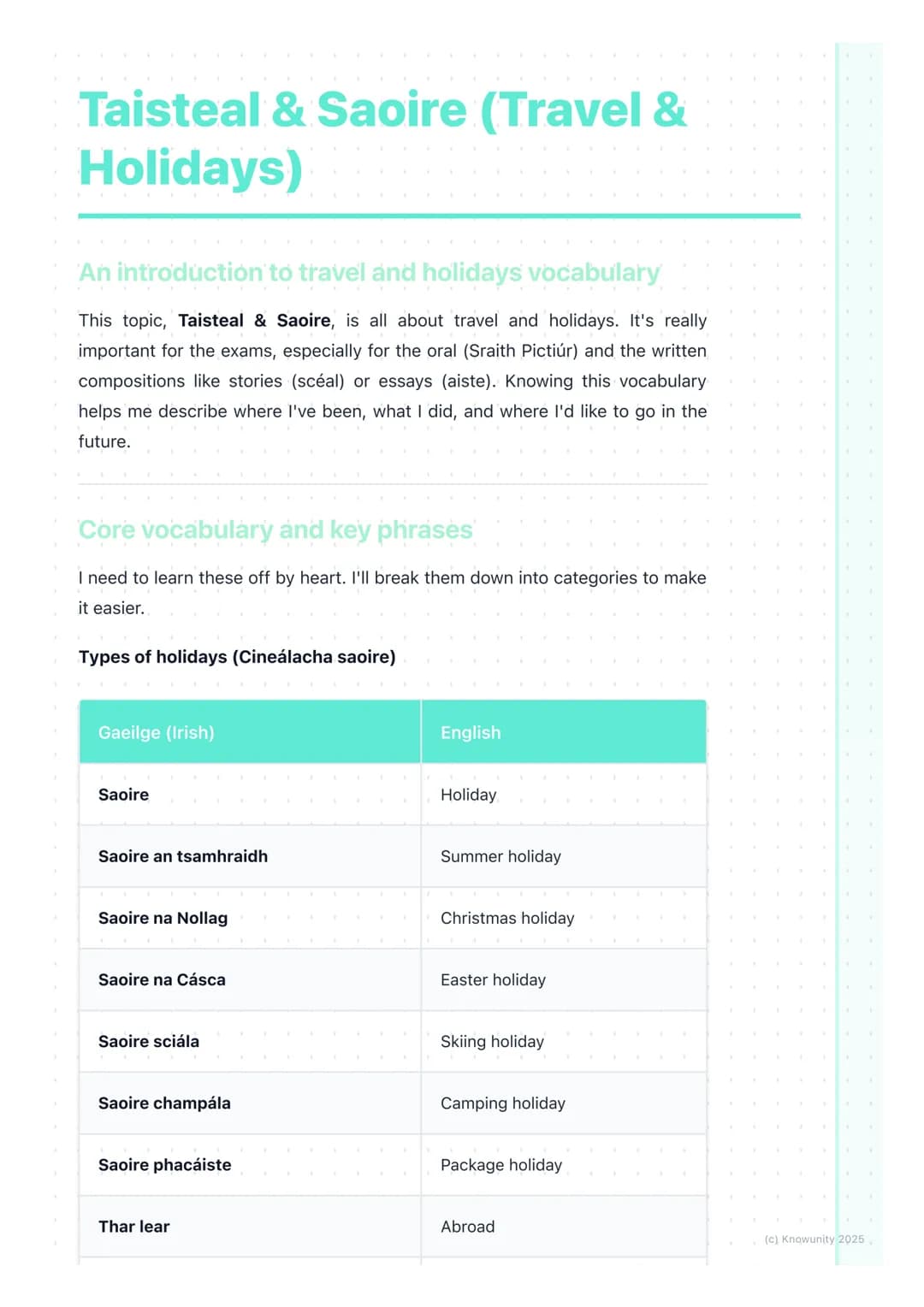
Introduction to Travel & Holiday Vocabulary
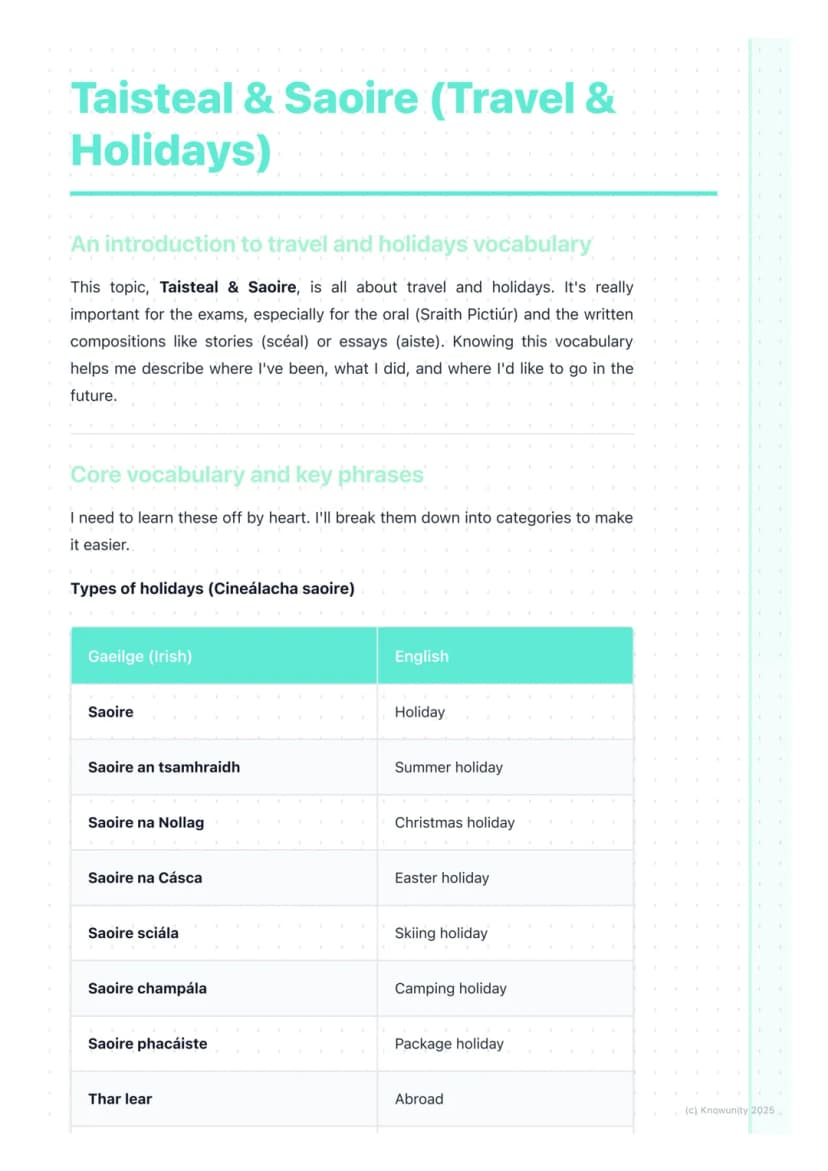
When it comes to your Irish exams, being able to talk about holidays is absolutely crucial. This vocabulary will appear in your oral exam (especially in the Sraith Pictiúr) and in written compositions where you'll need to describe travels and adventures.
Learning different types of holidays in Irish gives you a strong foundation. Remember these key terms: saoire (holiday), saoire an tsamhraidh (summer holiday), and thar lear (abroad). These will be essential building blocks for your conversations and writing.
The types of holidays you should know include saoire sciála (skiing holiday), saoire champála (camping holiday), and saoire phacáiste (package holiday). Having these specific terms ready will make your Irish sound more natural and impressive to examiners.
Top Tip: Create flashcards with these holiday types and practice using them in simple sentences. For example: "Chuaigh mé ar saoire champála" (I went on a camping holiday).
2
of 6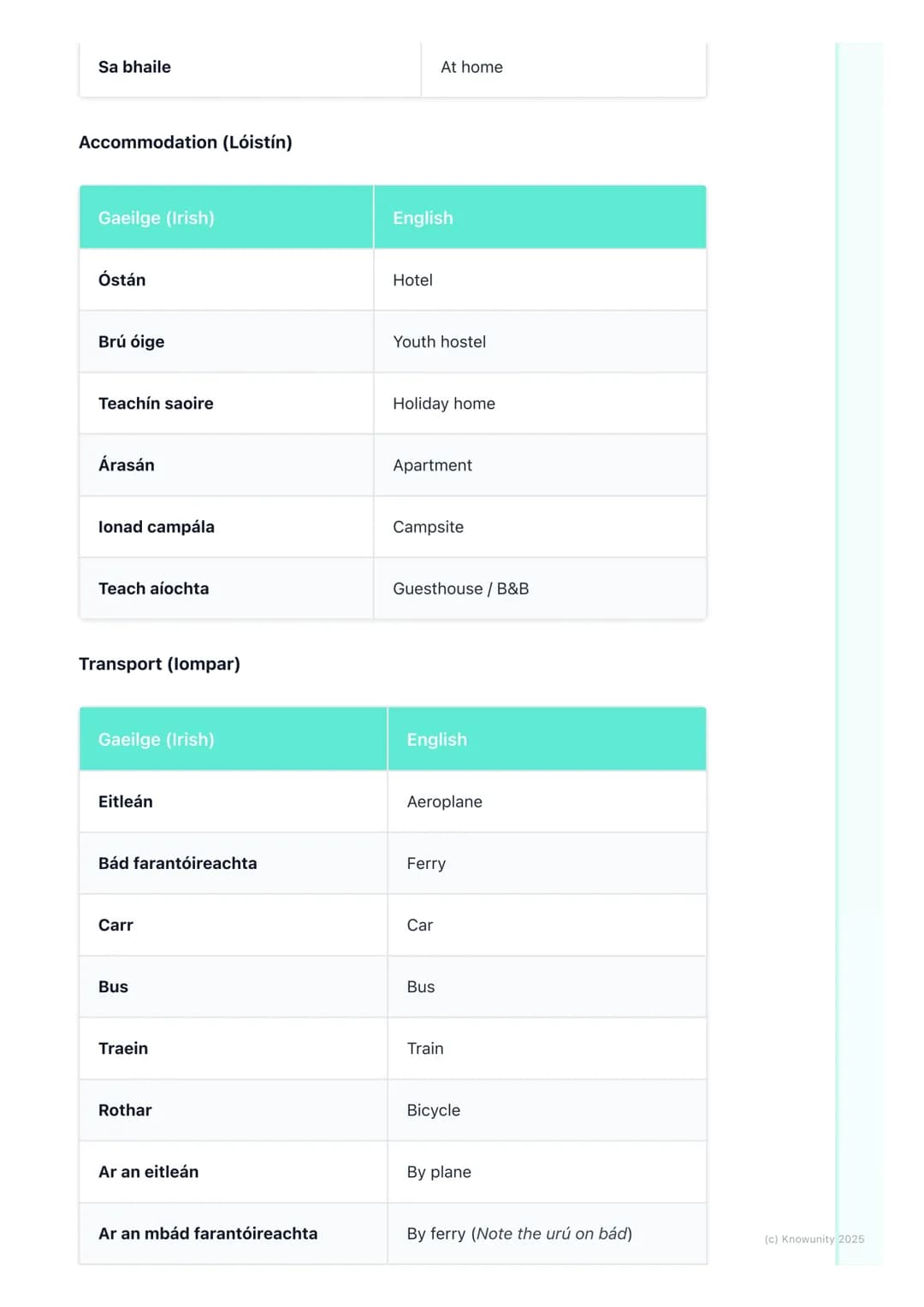
Accommodation & Transport Vocabulary
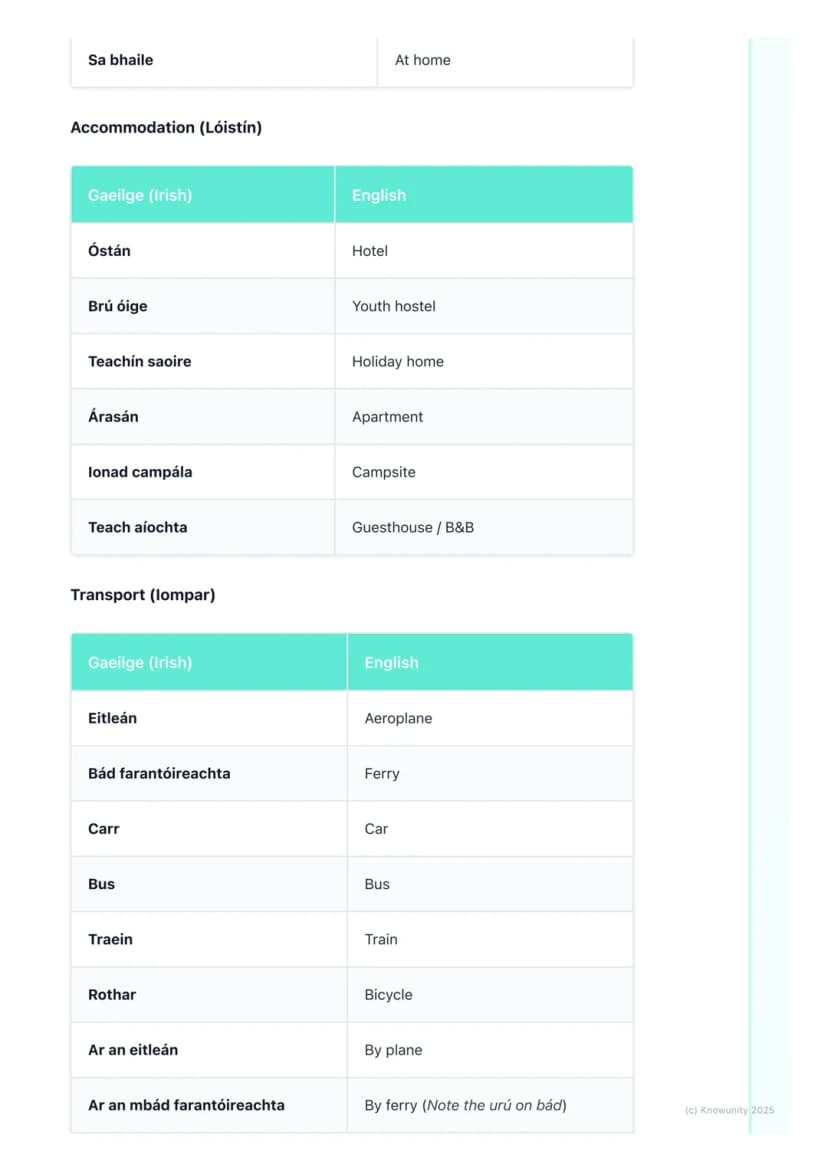
Where you stay and how you travel are key parts of any holiday story. For accommodation, learn terms like óstán (hotel), brú óige (youth hostel), and teachín saoire (holiday home). These words will help you describe where you stayed during your trips.
Transport vocabulary is equally important for explaining how you got to your destination. The main terms include eitleán (aeroplane), bád farantóireachta (ferry), and traein (train). Remember phrases like ar an eitleán (by plane) to describe your method of travel.
When describing transport in Irish, watch out for grammar changes. Notice how "bád" changes to "mbád" in the phrase ar an mbád farantóireachta - this is called an urú and it happens after certain prepositions like "ar an".
Grammar Alert: Pay attention to how words change after "ar an" - some words get an urú (ar an mbád), while others get a séimhiú (ar an charr → ar an charr). This small detail can really impress your examiner!
3
of 6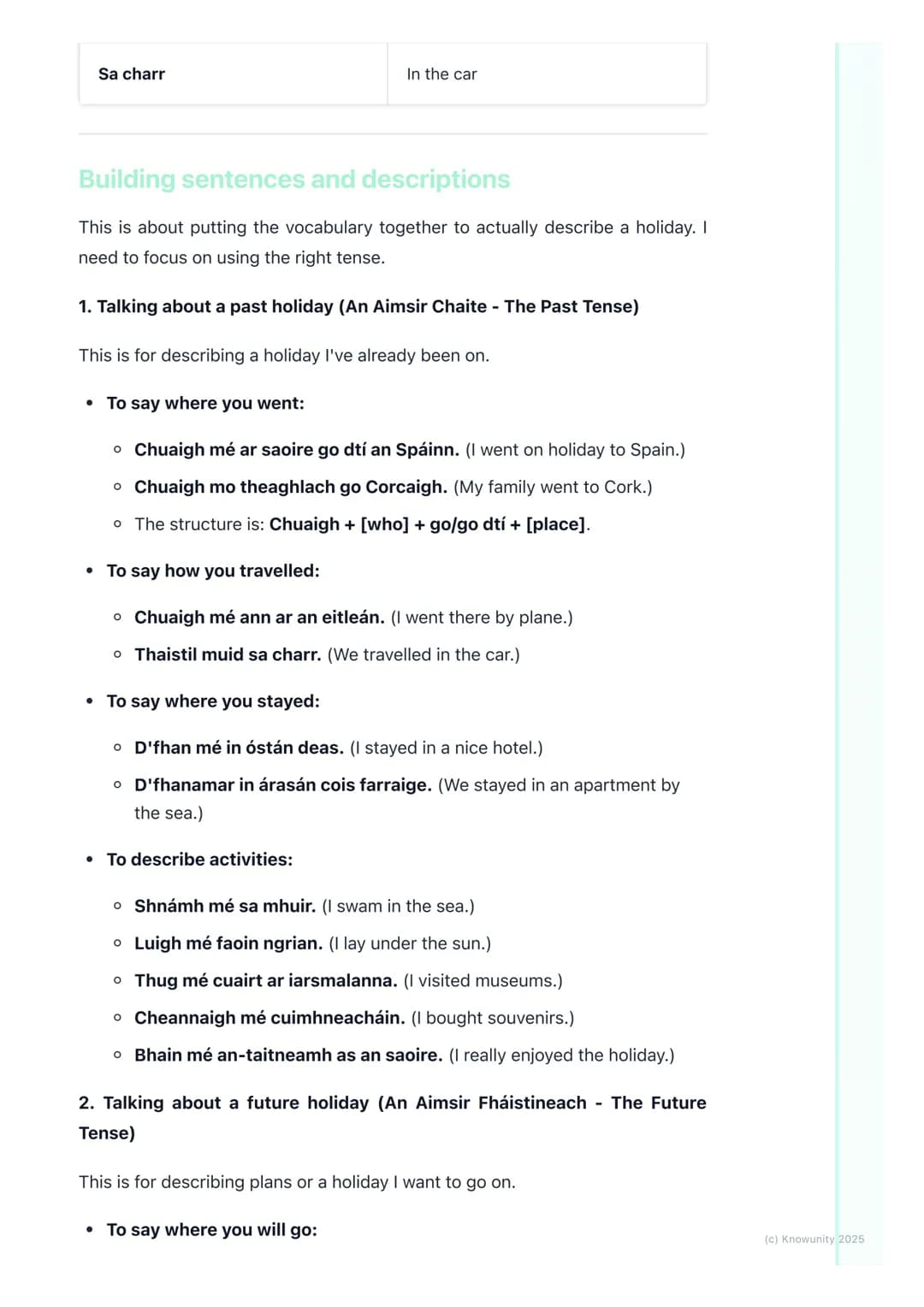
Building Holiday Descriptions
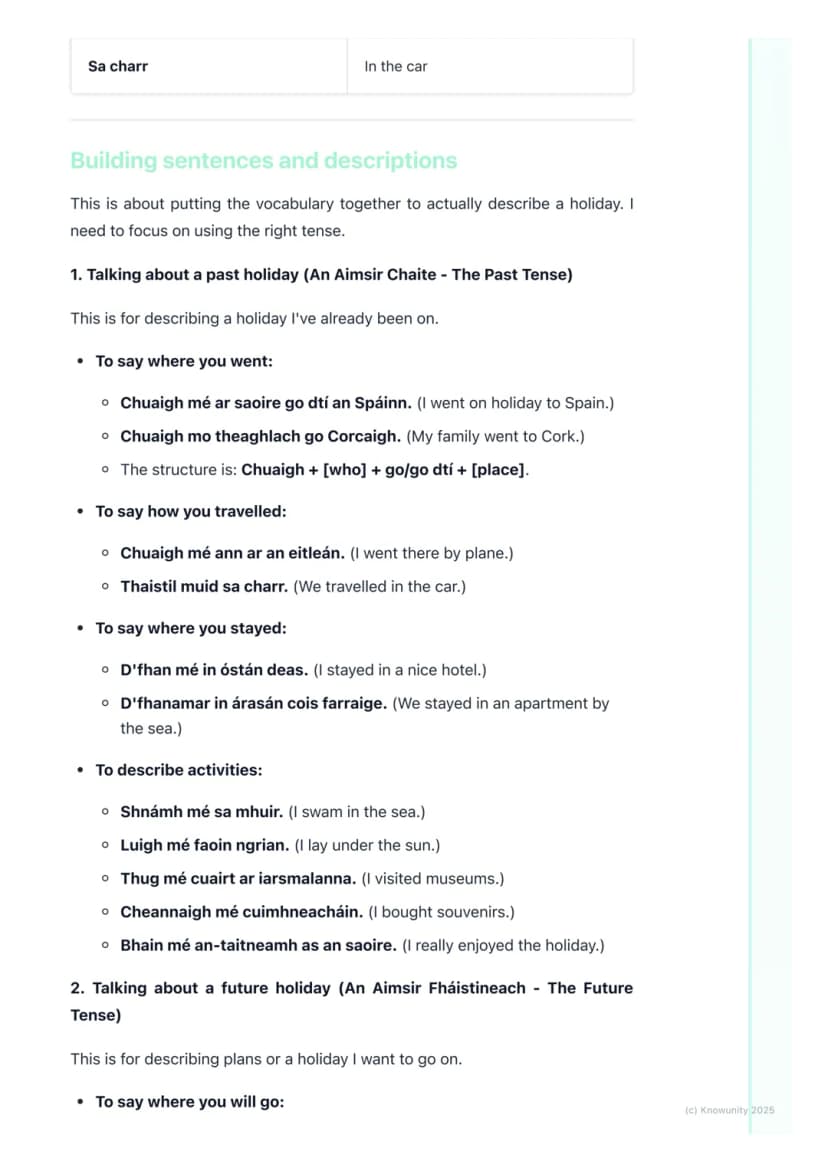
Now it's time to put your vocabulary to work by constructing proper sentences about holidays. For past holidays, you'll use An Aimsir Chaite (the past tense) with verbs like chuaigh (went) and d'fhan (stayed).
When describing where you went, follow this pattern: Chuaigh mé ar saoire go dtí an Spáinn (I went on holiday to Spain). For transport, say Chuaigh mé ann ar an eitleán (I went there by plane) or Thaistil muid sa charr (We travelled in the car).
Activities are what make a holiday interesting! Learn phrases like Shnámh mé sa mhuir (I swam in the sea), Luigh mé faoin ngrian (I lay under the sun), and Bhain mé an-taitneamh as an saoire (I really enjoyed the holiday). These vivid descriptions will bring your holiday stories to life.
Examiner's Favourite: Show off your language skills by including both where you stayed AND what you did each day. For example: "D'fhan mé in óstán deas agus shnámh mé sa mhuir gach lá" (I stayed in a nice hotel and swam in the sea every day).
4
of 6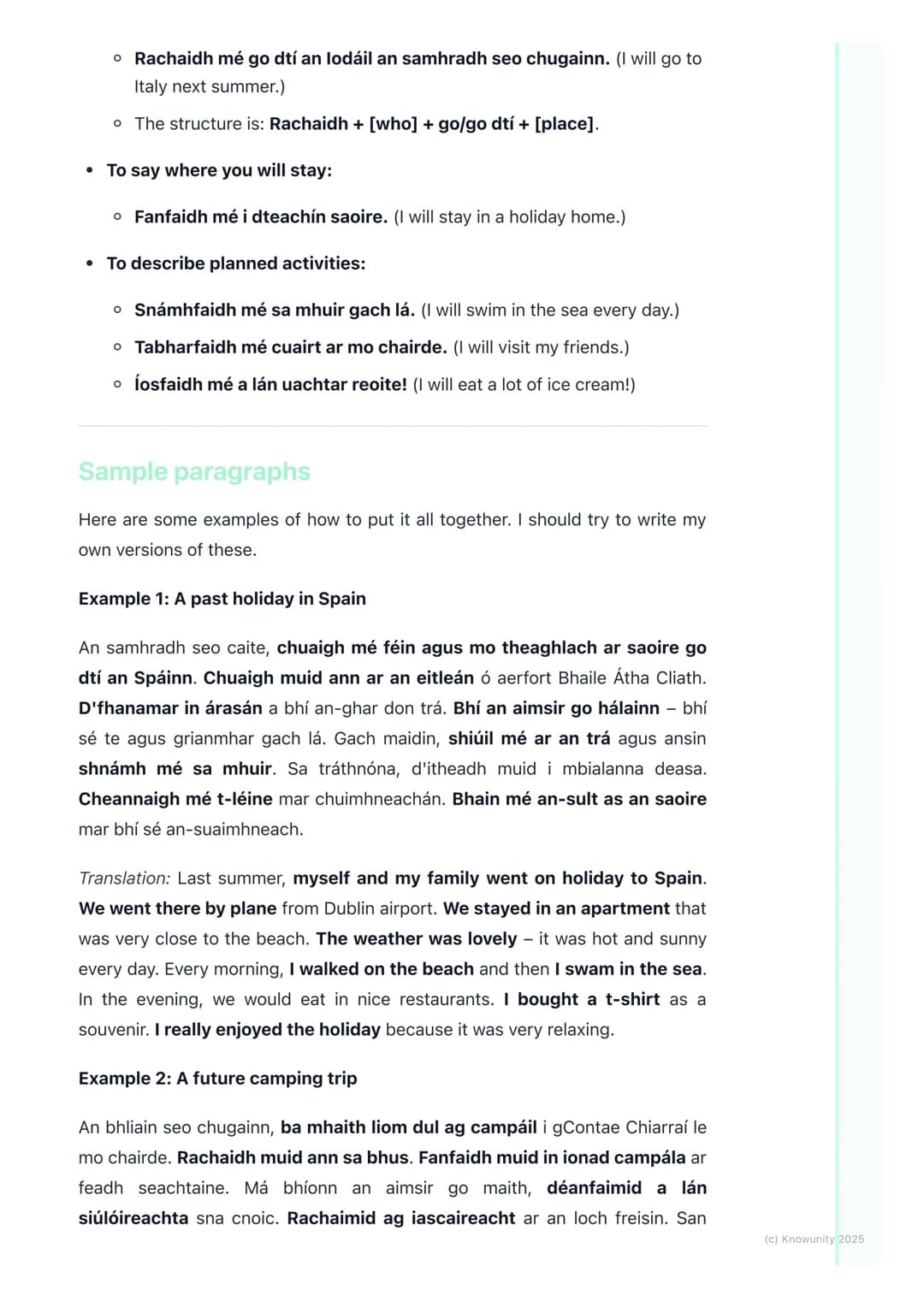
Future Holiday Plans
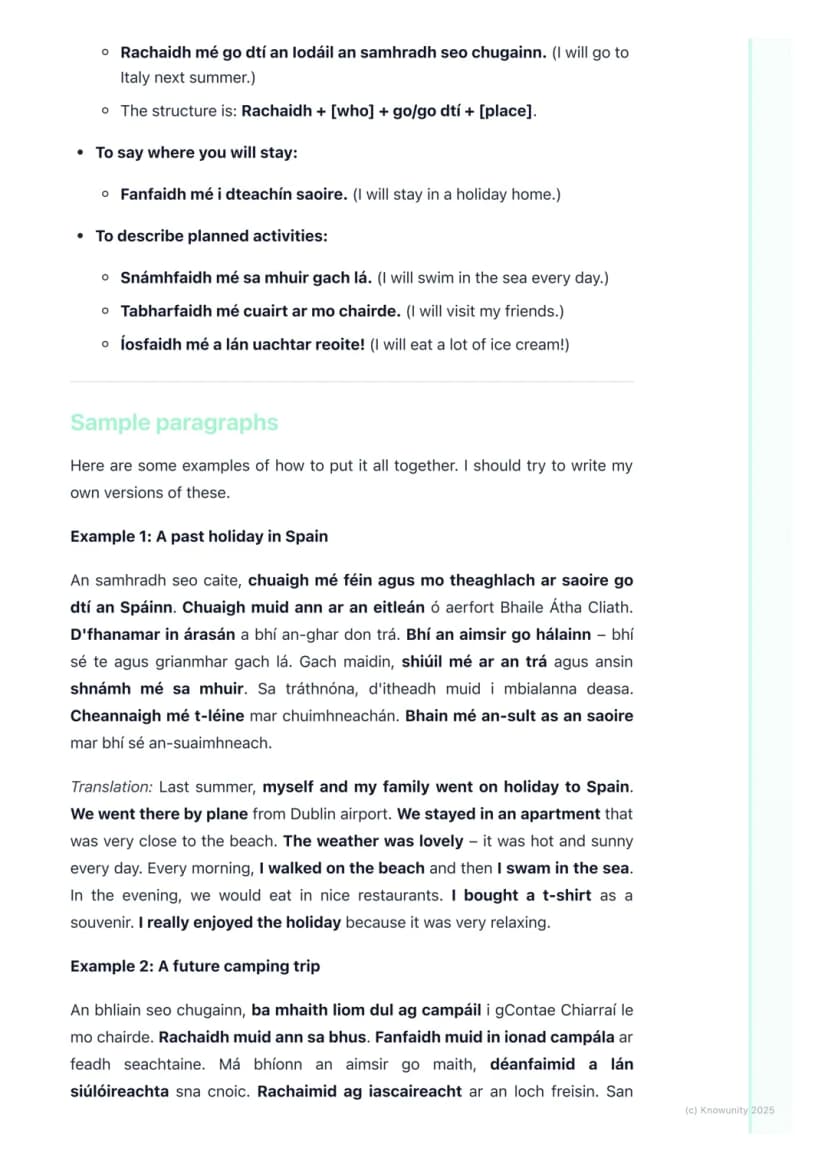
For talking about future holidays, you'll need An Aimsir Fháistineach (the future tense). Start with phrases like Rachaidh mé go dtí an Iodáil (I will go to Italy) to set the scene for your planned adventure.
Your accommodation plans use the verb fanfaidh: Fanfaidh mé i dteachín saoire (I will stay in a holiday home). For activities, learn future tense verbs like snámhfaidh (will swim), tabharfaidh (will visit), and íosfaidh (will eat).
Look at how a complete paragraph flows together in the example about a past holiday in Spain. Notice how it includes travel method, accommodation, daily activities, and an overall impression. Your goal is to create similar flowing descriptions that sound natural.
Sample Structure: Try this formula for success - where you went + how you travelled + where you stayed + what you did + overall impression. This covers all the bases examiners look for!
5
of 6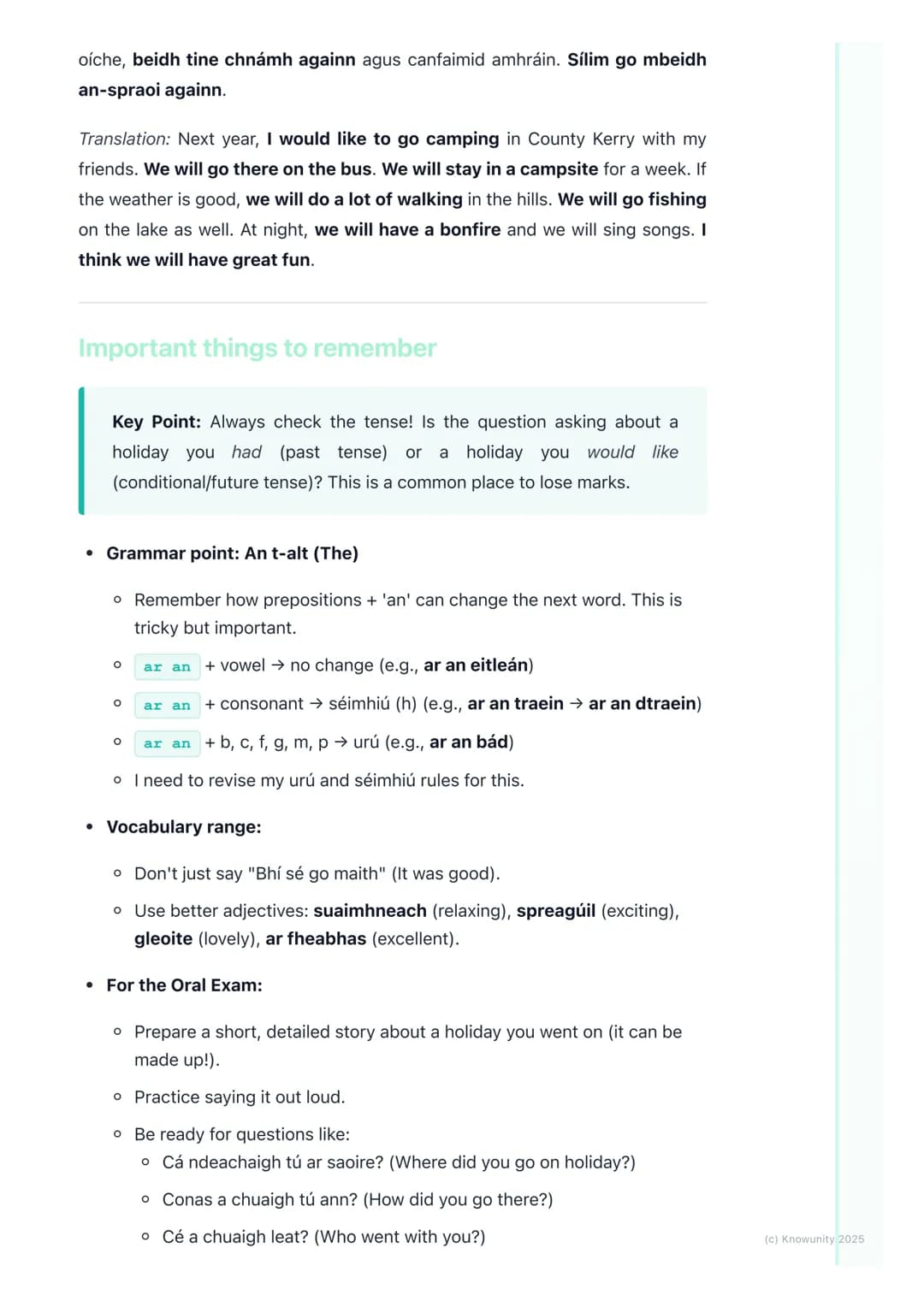
Important Grammar Points & Tips
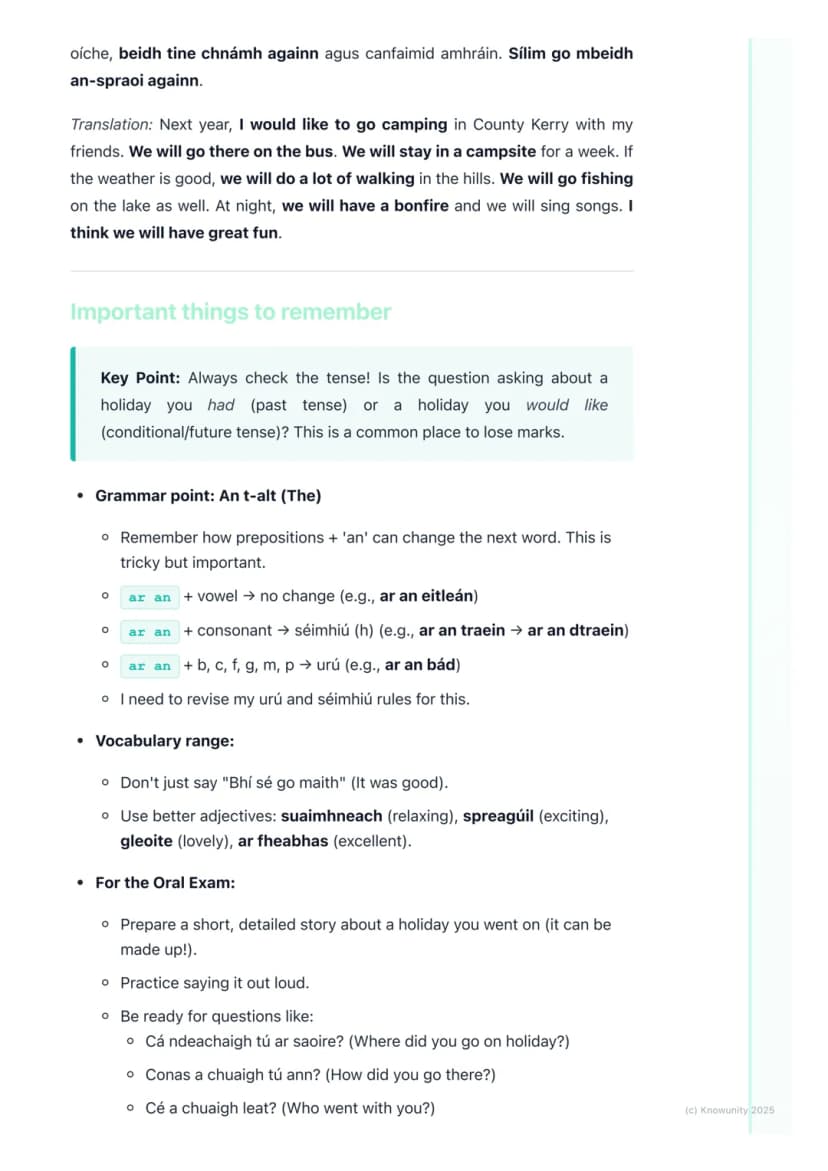
Always check what tense the question is asking for! Using the wrong tense is a common mistake that costs students marks. If the question asks about a past holiday, use Chuaigh mé (I went), not Rachaidh mé (I will go).
The definite article (an - the) causes changes to the following word. After ar an + consonant, you add a séimhiú (h) in some cases, while ar an + b, c, f, g, m, p requires an urú. This is tricky but will really impress your examiner.
Expand your vocabulary beyond basic descriptions. Instead of saying "Bhí sé go maith" (It was good), use more impressive adjectives like suaimhneach (relaxing), spreagúil (exciting), or ar fheabhas (excellent).
Oral Exam Tip: Prepare a detailed 1-minute story about a holiday (real or imagined) and practice it until it flows naturally. Be ready for follow-up questions about where you went, how you travelled, and what activities you enjoyed.
6
of 6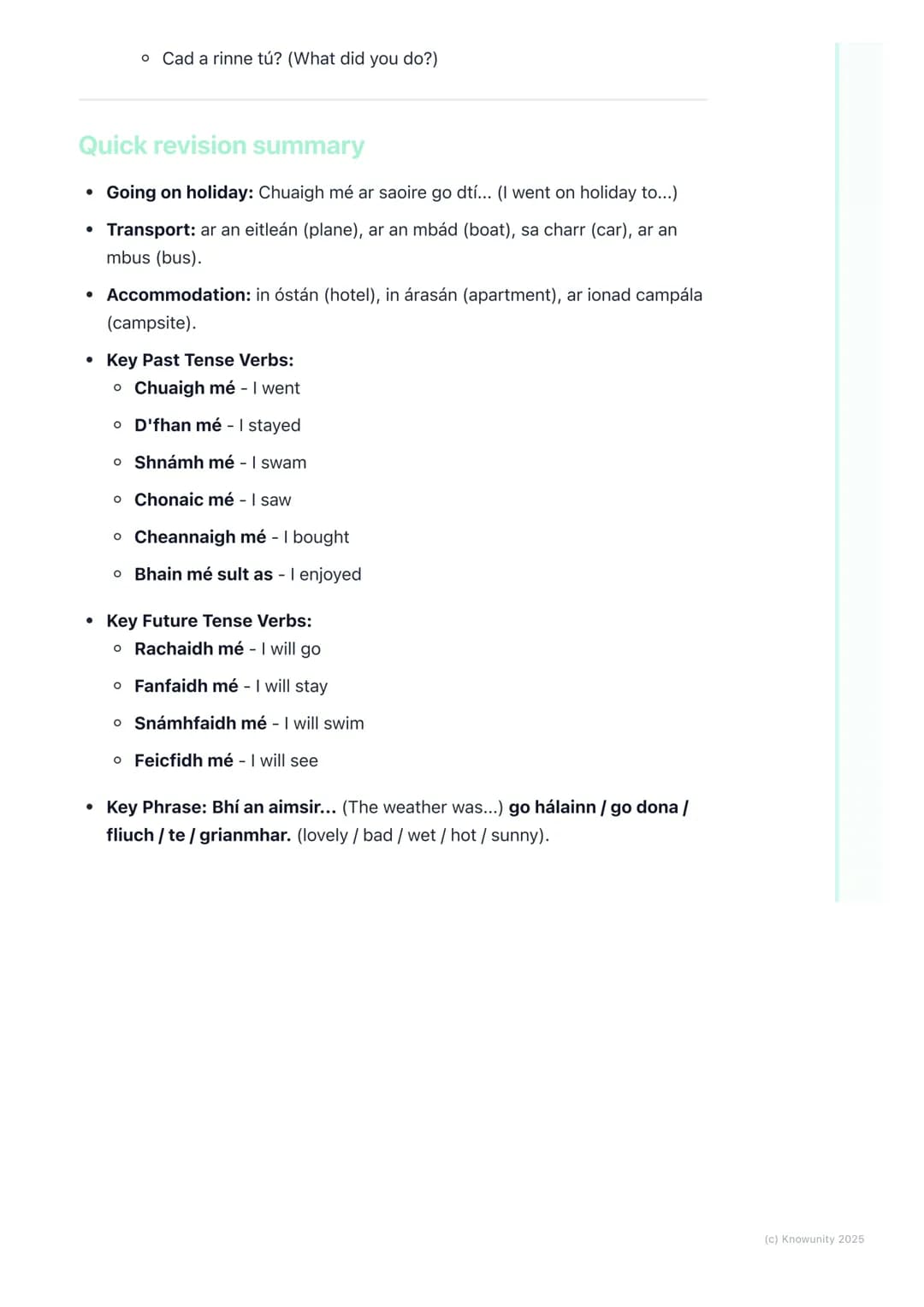
Quick Revision Summary
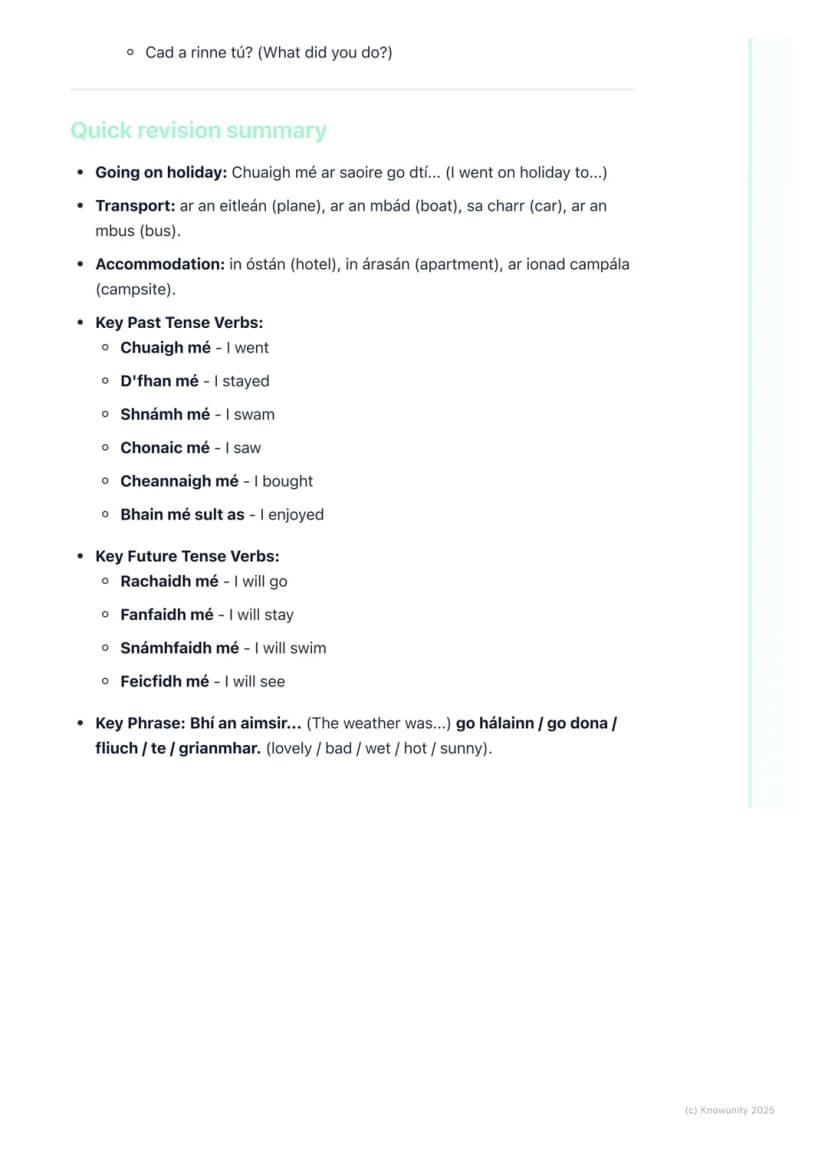
The key structures for talking about holidays are Chuaigh mé ar saoire go dtí... (I went on holiday to...) for the past and Rachaidh mé go dtí... (I will go to...) for the future. These are your starting points for any holiday description.
Master the essential past tense verbs: chuaigh (went), d'fhan (stayed), shnámh (swam), chonaic (saw), and bhain sult as (enjoyed). Similarly, know your future tense verbs: rachaidh (will go), fanfaidh (will stay), and feicfidh (will see).
Always include details about the weather using the phrase Bhí an aimsir... (The weather was...) followed by descriptions like go hálainn (lovely), go dona (bad), fliuch (wet), or grianmhar (sunny). This adds authenticity to your holiday account.
Revision Strategy: Create mini-stories using the past tense one day and the future tense the next. This contrast will help cement both forms in your mind and make them readily available during your exam.
Mislili smo da nikad nećeš pitati...
Šta je Knowunity AI companion?
Naš AI Companion je AI alat fokusiran na učenike koji nudi više od samih odgovora. Napravljen na milionima Knowunity resursa, pruža relevantne informacije, personalizovane planove učenja, kvizove i sadržaj direktno u chatu, prilagođavajući se tvom individualnom putu učenja.
Gde mogu da preuzmem Knowunity aplikaciju?
Možeš preuzeti aplikaciju sa Google Play Store-a i Apple App Store-a.
Da li je Knowunity stvarno besplatan?
Tako je! Uživaj u besplatnom pristupu sadržaju za učenje, povezuj se sa drugim učenicima i dobijaj trenutnu pomoć – sve na dohvat ruke.
Najpopularniji sadržaj u Irish
9IrishIrish oral questions and answers
Questions and answers for the leaving cert oral
5th Year4264
IrishIrish oral questions
Outline of oral questions
5th Year2055
IrishIrish poetry 2027
Iníon + Dínit an Bhróin
5th Year1153
IrishIníon- le hÁine Durkin
Aine Durkin’s poem, Iníon: Themes & summary
5th Year890
IrishLC HL notes- Iníon (poem)
Includes poem in English and Irish, theme, key words & phrases
5th Year2304
IrishMo Ghrá-sa (Idir Lúibíní)
Notes on mo ghrá-sa
5th Year380
IrishGaeilge Grammar Office
All the basics you need to know on Irish grammar.
6th Year1063
IrishAn Gaeilge Aiste
Irish Language essay
6th Year1320
IrishMé Féin & Mo Chlann (Myself & My Family)
Students will learn vocabulary to describe themselves, their family members, and daily routines. This helps in personal introductions and discussions.
TY291
Najpopularniji sadržaj
9IrishIrish oral questions and answers
Questions and answers for the leaving cert oral
5th Year4264
 English
Key Quotes : Sive
Key Quotes and explanations: Sive
6th Year2842
IrishIrish oral questions
Outline of oral questions
5th Year2055
IrishIníon- le hÁine Durkin
Aine Durkin’s poem, Iníon: Themes & summary
5th Year890
IrishIrish poetry 2027
Iníon + Dínit an Bhróin
5th Year1153
IrishLC HL notes- Iníon (poem)
Includes poem in English and Irish, theme, key words & phrases
5th Year2304
EnglishCultural Context : Shawshank Redemption : Sive : Small Things Like These
Comparative Study : Cultural Context : Shawshank Redemption, Sive and Small Things Like These
6th Year1430
IrishMo Ghrá-sa (Idir Lúibíní)
Notes on mo ghrá-sa
5th Year380
IrishAn Gaeilge Aiste
Irish Language essay
6th Year1320
Ne možeš da nađeš ono što tražiš? Istražuj druge predmete.
Učenici nas obožavaju — i ti ćeš takođe.
4.6/5App Store
4.7/5Google Play
Aplikacija je super laka za korišćenje i odlično dizajnirana. Našao sam sve što mi je trebalo i dosta sam naučio iz prezentacija! Definitivno ću koristiti aplikaciju za školski zadatak! A naravno, pomaže i kao inspiracija.
Stefan SiOS korisnik
Ova aplikacija je stvarno odlična. Tu je toliko beleški za učenje i pomoći [...]. Na primer, problem mi je francuski, a aplikacija ima toliko opcija za pomoć. Zahvaljujući ovoj aplikaciji, poboljšao sam francuski. Preporučio bih je svima.
Samantha KlichAndroid korisnik
Vau, stvarno sam oduševljena. Probala sam aplikaciju jer sam je videla u reklamama mnogo puta i bila sam potpuno šokirana. Ova aplikacija je POMOĆ koju želiš za školu i pre svega, nudi toliko stvari, kao što su vežbe i sažeci, što mi je lično bilo VEOMA korisno.
AnaiOS korisnik
Irish3 pregledi·Ažurirano Jun 7, 2026·6 straniceModhanna Taistil agus Áiteanna Saoire: Foghlaim Teanga
Taisteal & Saoire (Travel & Holidays) is an essential topic for your Irish language exams. This vocabulary will help you describe past trips, future plans, and holiday experiences in both oral and written assessments. Learning these terms and phrases will...
1
of 6
Registruj se da vidiš sadržaj. Besplatno je!
- Pristup svim dokumentima
- Poboljšaj svoje ocene
- Pridruži se milionima učenika
Introduction to Travel & Holiday Vocabulary
When it comes to your Irish exams, being able to talk about holidays is absolutely crucial. This vocabulary will appear in your oral exam (especially in the Sraith Pictiúr) and in written compositions where you'll need to describe travels and adventures.
Learning different types of holidays in Irish gives you a strong foundation. Remember these key terms: saoire (holiday), saoire an tsamhraidh (summer holiday), and thar lear (abroad). These will be essential building blocks for your conversations and writing.
The types of holidays you should know include saoire sciála (skiing holiday), saoire champála (camping holiday), and saoire phacáiste (package holiday). Having these specific terms ready will make your Irish sound more natural and impressive to examiners.
Top Tip: Create flashcards with these holiday types and practice using them in simple sentences. For example: "Chuaigh mé ar saoire champála" (I went on a camping holiday).
2
of 6Registruj se da vidiš sadržaj. Besplatno je!
- Pristup svim dokumentima
- Poboljšaj svoje ocene
- Pridruži se milionima učenika
Accommodation & Transport Vocabulary
Where you stay and how you travel are key parts of any holiday story. For accommodation, learn terms like óstán (hotel), brú óige (youth hostel), and teachín saoire (holiday home). These words will help you describe where you stayed during your trips.
Transport vocabulary is equally important for explaining how you got to your destination. The main terms include eitleán (aeroplane), bád farantóireachta (ferry), and traein (train). Remember phrases like ar an eitleán (by plane) to describe your method of travel.
When describing transport in Irish, watch out for grammar changes. Notice how "bád" changes to "mbád" in the phrase ar an mbád farantóireachta - this is called an urú and it happens after certain prepositions like "ar an".
Grammar Alert: Pay attention to how words change after "ar an" - some words get an urú (ar an mbád), while others get a séimhiú (ar an charr → ar an charr). This small detail can really impress your examiner!
3
of 6Registruj se da vidiš sadržaj. Besplatno je!
- Pristup svim dokumentima
- Poboljšaj svoje ocene
- Pridruži se milionima učenika
Building Holiday Descriptions
Now it's time to put your vocabulary to work by constructing proper sentences about holidays. For past holidays, you'll use An Aimsir Chaite (the past tense) with verbs like chuaigh (went) and d'fhan (stayed).
When describing where you went, follow this pattern: Chuaigh mé ar saoire go dtí an Spáinn (I went on holiday to Spain). For transport, say Chuaigh mé ann ar an eitleán (I went there by plane) or Thaistil muid sa charr (We travelled in the car).
Activities are what make a holiday interesting! Learn phrases like Shnámh mé sa mhuir (I swam in the sea), Luigh mé faoin ngrian (I lay under the sun), and Bhain mé an-taitneamh as an saoire (I really enjoyed the holiday). These vivid descriptions will bring your holiday stories to life.
Examiner's Favourite: Show off your language skills by including both where you stayed AND what you did each day. For example: "D'fhan mé in óstán deas agus shnámh mé sa mhuir gach lá" (I stayed in a nice hotel and swam in the sea every day).
4
of 6Registruj se da vidiš sadržaj. Besplatno je!
- Pristup svim dokumentima
- Poboljšaj svoje ocene
- Pridruži se milionima učenika
Future Holiday Plans
For talking about future holidays, you'll need An Aimsir Fháistineach (the future tense). Start with phrases like Rachaidh mé go dtí an Iodáil (I will go to Italy) to set the scene for your planned adventure.
Your accommodation plans use the verb fanfaidh: Fanfaidh mé i dteachín saoire (I will stay in a holiday home). For activities, learn future tense verbs like snámhfaidh (will swim), tabharfaidh (will visit), and íosfaidh (will eat).
Look at how a complete paragraph flows together in the example about a past holiday in Spain. Notice how it includes travel method, accommodation, daily activities, and an overall impression. Your goal is to create similar flowing descriptions that sound natural.
Sample Structure: Try this formula for success - where you went + how you travelled + where you stayed + what you did + overall impression. This covers all the bases examiners look for!
5
of 6Registruj se da vidiš sadržaj. Besplatno je!
- Pristup svim dokumentima
- Poboljšaj svoje ocene
- Pridruži se milionima učenika
Important Grammar Points & Tips
Always check what tense the question is asking for! Using the wrong tense is a common mistake that costs students marks. If the question asks about a past holiday, use Chuaigh mé (I went), not Rachaidh mé (I will go).
The definite article (an - the) causes changes to the following word. After ar an + consonant, you add a séimhiú (h) in some cases, while ar an + b, c, f, g, m, p requires an urú. This is tricky but will really impress your examiner.
Expand your vocabulary beyond basic descriptions. Instead of saying "Bhí sé go maith" (It was good), use more impressive adjectives like suaimhneach (relaxing), spreagúil (exciting), or ar fheabhas (excellent).
Oral Exam Tip: Prepare a detailed 1-minute story about a holiday (real or imagined) and practice it until it flows naturally. Be ready for follow-up questions about where you went, how you travelled, and what activities you enjoyed.
6
of 6Registruj se da vidiš sadržaj. Besplatno je!
- Pristup svim dokumentima
- Poboljšaj svoje ocene
- Pridruži se milionima učenika
Quick Revision Summary
The key structures for talking about holidays are Chuaigh mé ar saoire go dtí... (I went on holiday to...) for the past and Rachaidh mé go dtí... (I will go to...) for the future. These are your starting points for any holiday description.
Master the essential past tense verbs: chuaigh (went), d'fhan (stayed), shnámh (swam), chonaic (saw), and bhain sult as (enjoyed). Similarly, know your future tense verbs: rachaidh (will go), fanfaidh (will stay), and feicfidh (will see).
Always include details about the weather using the phrase Bhí an aimsir... (The weather was...) followed by descriptions like go hálainn (lovely), go dona (bad), fliuch (wet), or grianmhar (sunny). This adds authenticity to your holiday account.
Revision Strategy: Create mini-stories using the past tense one day and the future tense the next. This contrast will help cement both forms in your mind and make them readily available during your exam.
Mislili smo da nikad nećeš pitati...
Šta je Knowunity AI companion?
Naš AI Companion je AI alat fokusiran na učenike koji nudi više od samih odgovora. Napravljen na milionima Knowunity resursa, pruža relevantne informacije, personalizovane planove učenja, kvizove i sadržaj direktno u chatu, prilagođavajući se tvom individualnom putu učenja.
Gde mogu da preuzmem Knowunity aplikaciju?
Možeš preuzeti aplikaciju sa Google Play Store-a i Apple App Store-a.
Da li je Knowunity stvarno besplatan?
Tako je! Uživaj u besplatnom pristupu sadržaju za učenje, povezuj se sa drugim učenicima i dobijaj trenutnu pomoć – sve na dohvat ruke.
Najpopularniji sadržaj u Irish
9IrishIrish oral questions and answers
Questions and answers for the leaving cert oral
5th Year4264
IrishIrish oral questions
Outline of oral questions
5th Year2055
IrishIrish poetry 2027
Iníon + Dínit an Bhróin
5th Year1153
IrishIníon- le hÁine Durkin
Aine Durkin’s poem, Iníon: Themes & summary
5th Year890
IrishLC HL notes- Iníon (poem)
Includes poem in English and Irish, theme, key words & phrases
5th Year2304
IrishMo Ghrá-sa (Idir Lúibíní)
Notes on mo ghrá-sa
5th Year380
IrishGaeilge Grammar Office
All the basics you need to know on Irish grammar.
6th Year1063
IrishAn Gaeilge Aiste
Irish Language essay
6th Year1320
IrishMé Féin & Mo Chlann (Myself & My Family)
Students will learn vocabulary to describe themselves, their family members, and daily routines. This helps in personal introductions and discussions.
TY291
Najpopularniji sadržaj
9IrishIrish oral questions and answers
Questions and answers for the leaving cert oral
5th Year4264
EnglishKey Quotes : Sive
Key Quotes and explanations: Sive
6th Year2842
IrishIrish oral questions
Outline of oral questions
5th Year2055
IrishIníon- le hÁine Durkin
Aine Durkin’s poem, Iníon: Themes & summary
5th Year890
IrishIrish poetry 2027
Iníon + Dínit an Bhróin
5th Year1153
IrishLC HL notes- Iníon (poem)
Includes poem in English and Irish, theme, key words & phrases
5th Year2304
EnglishCultural Context : Shawshank Redemption : Sive : Small Things Like These
Comparative Study : Cultural Context : Shawshank Redemption, Sive and Small Things Like These
6th Year1430
IrishMo Ghrá-sa (Idir Lúibíní)
Notes on mo ghrá-sa
5th Year380
IrishAn Gaeilge Aiste
Irish Language essay
6th Year1320
Ne možeš da nađeš ono što tražiš? Istražuj druge predmete.
Učenici nas obožavaju — i ti ćeš takođe.
4.6/5App Store
4.7/5Google Play
Aplikacija je super laka za korišćenje i odlično dizajnirana. Našao sam sve što mi je trebalo i dosta sam naučio iz prezentacija! Definitivno ću koristiti aplikaciju za školski zadatak! A naravno, pomaže i kao inspiracija.
Stefan SiOS korisnik
Ova aplikacija je stvarno odlična. Tu je toliko beleški za učenje i pomoći [...]. Na primer, problem mi je francuski, a aplikacija ima toliko opcija za pomoć. Zahvaljujući ovoj aplikaciji, poboljšao sam francuski. Preporučio bih je svima.
Samantha KlichAndroid korisnik
Vau, stvarno sam oduševljena. Probala sam aplikaciju jer sam je videla u reklamama mnogo puta i bila sam potpuno šokirana. Ova aplikacija je POMOĆ koju želiš za školu i pre svega, nudi toliko stvari, kao što su vežbe i sažeci, što mi je lično bilo VEOMA korisno.
AnaiOS korisnik