
Differentiation isn't just abstract maths - it's your toolkit for...
 Mathematics7 pregledi·Ažurirano Jun 6, 2026·7 stranice
Mastering Differentiation: Tangents, Normals, and Curve Sketching
1 / 7
1
of 7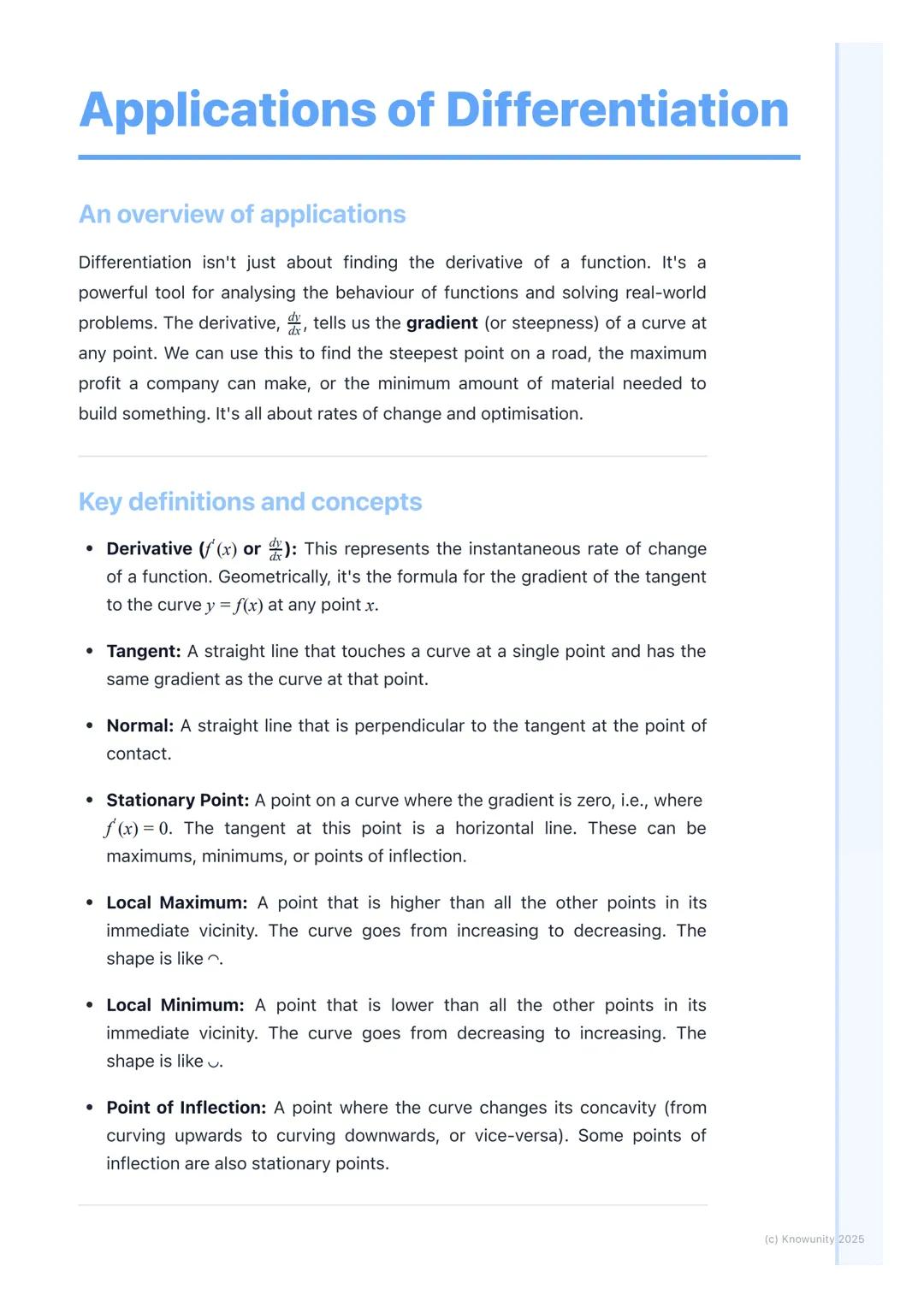
Applications Overview and Key Concepts
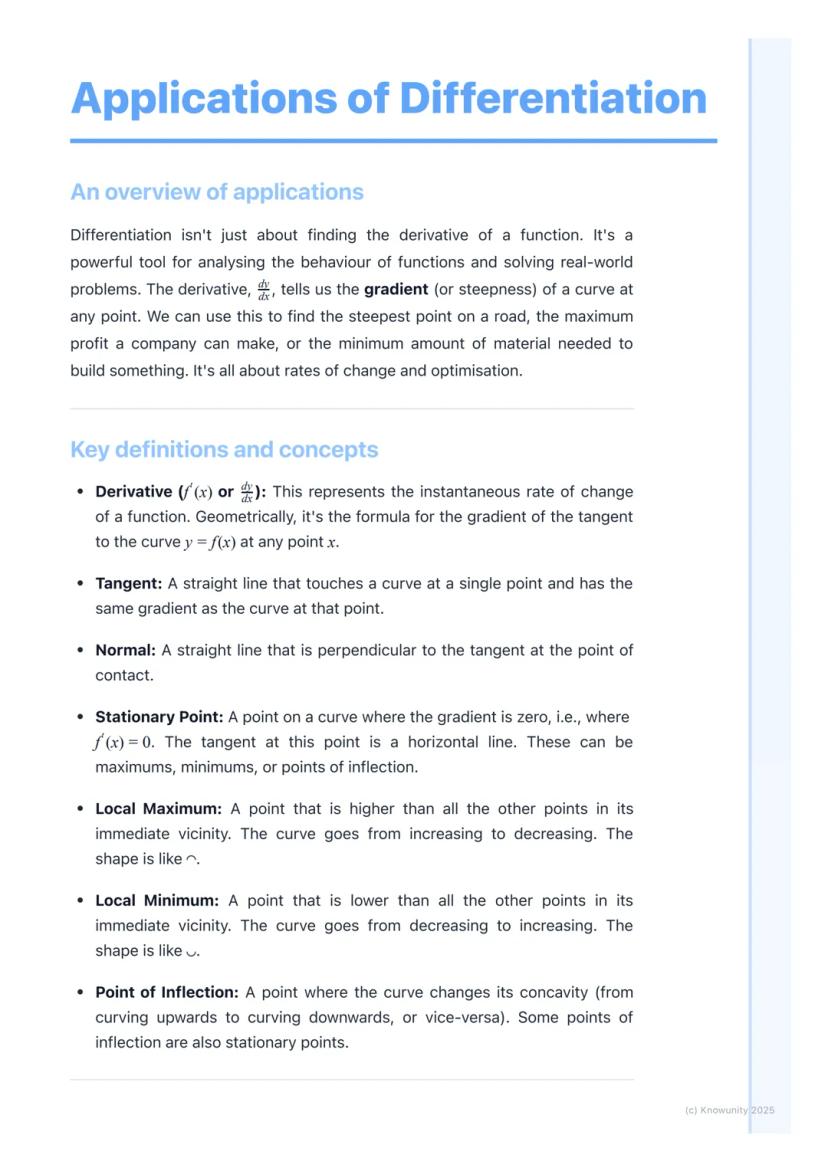
Understanding differentiation gives you the power to solve problems that matter in the real world. The derivative tells you how steep a curve is at any point, which translates to finding maximum profits, minimum costs, or optimal designs.
When you see or , you're looking at the instantaneous rate of change - basically the gradient of the tangent line at any point. This is your foundation for everything else.
Stationary points occur where , meaning the gradient is zero and you've got a horizontal tangent. These points are crucial because they're often where maximum and minimum values occur - exactly what you need for optimisation problems.
Remember: A tangent touches the curve at one point with the same gradient, while a normal is perpendicular to the tangent at that same point.
2
of 7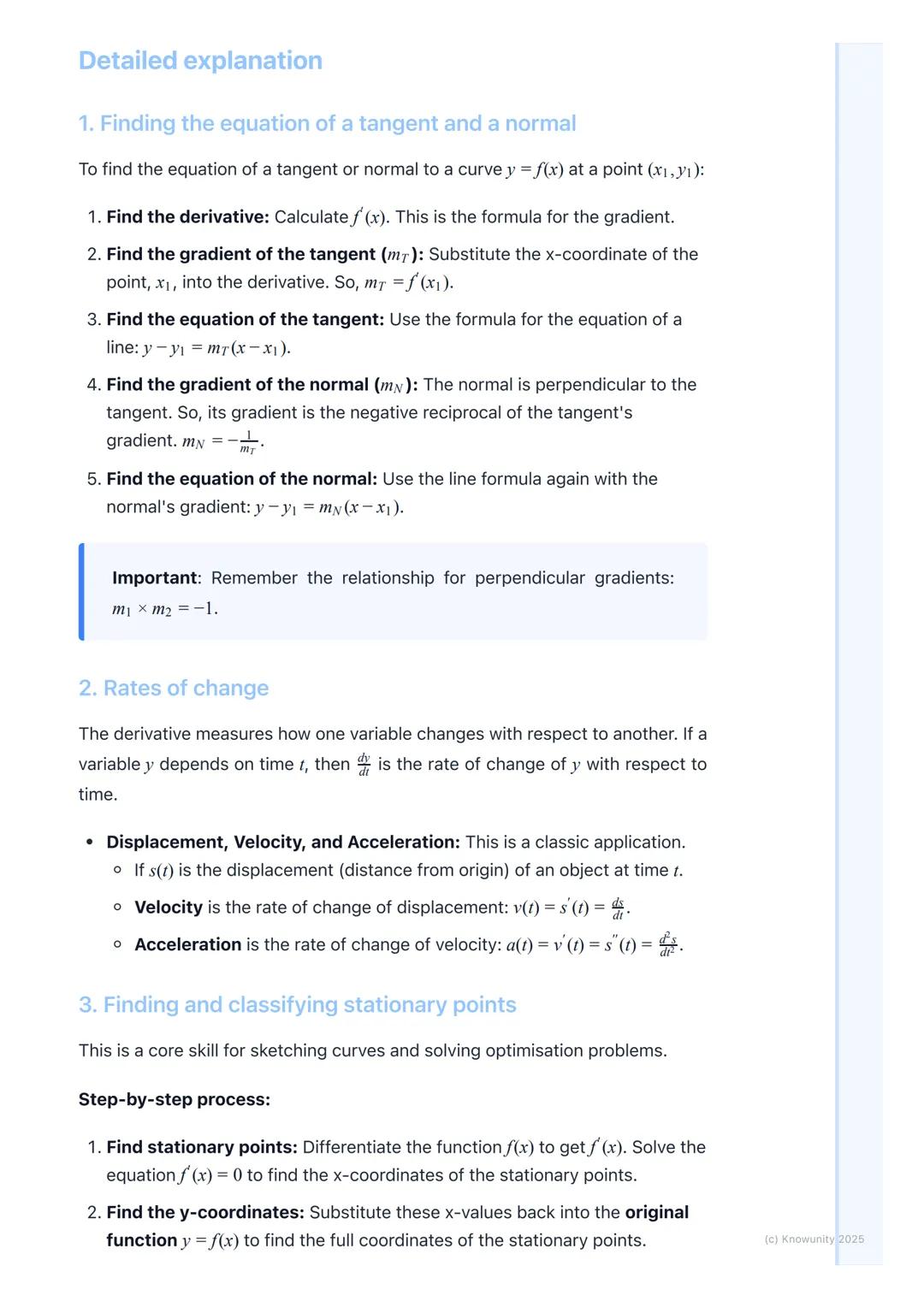
Finding Tangent and Normal Lines Plus Rates of Change
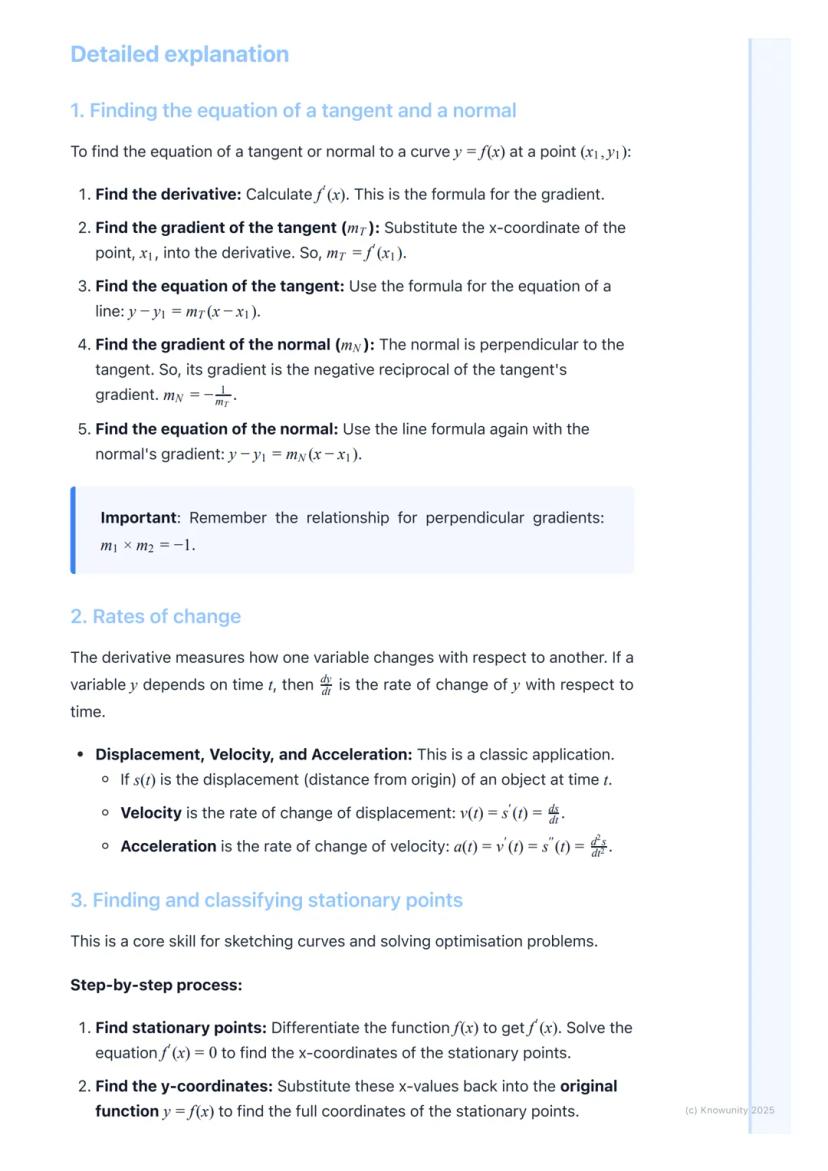
Getting the equation of a tangent follows a straightforward process: find , substitute your x-coordinate to get the gradient, then use . For the normal line, use since perpendicular lines have gradients that multiply to give -1.
Rates of change connect maths to physics beautifully. If you've got displacement , then velocity is and acceleration is . It's all about how quickly things change over time.
The real power comes when you realise that any rate of change problem follows the same pattern. Whether it's water flowing from a tank or profit changing with production levels, the derivative gives you the rate.
Top Tip: Always check your perpendicular gradients multiply to give -1 - it's an easy way to catch mistakes!
3
of 7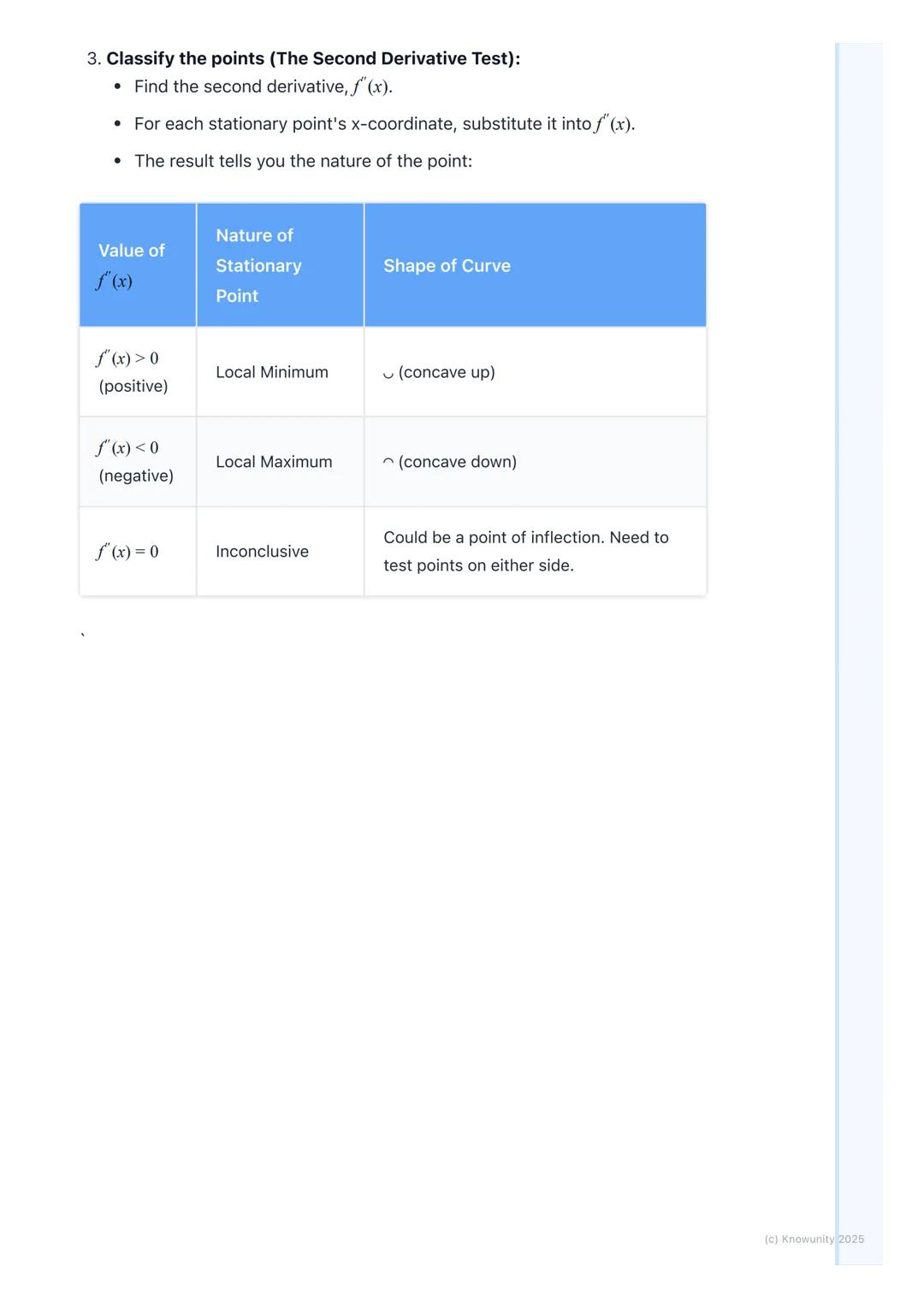
Classifying Stationary Points
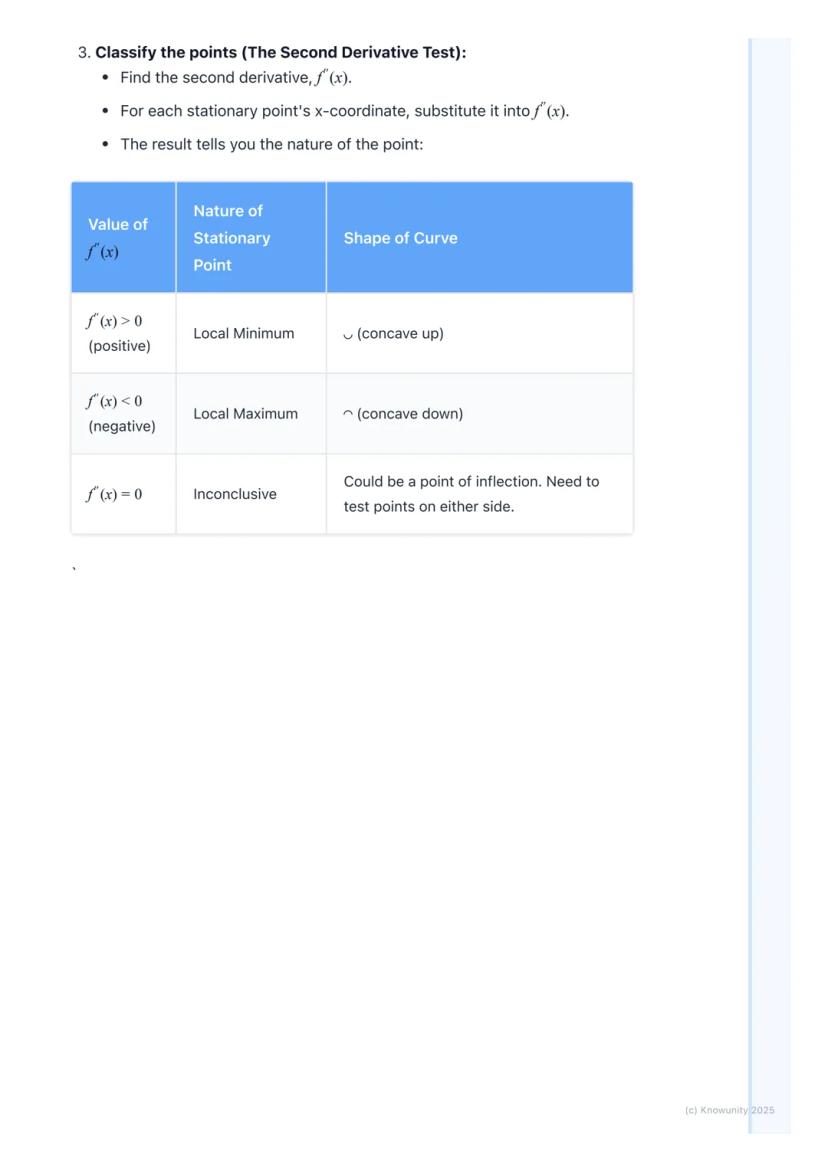
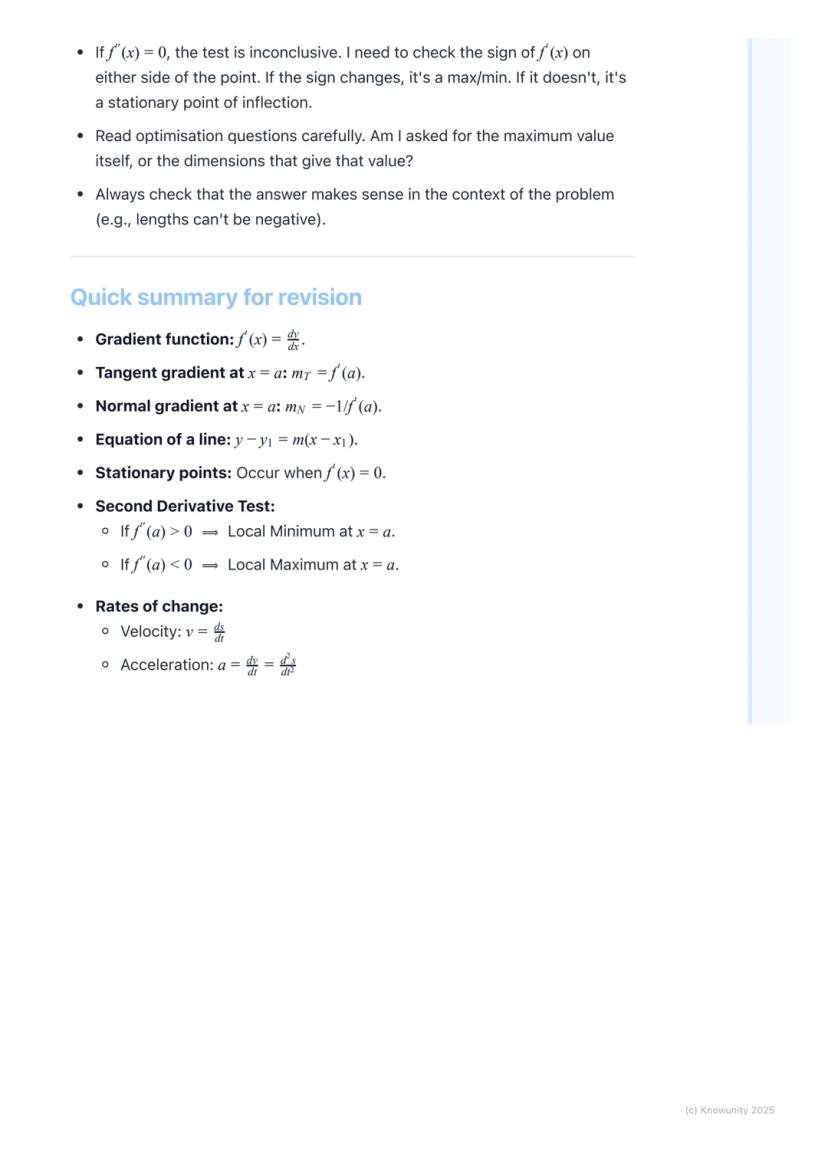
The second derivative test is your best friend for determining whether stationary points are maximums, minimums, or points of inflection. Once you've found where , substitute those x-values into .
If , you've got a local minimum - think of a smile shape. If , it's a local maximum - like a frown. When , the test is inconclusive and you'll need to check the behaviour on either side.
Points of inflection occur where the curve changes from concave up to concave down (or vice versa). These might also be stationary points, but not always.
Memory Trick: Positive second derivative = minimum (like a positive, happy smile ☺). Negative second derivative = maximum (like a negative, sad frown ☹).
4
of 7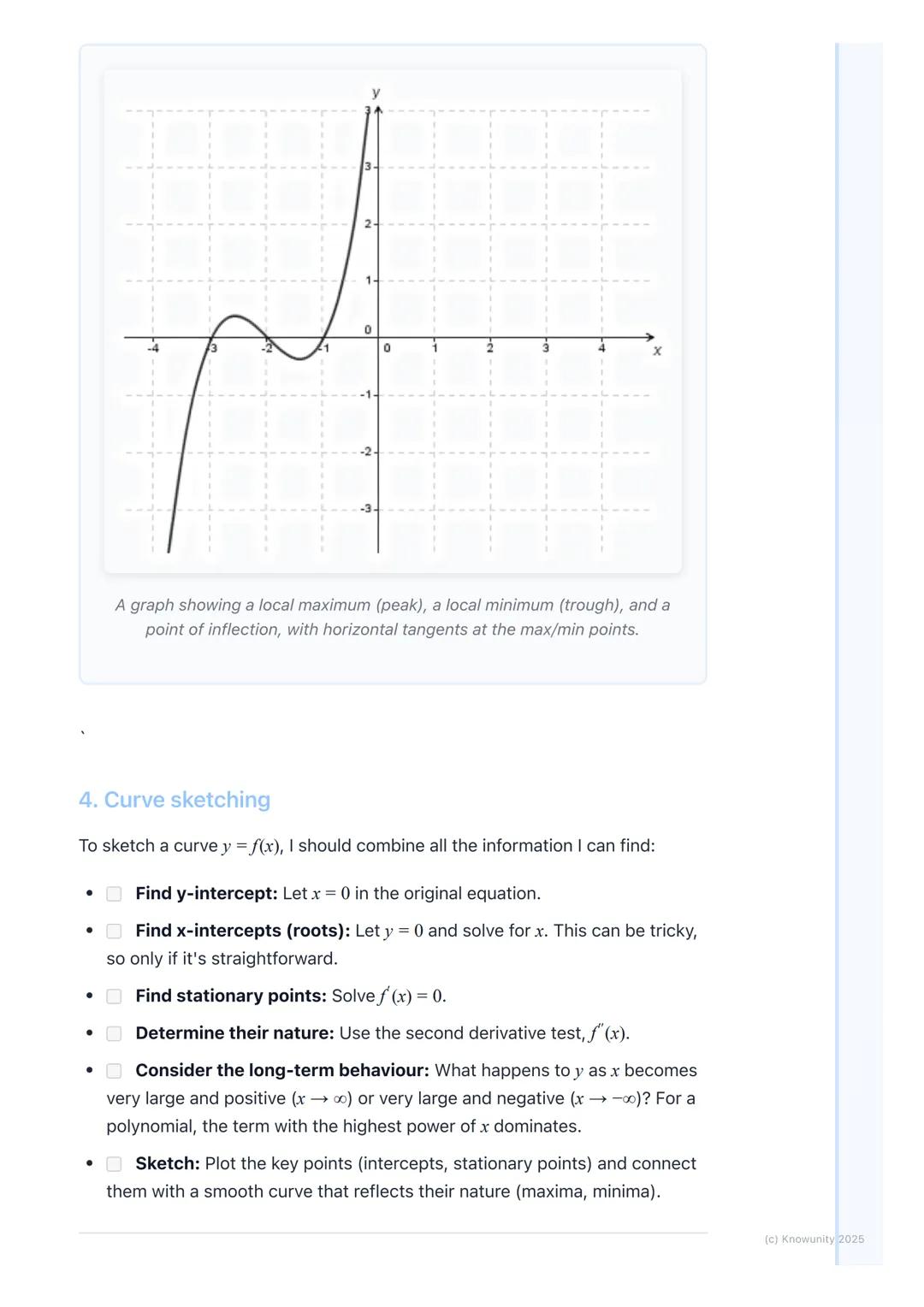
Curve Sketching Techniques
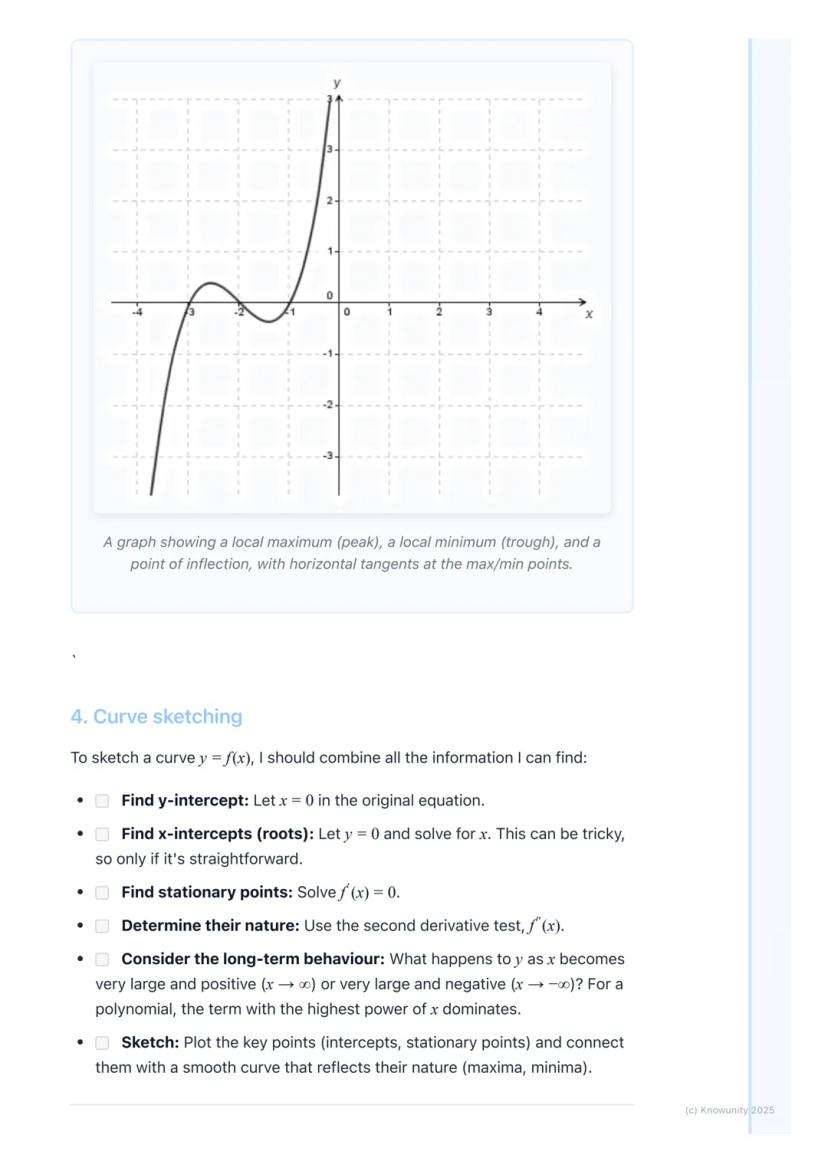
Curve sketching brings together everything you know about a function into one clear picture. Start with the y-intercept , find any obvious x-intercepts, then locate and classify all stationary points.
Consider what happens as x approaches positive and negative infinity - for polynomials, the highest power term dominates the behaviour. This tells you how the curve behaves at the extremes.
Plot your key points (intercepts and stationary points) and connect them with smooth curves that respect the nature of each point. Maximums create peaks, minimums create troughs.
Pro Tip: Always sketch a rough version first to check your curve makes sense before drawing the final version!
5
of 7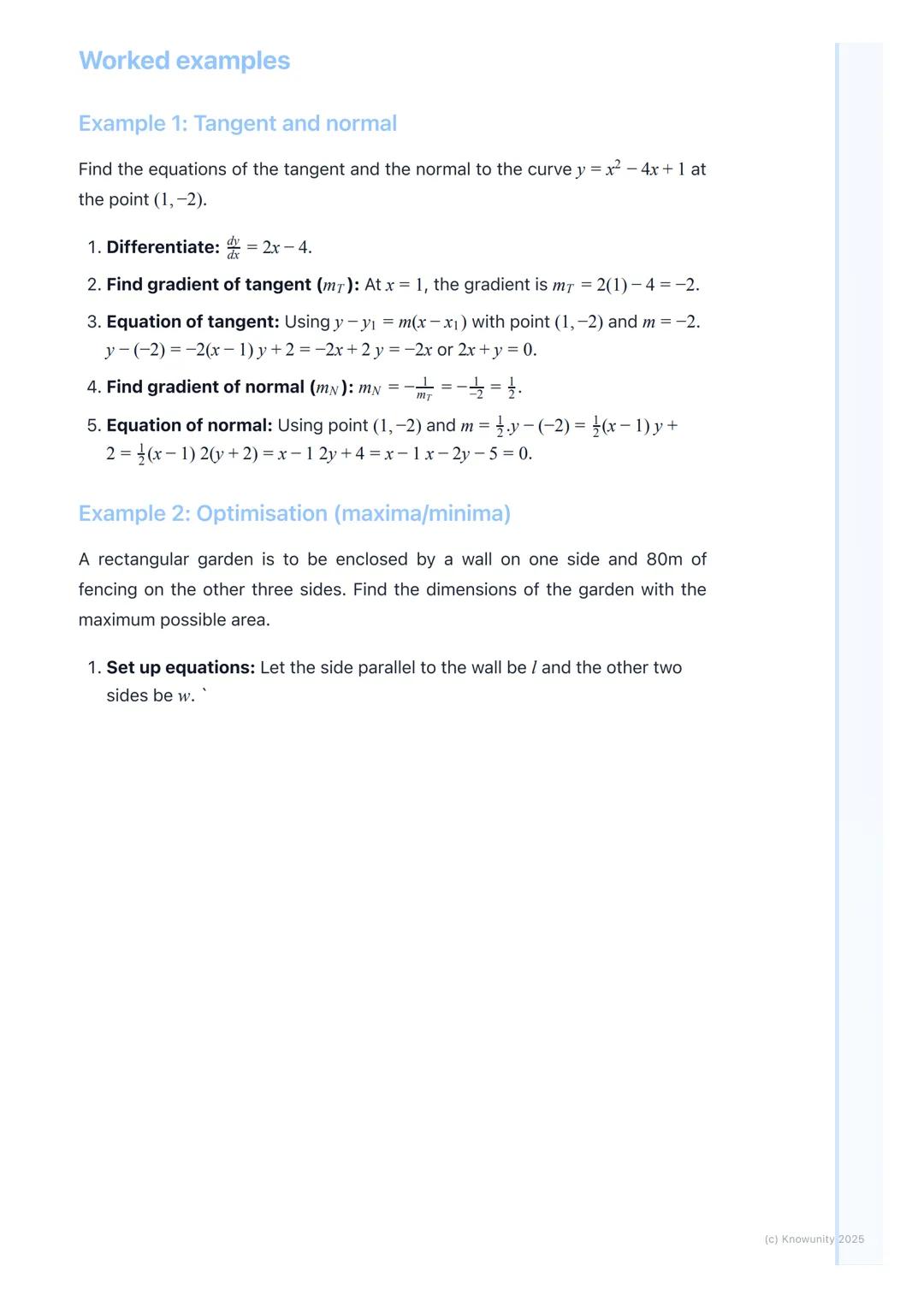
Worked Example: Tangent and Normal Lines
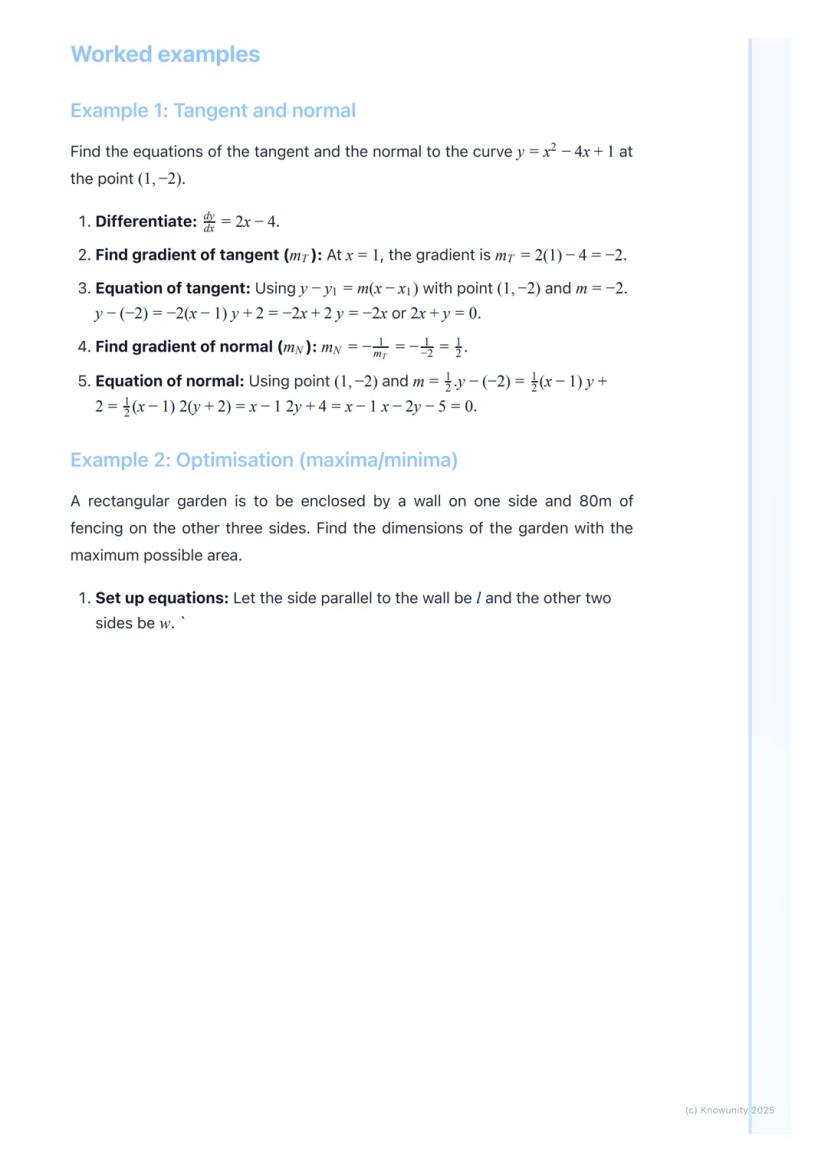
Let's work through finding tangent and normal equations for at point (1, -2). First, differentiate to get .
At x = 1, the gradient of the tangent is . Using the point-slope form: , which simplifies to $2x + y = 0$.
For the normal, the gradient is . Using the same point: , which gives us .
Check Your Work: Verify that ✓
6
of 7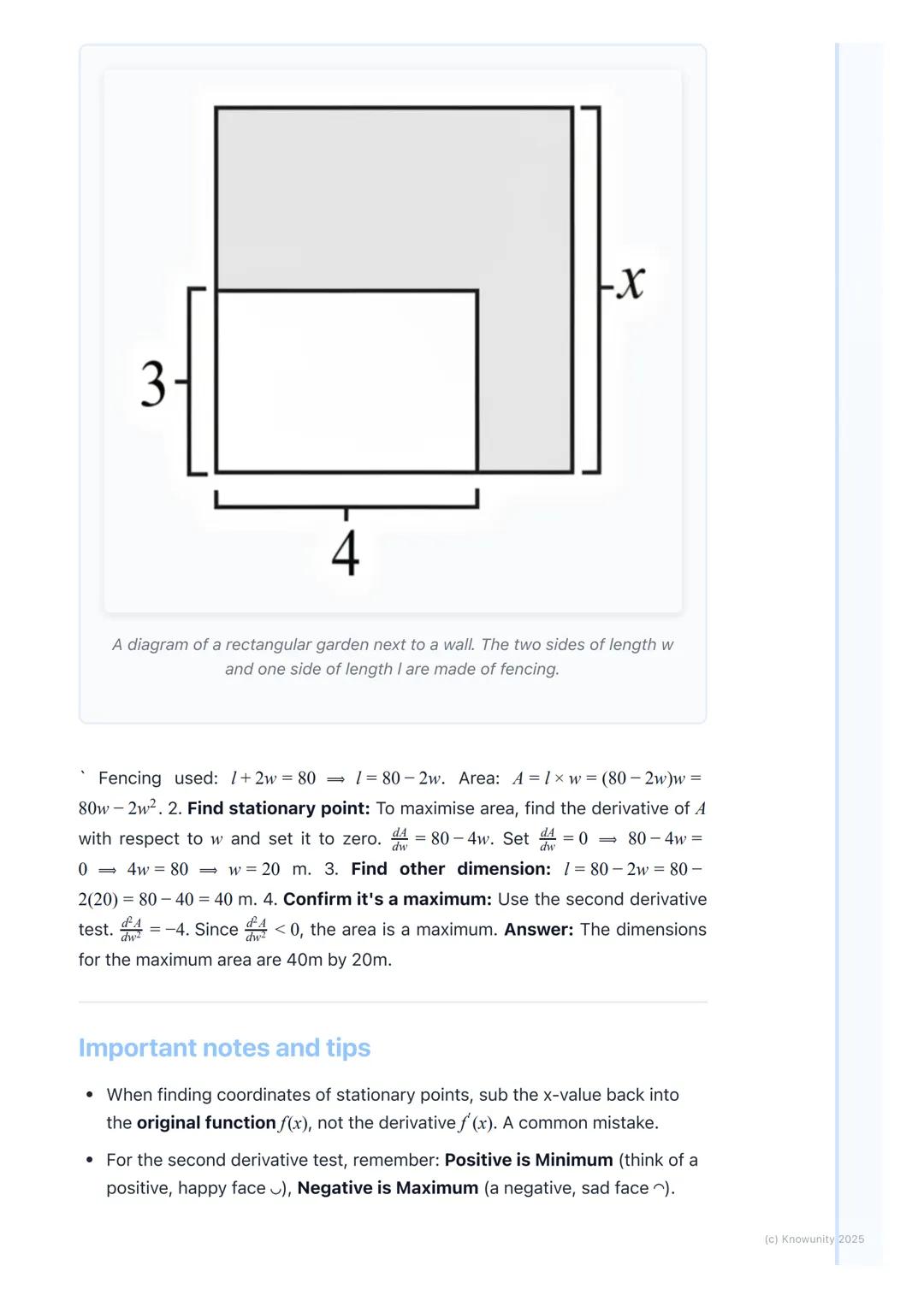
Optimisation Example: Maximum Area Problem
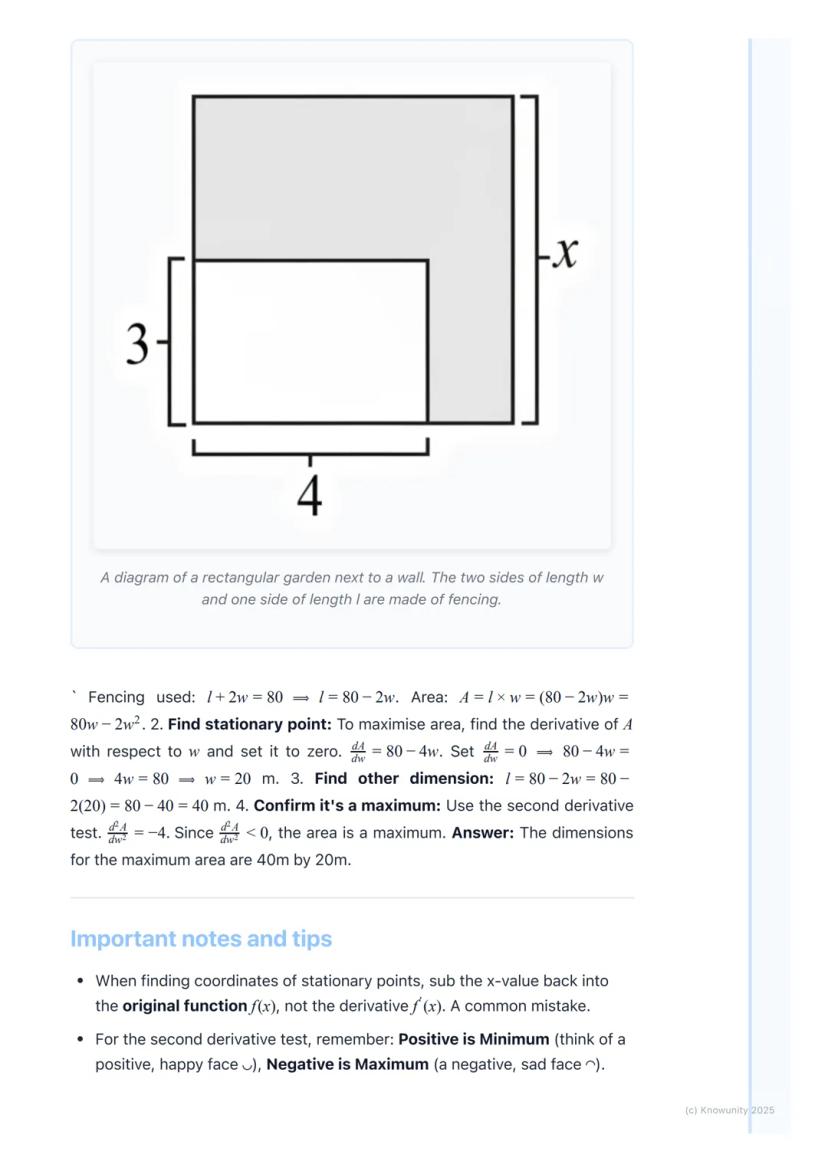
Optimisation problems are where differentiation really shines. Consider a rectangular garden against a wall, using 80m of fencing for three sides. Let the parallel side be l and the other sides be w.
Since fencing covers , we get . The area function becomes .
To maximise area, find and set it to zero: $80 - 4w = 0w = 20ml = 80 - 2(20) = 40m\frac{d^2A}{dw^2} = -4 < 0$, this confirms a maximum.
Real-World Check: Always verify your answer makes physical sense - negative dimensions would be impossible!
7
of 7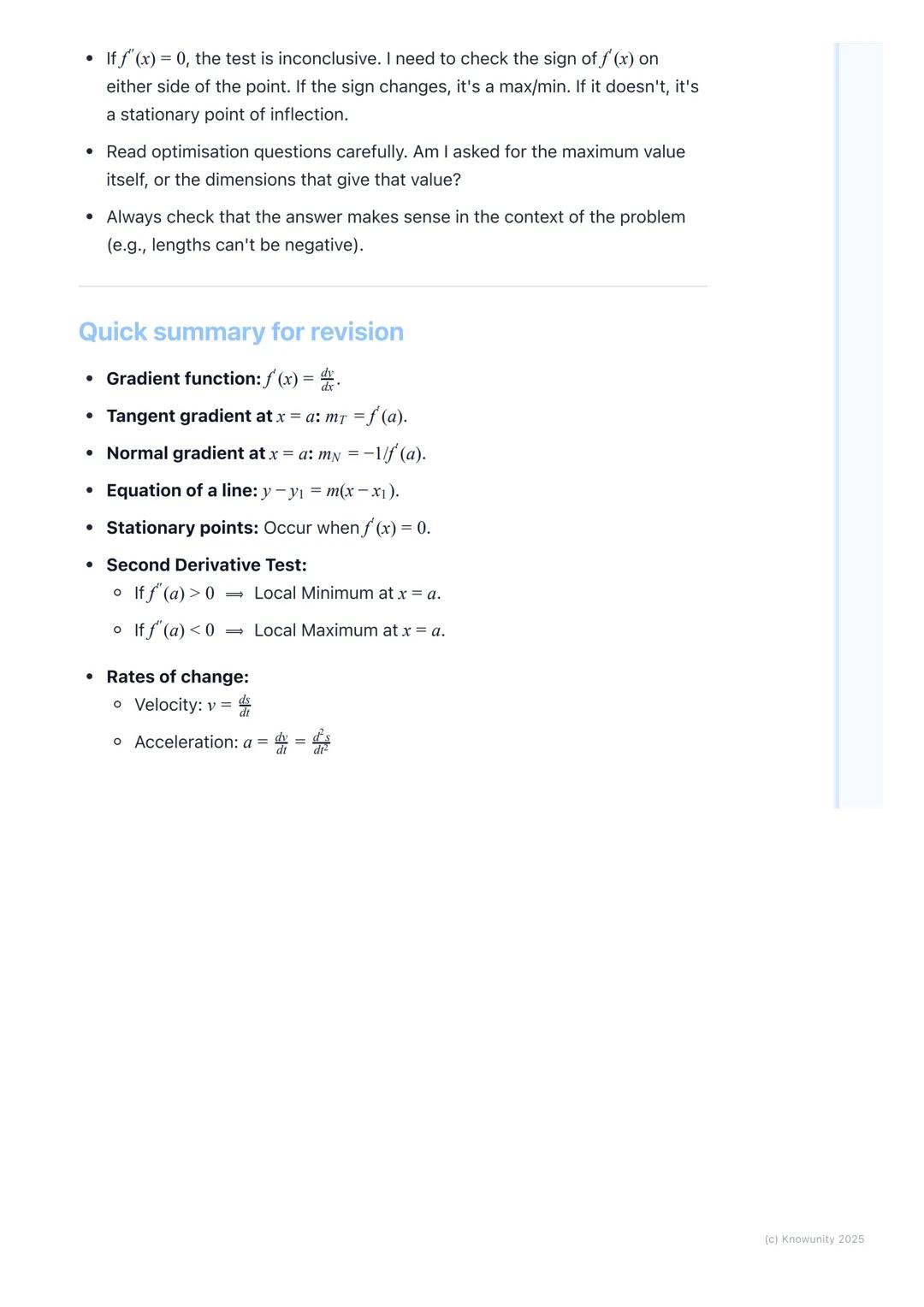
Essential Tips and Quick Reference
Common mistakes to avoid: Always substitute x-values back into the original function for coordinates, not into the derivative. When the second derivative test gives zero, check the sign of on either side of the stationary point.
Read optimisation questions carefully - are you finding the maximum value itself or the conditions that create it? Context matters enormously.
Quick reference for revision: Stationary points occur when . Use for minimums, for maximums. For motion problems: velocity is and acceleration is .
Success Strategy: Practice identifying what type of problem you're dealing with first - this determines which technique to use!
Mislili smo da nikad nećeš pitati...
Šta je Knowunity AI companion?
Naš AI Companion je AI alat fokusiran na učenike koji nudi više od samih odgovora. Napravljen na milionima Knowunity resursa, pruža relevantne informacije, personalizovane planove učenja, kvizove i sadržaj direktno u chatu, prilagođavajući se tvom individualnom putu učenja.
Gde mogu da preuzmem Knowunity aplikaciju?
Možeš preuzeti aplikaciju sa Google Play Store-a i Apple App Store-a.
Da li je Knowunity stvarno besplatan?
Tako je! Uživaj u besplatnom pristupu sadržaju za učenje, povezuj se sa drugim učenicima i dobijaj trenutnu pomoć – sve na dohvat ruke.
Najpopularniji sadržaj u Mathematics
8MathematicsAlgebra
Algebra
5th Year91
MathematicsAlgebra 2
Algebra notes focusing on the factor theorem, completing the square, -b formula, graphs of polynomials
5th Year130
MathematicsSolving Equations
This section focuses on solving one-step and two-step linear equations to find the value of an unknown variable.
1st Year131
MathematicsArithmetic sequences and series
With examples
5th Year130
MathematicsIntroduction to Probability
This topic introduces basic probability concepts, including calculating the probability of simple events and understanding the difference between experimental and theoretical probability.
2nd Year91
MathematicsMaths jc algebra
Maths jc
1st Year230
MathematicsNatural Numbers and Integers
Students will learn about positive whole numbers, zero, and negative whole numbers, and how to add, subtract, multiply, and divide them correctly.
1st Year131
MathematicsDifferential Calculus
Calculus is a topic that comes up nearly everywhere on your maths LC. This is just starter notes that could be useful end of 5th year or start of 6th year
5th Year271
Najpopularniji sadržaj
9 Irish
IrishIrish oral questions and answers
Questions and answers for the leaving cert oral
5th Year4264
 English
Key Quotes : Sive
Key Quotes and explanations: Sive
6th Year2842
IrishIrish oral questions
Outline of oral questions
5th Year2055
IrishIníon- le hÁine Durkin
Aine Durkin’s poem, Iníon: Themes & summary
5th Year890
IrishIrish poetry 2027
Iníon + Dínit an Bhróin
5th Year1153
IrishLC HL notes- Iníon (poem)
Includes poem in English and Irish, theme, key words & phrases
5th Year2304
EnglishCultural Context : Shawshank Redemption : Sive : Small Things Like These
Comparative Study : Cultural Context : Shawshank Redemption, Sive and Small Things Like These
6th Year1430
IrishMo Ghrá-sa (Idir Lúibíní)
Notes on mo ghrá-sa
5th Year380
IrishAn Gaeilge Aiste
Irish Language essay
6th Year1320
Ne možeš da nađeš ono što tražiš? Istražuj druge predmete.
Učenici nas obožavaju — i ti ćeš takođe.
4.6/5App Store
4.7/5Google Play
Aplikacija je super laka za korišćenje i odlično dizajnirana. Našao sam sve što mi je trebalo i dosta sam naučio iz prezentacija! Definitivno ću koristiti aplikaciju za školski zadatak! A naravno, pomaže i kao inspiracija.
Stefan SiOS korisnik
Ova aplikacija je stvarno odlična. Tu je toliko beleški za učenje i pomoći [...]. Na primer, problem mi je francuski, a aplikacija ima toliko opcija za pomoć. Zahvaljujući ovoj aplikaciji, poboljšao sam francuski. Preporučio bih je svima.
Samantha KlichAndroid korisnik
Vau, stvarno sam oduševljena. Probala sam aplikaciju jer sam je videla u reklamama mnogo puta i bila sam potpuno šokirana. Ova aplikacija je POMOĆ koju želiš za školu i pre svega, nudi toliko stvari, kao što su vežbe i sažeci, što mi je lično bilo VEOMA korisno.
AnaiOS korisnik
Mathematics7 pregledi·Ažurirano Jun 6, 2026·7 straniceMastering Differentiation: Tangents, Normals, and Curve Sketching
Differentiation isn't just abstract maths - it's your toolkit for solving real-world problems like finding the steepest point on a road or calculating maximum profit. You'll use derivatives to analyse how functions behave and find optimal solutions to practical situations.
1
of 7
Registruj se da vidiš sadržaj. Besplatno je!
- Pristup svim dokumentima
- Poboljšaj svoje ocene
- Pridruži se milionima učenika
Applications Overview and Key Concepts
Understanding differentiation gives you the power to solve problems that matter in the real world. The derivative tells you how steep a curve is at any point, which translates to finding maximum profits, minimum costs, or optimal designs.
When you see or , you're looking at the instantaneous rate of change - basically the gradient of the tangent line at any point. This is your foundation for everything else.
Stationary points occur where , meaning the gradient is zero and you've got a horizontal tangent. These points are crucial because they're often where maximum and minimum values occur - exactly what you need for optimisation problems.
Remember: A tangent touches the curve at one point with the same gradient, while a normal is perpendicular to the tangent at that same point.
2
of 7Registruj se da vidiš sadržaj. Besplatno je!
- Pristup svim dokumentima
- Poboljšaj svoje ocene
- Pridruži se milionima učenika
Finding Tangent and Normal Lines Plus Rates of Change
Getting the equation of a tangent follows a straightforward process: find , substitute your x-coordinate to get the gradient, then use . For the normal line, use since perpendicular lines have gradients that multiply to give -1.
Rates of change connect maths to physics beautifully. If you've got displacement , then velocity is and acceleration is . It's all about how quickly things change over time.
The real power comes when you realise that any rate of change problem follows the same pattern. Whether it's water flowing from a tank or profit changing with production levels, the derivative gives you the rate.
Top Tip: Always check your perpendicular gradients multiply to give -1 - it's an easy way to catch mistakes!
3
of 7Registruj se da vidiš sadržaj. Besplatno je!
- Pristup svim dokumentima
- Poboljšaj svoje ocene
- Pridruži se milionima učenika
Classifying Stationary Points
The second derivative test is your best friend for determining whether stationary points are maximums, minimums, or points of inflection. Once you've found where , substitute those x-values into .
If , you've got a local minimum - think of a smile shape. If , it's a local maximum - like a frown. When , the test is inconclusive and you'll need to check the behaviour on either side.
Points of inflection occur where the curve changes from concave up to concave down (or vice versa). These might also be stationary points, but not always.
Memory Trick: Positive second derivative = minimum (like a positive, happy smile ☺). Negative second derivative = maximum (like a negative, sad frown ☹).
4
of 7Registruj se da vidiš sadržaj. Besplatno je!
- Pristup svim dokumentima
- Poboljšaj svoje ocene
- Pridruži se milionima učenika
Curve Sketching Techniques
Curve sketching brings together everything you know about a function into one clear picture. Start with the y-intercept , find any obvious x-intercepts, then locate and classify all stationary points.
Consider what happens as x approaches positive and negative infinity - for polynomials, the highest power term dominates the behaviour. This tells you how the curve behaves at the extremes.
Plot your key points (intercepts and stationary points) and connect them with smooth curves that respect the nature of each point. Maximums create peaks, minimums create troughs.
Pro Tip: Always sketch a rough version first to check your curve makes sense before drawing the final version!
5
of 7Registruj se da vidiš sadržaj. Besplatno je!
- Pristup svim dokumentima
- Poboljšaj svoje ocene
- Pridruži se milionima učenika
Worked Example: Tangent and Normal Lines
Let's work through finding tangent and normal equations for at point (1, -2). First, differentiate to get .
At x = 1, the gradient of the tangent is . Using the point-slope form: , which simplifies to $2x + y = 0$.
For the normal, the gradient is . Using the same point: , which gives us .
Check Your Work: Verify that ✓
6
of 7Registruj se da vidiš sadržaj. Besplatno je!
- Pristup svim dokumentima
- Poboljšaj svoje ocene
- Pridruži se milionima učenika
Optimisation Example: Maximum Area Problem
Optimisation problems are where differentiation really shines. Consider a rectangular garden against a wall, using 80m of fencing for three sides. Let the parallel side be l and the other sides be w.
Since fencing covers , we get . The area function becomes .
To maximise area, find and set it to zero: $80 - 4w = 0w = 20ml = 80 - 2(20) = 40m\frac{d^2A}{dw^2} = -4 < 0$, this confirms a maximum.
Real-World Check: Always verify your answer makes physical sense - negative dimensions would be impossible!
7
of 7Registruj se da vidiš sadržaj. Besplatno je!
- Pristup svim dokumentima
- Poboljšaj svoje ocene
- Pridruži se milionima učenika
Essential Tips and Quick Reference
Common mistakes to avoid: Always substitute x-values back into the original function for coordinates, not into the derivative. When the second derivative test gives zero, check the sign of on either side of the stationary point.
Read optimisation questions carefully - are you finding the maximum value itself or the conditions that create it? Context matters enormously.
Quick reference for revision: Stationary points occur when . Use for minimums, for maximums. For motion problems: velocity is and acceleration is .
Success Strategy: Practice identifying what type of problem you're dealing with first - this determines which technique to use!
Mislili smo da nikad nećeš pitati...
Šta je Knowunity AI companion?
Naš AI Companion je AI alat fokusiran na učenike koji nudi više od samih odgovora. Napravljen na milionima Knowunity resursa, pruža relevantne informacije, personalizovane planove učenja, kvizove i sadržaj direktno u chatu, prilagođavajući se tvom individualnom putu učenja.
Gde mogu da preuzmem Knowunity aplikaciju?
Možeš preuzeti aplikaciju sa Google Play Store-a i Apple App Store-a.
Da li je Knowunity stvarno besplatan?
Tako je! Uživaj u besplatnom pristupu sadržaju za učenje, povezuj se sa drugim učenicima i dobijaj trenutnu pomoć – sve na dohvat ruke.
Najpopularniji sadržaj u Mathematics
8MathematicsAlgebra
Algebra
5th Year91
MathematicsAlgebra 2
Algebra notes focusing on the factor theorem, completing the square, -b formula, graphs of polynomials
5th Year130
MathematicsSolving Equations
This section focuses on solving one-step and two-step linear equations to find the value of an unknown variable.
1st Year131
MathematicsArithmetic sequences and series
With examples
5th Year130
MathematicsIntroduction to Probability
This topic introduces basic probability concepts, including calculating the probability of simple events and understanding the difference between experimental and theoretical probability.
2nd Year91
MathematicsMaths jc algebra
Maths jc
1st Year230
MathematicsNatural Numbers and Integers
Students will learn about positive whole numbers, zero, and negative whole numbers, and how to add, subtract, multiply, and divide them correctly.
1st Year131
MathematicsDifferential Calculus
Calculus is a topic that comes up nearly everywhere on your maths LC. This is just starter notes that could be useful end of 5th year or start of 6th year
5th Year271
Najpopularniji sadržaj
9IrishIrish oral questions and answers
Questions and answers for the leaving cert oral
5th Year4264
EnglishKey Quotes : Sive
Key Quotes and explanations: Sive
6th Year2842
IrishIrish oral questions
Outline of oral questions
5th Year2055
IrishIníon- le hÁine Durkin
Aine Durkin’s poem, Iníon: Themes & summary
5th Year890
IrishIrish poetry 2027
Iníon + Dínit an Bhróin
5th Year1153
IrishLC HL notes- Iníon (poem)
Includes poem in English and Irish, theme, key words & phrases
5th Year2304
EnglishCultural Context : Shawshank Redemption : Sive : Small Things Like These
Comparative Study : Cultural Context : Shawshank Redemption, Sive and Small Things Like These
6th Year1430
IrishMo Ghrá-sa (Idir Lúibíní)
Notes on mo ghrá-sa
5th Year380
IrishAn Gaeilge Aiste
Irish Language essay
6th Year1320
Ne možeš da nađeš ono što tražiš? Istražuj druge predmete.
Učenici nas obožavaju — i ti ćeš takođe.
4.6/5App Store
4.7/5Google Play
Aplikacija je super laka za korišćenje i odlično dizajnirana. Našao sam sve što mi je trebalo i dosta sam naučio iz prezentacija! Definitivno ću koristiti aplikaciju za školski zadatak! A naravno, pomaže i kao inspiracija.
Stefan SiOS korisnik
Ova aplikacija je stvarno odlična. Tu je toliko beleški za učenje i pomoći [...]. Na primer, problem mi je francuski, a aplikacija ima toliko opcija za pomoć. Zahvaljujući ovoj aplikaciji, poboljšao sam francuski. Preporučio bih je svima.
Samantha KlichAndroid korisnik
Vau, stvarno sam oduševljena. Probala sam aplikaciju jer sam je videla u reklamama mnogo puta i bila sam potpuno šokirana. Ova aplikacija je POMOĆ koju želiš za školu i pre svega, nudi toliko stvari, kao što su vežbe i sažeci, što mi je lično bilo VEOMA korisno.
AnaiOS korisnik