
Ever wondered how scientists figure out how the world works?... Prikaži više
 Science2 pregledi·Ažurirano May 17, 2026·7 stranice
Exploring the Scientific Method: Steps and Applications

1 / 7
1
of 7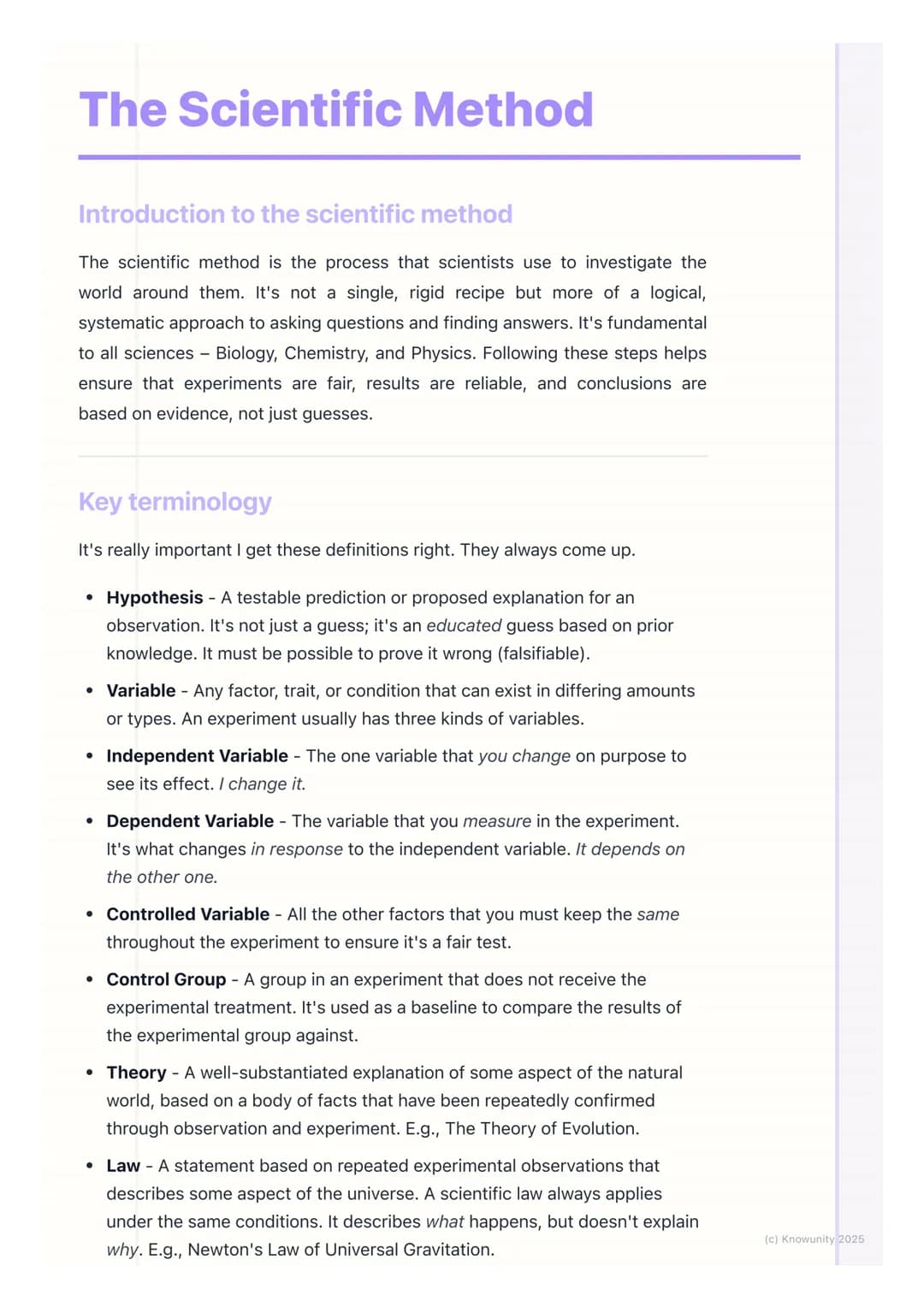
The Scientific Method Basics
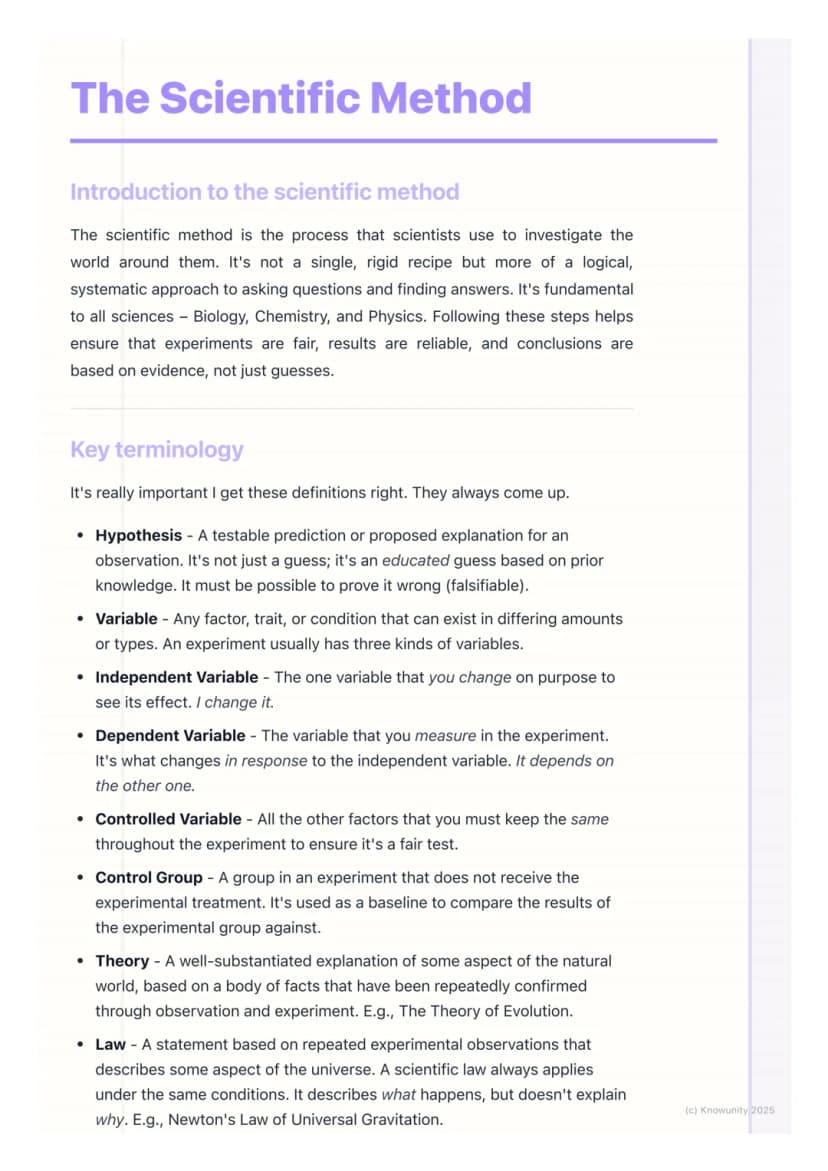
The scientific method isn't some rigid set of rules - it's more like a logical way of asking questions and finding reliable answers. Scientists use this approach in Biology, Chemistry, and Physics to make sure their experiments are fair and their results actually mean something.
Think of it as detective work for science. Instead of just guessing why something happens, scientists follow specific steps to gather evidence and draw conclusions. This systematic approach helps separate facts from opinions and ensures that scientific discoveries are based on solid proof, not just hunches.
Key Point: The scientific method helps ensure experiments are fair, results are reliable, and conclusions are based on evidence rather than guesses.
2
of 7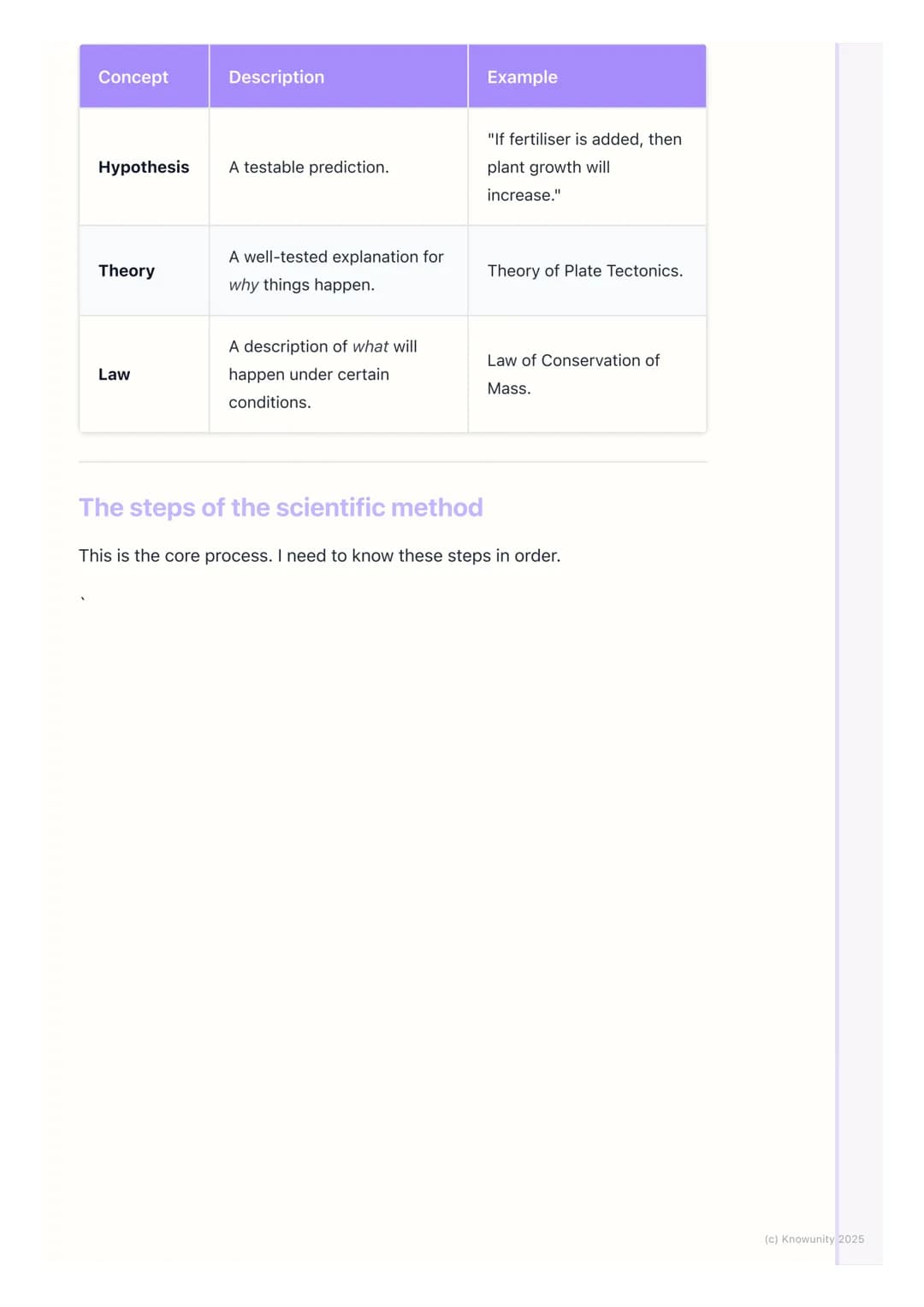
Essential Scientific Terms You Need to Know
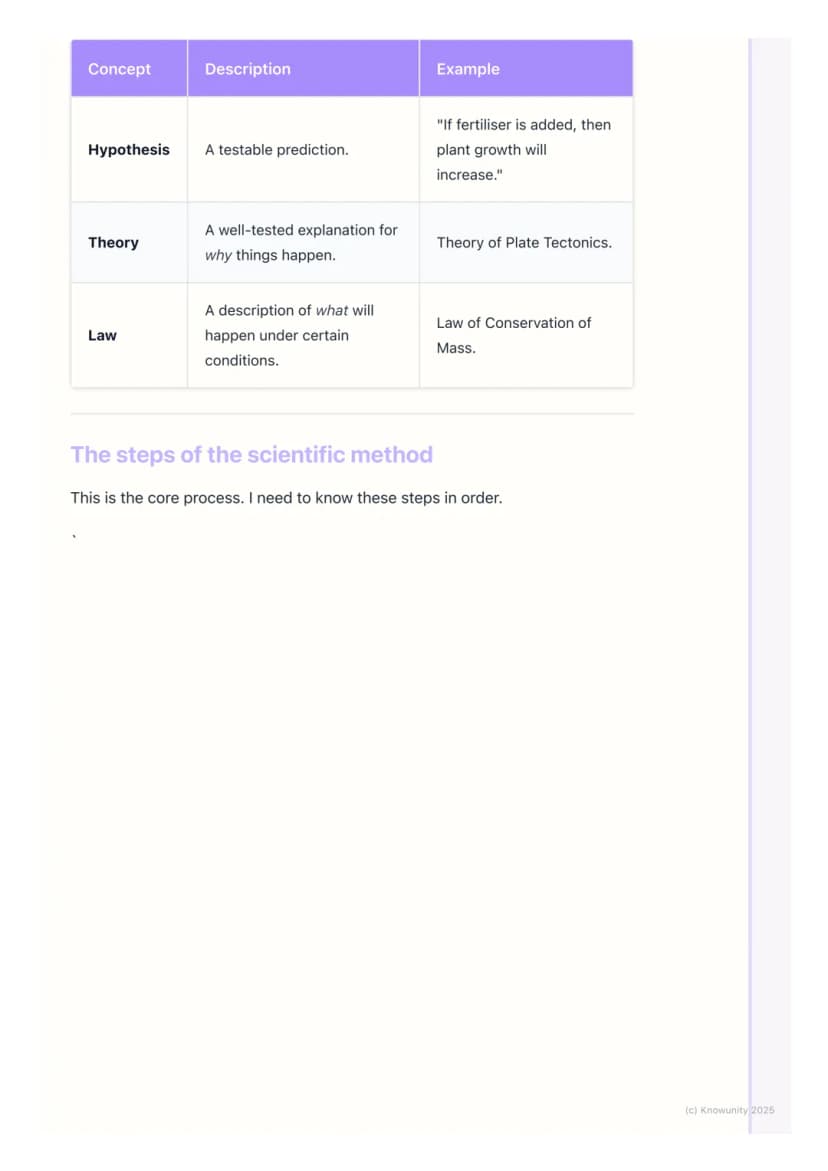
Let's sort out the key vocabulary that always pops up in exams. A hypothesis is your educated guess about what might happen - but it has to be testable. Think "If I do X, then Y will happen."
Variables are the different factors in your experiment. The independent variable is what you deliberately change (like adding fertiliser), the dependent variable is what you measure as a result (like plant height), and controlled variables are everything else you keep exactly the same to make it fair.
Here's where students often get confused: a theory (like Evolution) is a well-tested explanation backed by loads of evidence, whilst a law (like gravity) simply describes what happens without explaining why. A control group gets no treatment - it's your baseline for comparison.
Remember: A hypothesis must be falsifiable - there must be a way to prove it wrong through experimentation.
3
of 7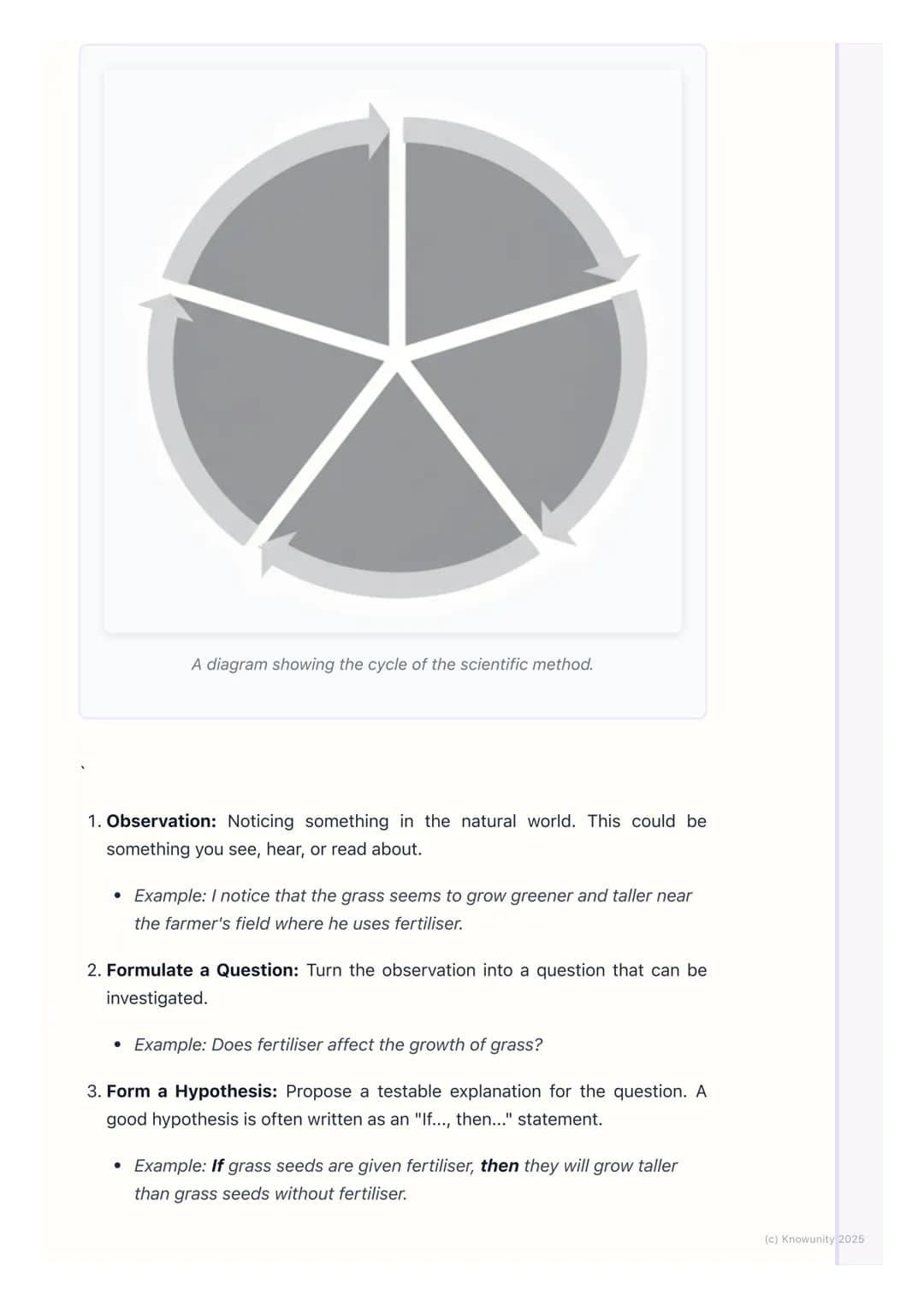
The Seven Steps in Action
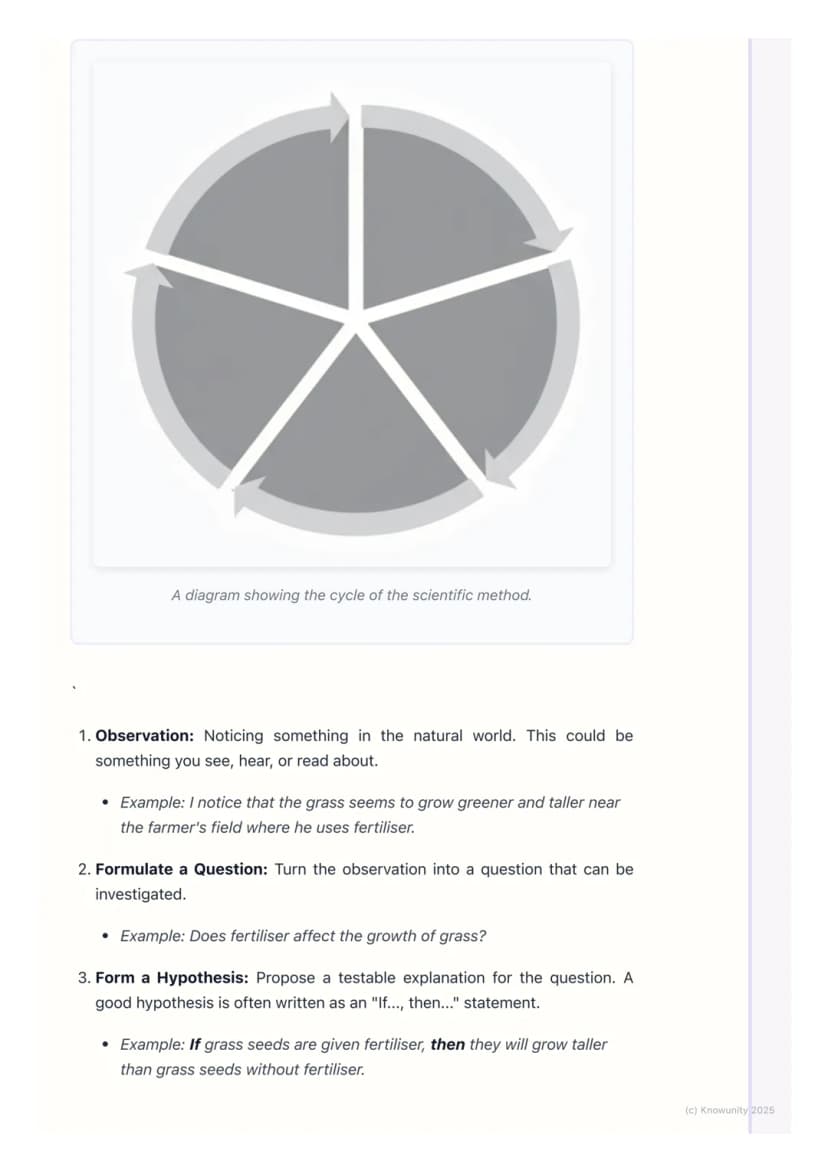
The scientific method follows a logical sequence that starts with simple observation. You notice something interesting in the world around you - maybe grass grows better near a farmer's field.
Next, you formulate a question that can actually be investigated: "Does fertiliser affect grass growth?" Then comes your hypothesis - your testable prediction written as an "If... then..." statement: "If grass gets fertiliser, then it will grow taller than grass without fertiliser."
This systematic approach ensures you're not just randomly experimenting but following a logical path from curiosity to evidence-based conclusions.
Pro Tip: Good hypotheses are specific, measurable, and written in "If... then..." format to make testing straightforward.
4
of 7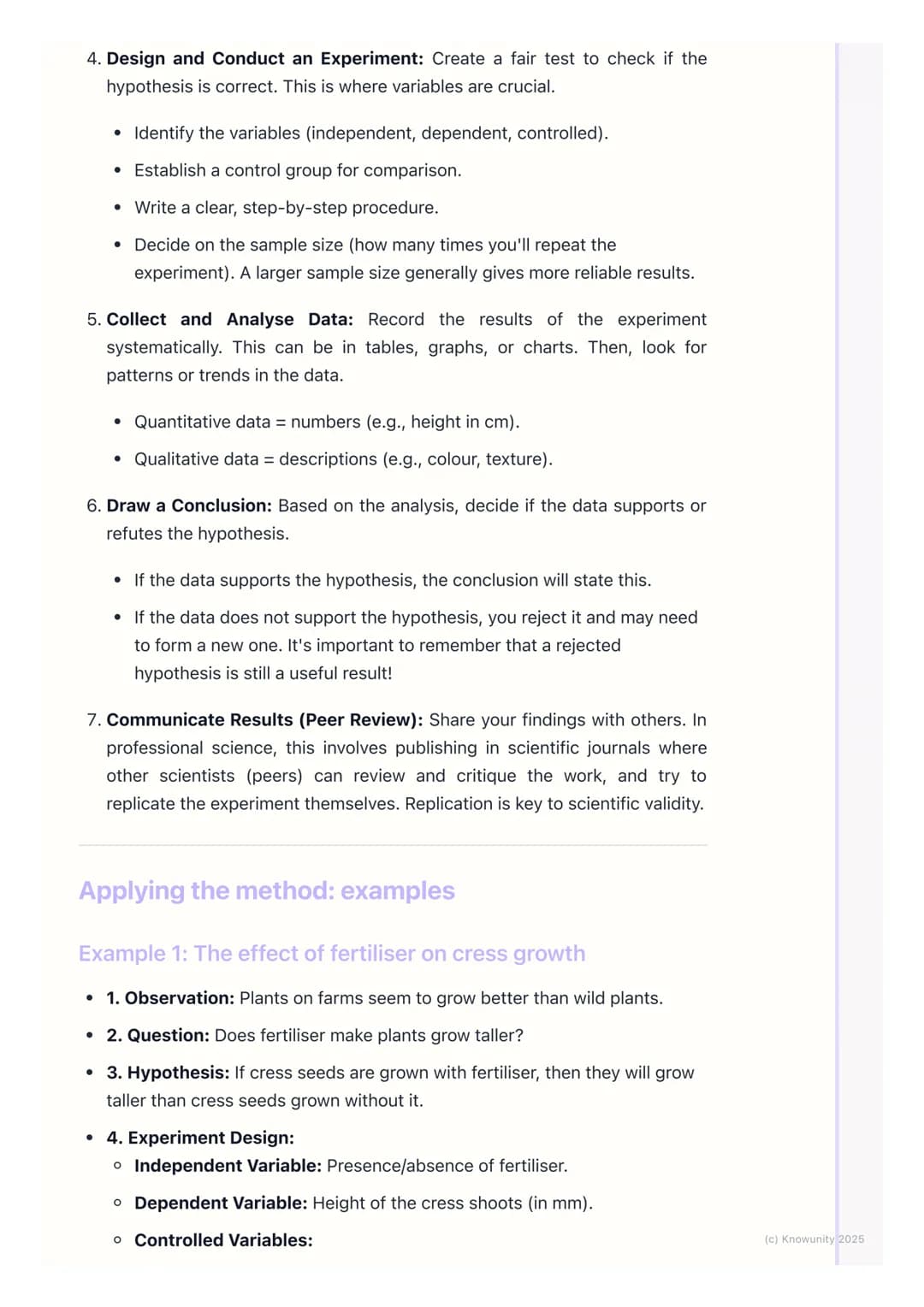
Designing and Conducting Fair Experiments
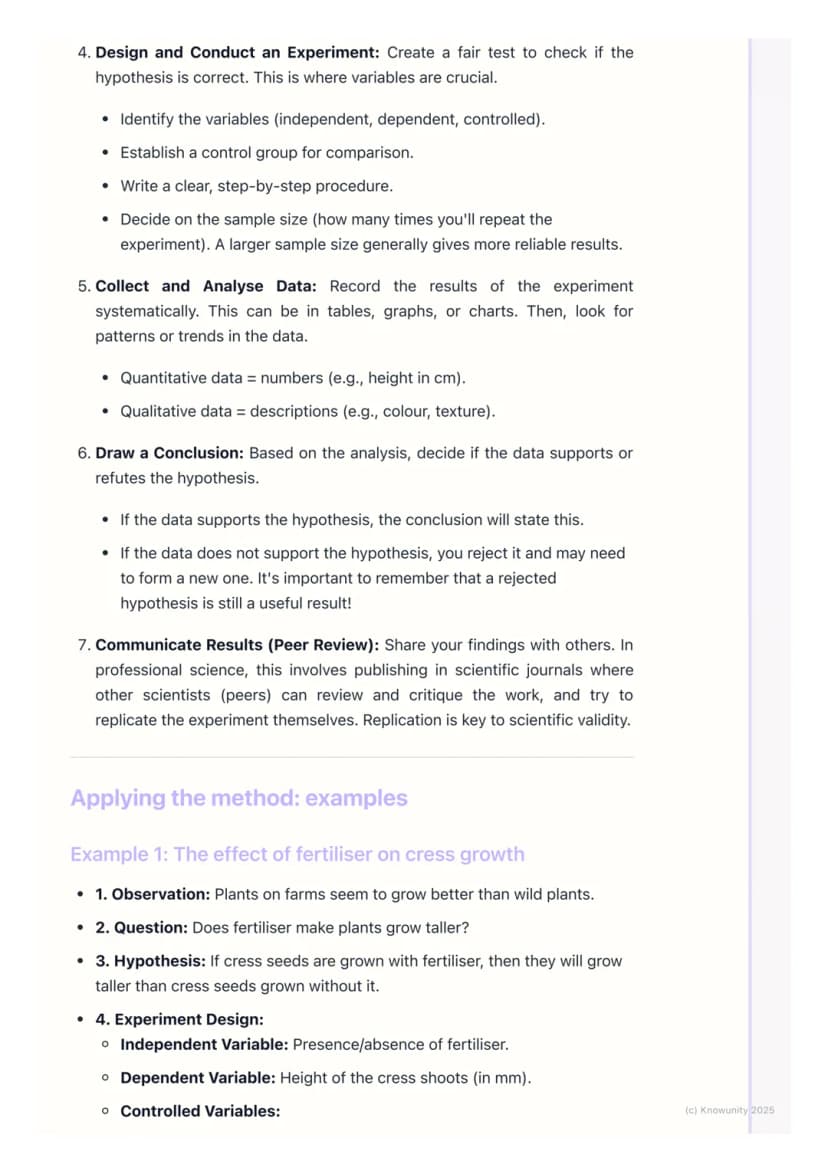
Now for the practical bit - designing your experiment. You need to identify your variables clearly, set up a control group for comparison, and write a step-by-step procedure that someone else could follow exactly.
Sample size matters here - testing one plant won't give reliable results, but testing 50 plants and averaging the results will. The bigger your sample, the more trustworthy your conclusions become.
When you collect and analyse data, you're looking for patterns. Quantitative data gives you numbers (height in cm), whilst qualitative data gives you descriptions (colour changes). Both types can be valuable depending on what you're investigating.
Fair Test Rule: Only change ONE variable at a time - if you change light AND fertiliser, you won't know which one caused the effect!
5
of 7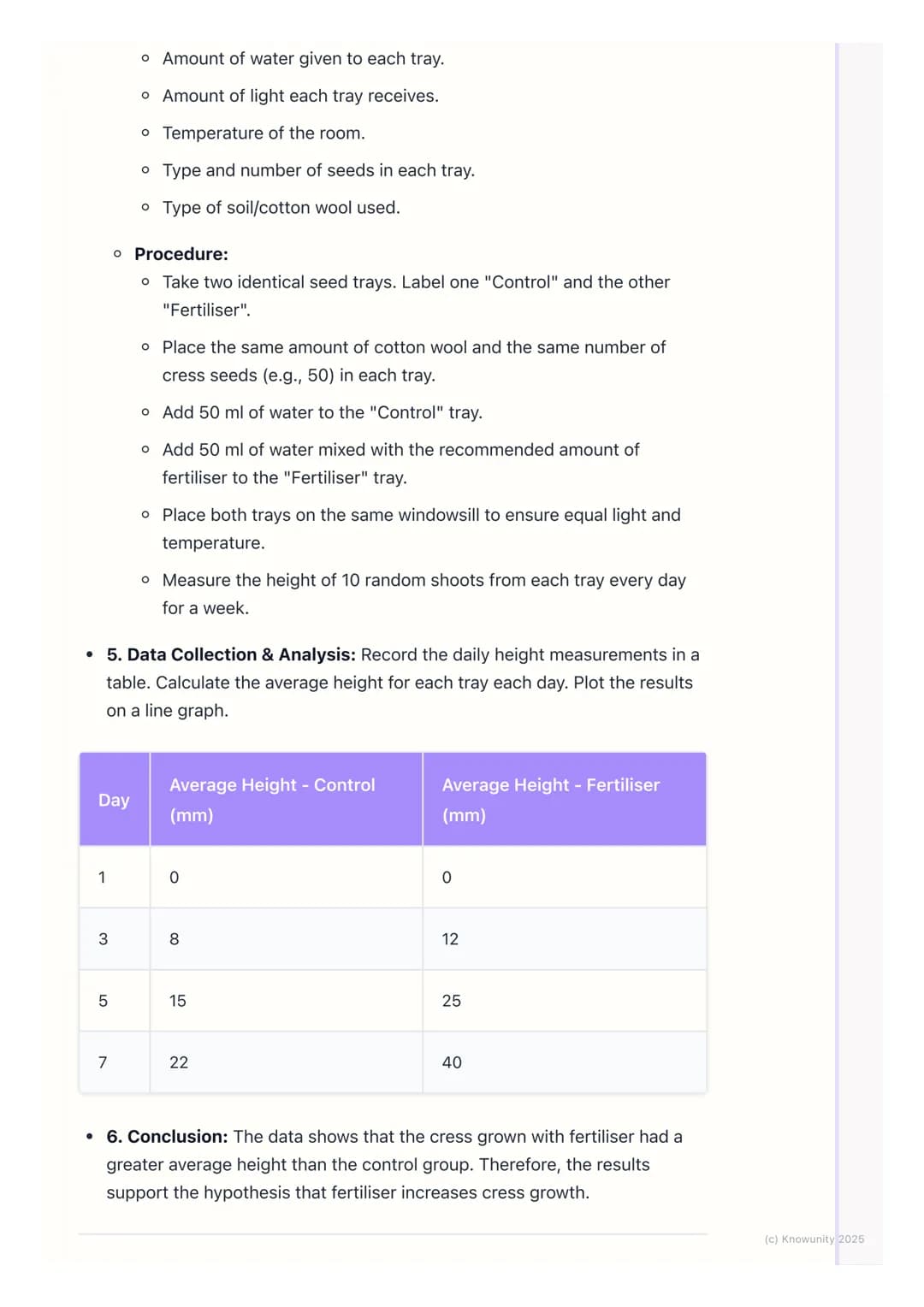
Drawing Conclusions and Real Examples
After analysing your data, it's time to draw conclusions. If your results support your hypothesis, brilliant! If they don't, that's still valuable - you've learned something important and can form a new hypothesis.
The final step is communicating your results through peer review, where other scientists can check your work and try to replicate your experiment. Replication is crucial in science.
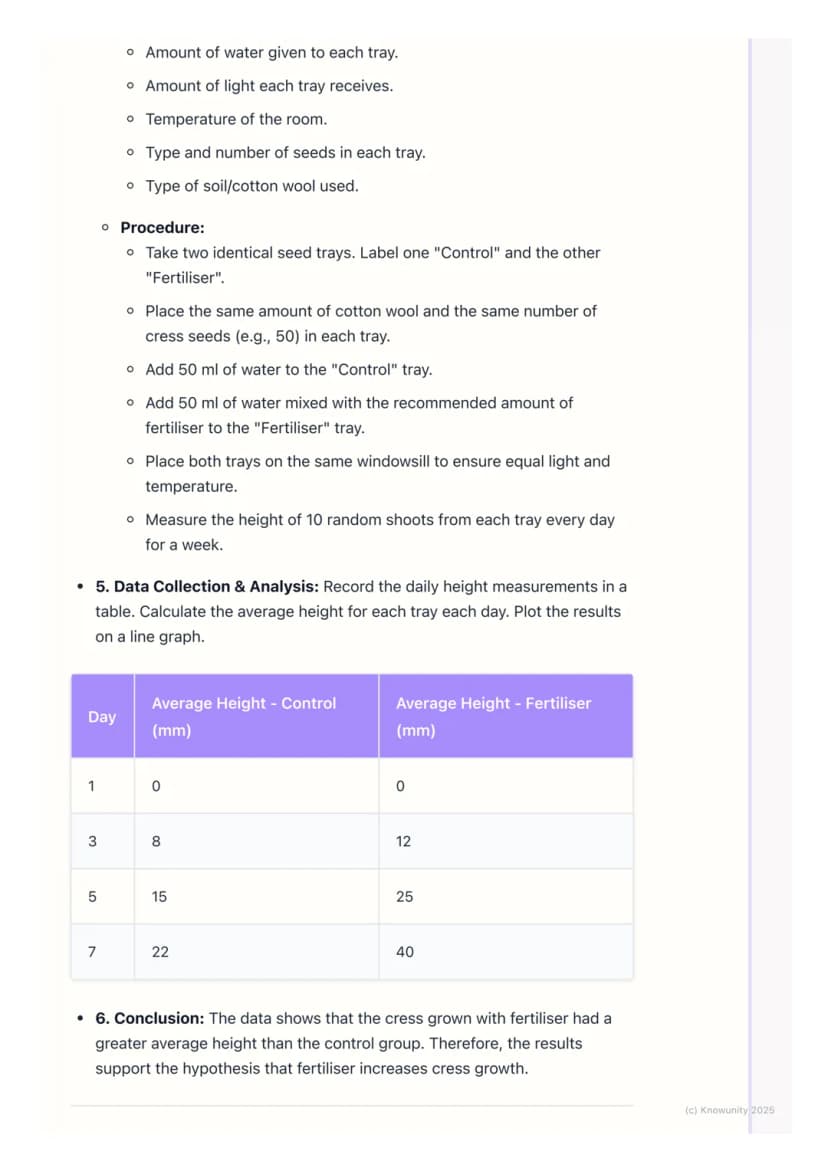
Here's a practical example: testing fertiliser on cress. You'd have two identical trays - one control (water only) and one experimental . Keep everything else the same: same light, temperature, soil, and number of seeds. Measure growth daily and compare the averages.
Key Insight: A rejected hypothesis is still a useful result - it eliminates one possibility and guides future investigations.
6
of 7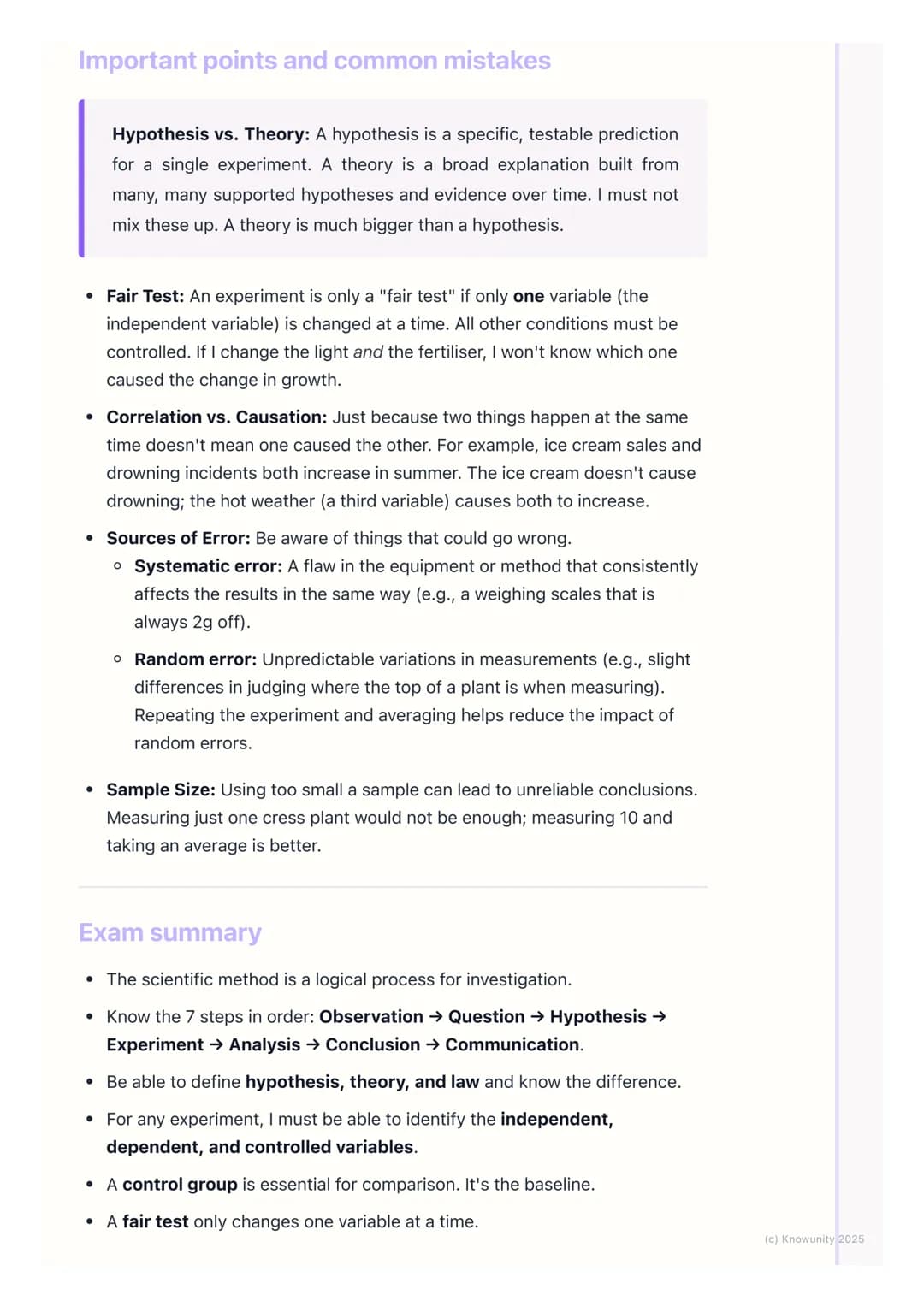
Common Mistakes and Important Distinctions
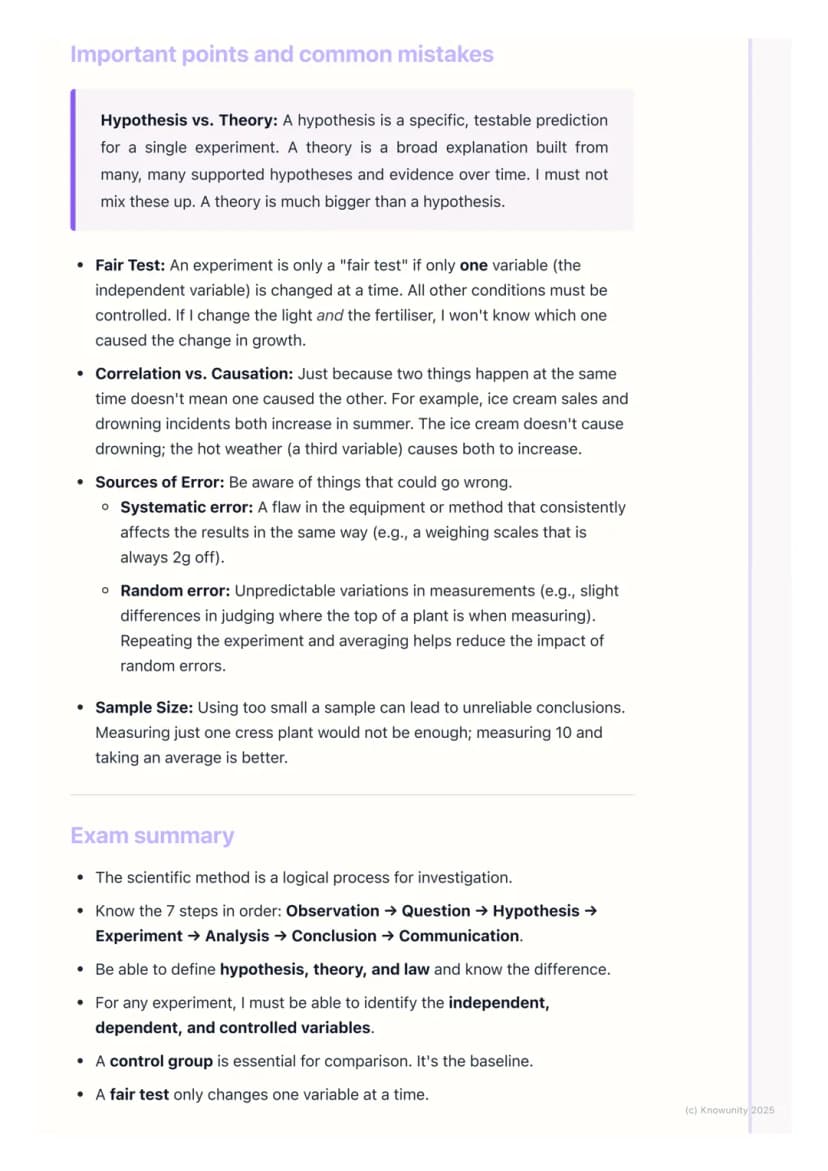
Don't mix up correlation and causation - just because ice cream sales and drowning both increase in summer doesn't mean ice cream causes drowning! Hot weather causes both increases.
Systematic errors happen when your equipment is consistently wrong (like scales that are always 2g off), whilst random errors are unpredictable variations. Repeating experiments and averaging results helps reduce random errors.
Remember the hierarchy: hypothesis → theory → law. A hypothesis is a single testable prediction, a theory is a broad explanation built from many supported hypotheses over time, and a law describes what happens without explaining why.
Exam Success: Always identify independent, dependent, and controlled variables in any experiment question - this is guaranteed to come up!
7
of 7
Exam Summary Points
For your exams, nail down these essentials: know the seven steps in order (Observation → Question → Hypothesis → Experiment → Analysis → Conclusion → Communication), and be able to spot variables in any experimental setup.
Remember that control groups are your baseline for comparison, fair tests only change one variable at a time, and conclusions must stick strictly to the evidence you've collected. Replication by other scientists is what makes results trustworthy in the scientific community.
The scientific method isn't just academic theory - it's the foundation of how we understand everything from medicine to climate change. Master these concepts and you'll have the tools to think like a scientist.
Final Tip: Practice identifying variables in different scenarios - this skill transfers across all science subjects and exam questions.
Mislili smo da nikad nećeš pitati...
Šta je Knowunity AI companion?
Naš AI Companion je AI alat fokusiran na učenike koji nudi više od samih odgovora. Napravljen na milionima Knowunity resursa, pruža relevantne informacije, personalizovane planove učenja, kvizove i sadržaj direktno u chatu, prilagođavajući se tvom individualnom putu učenja.
Gde mogu da preuzmem Knowunity aplikaciju?
Možeš preuzeti aplikaciju sa Google Play Store-a i Apple App Store-a.
Da li je Knowunity stvarno besplatan?
Tako je! Uživaj u besplatnom pristupu sadržaju za učenje, povezuj se sa drugim učenicima i dobijaj trenutnu pomoć – sve na dohvat ruke.
Najpopularniji sadržaj u Science
5ScienceHuman Reproductive System
A basic overview of the male and female reproductive systems, including their main structures and functions.
TY191
ScienceJunior Cert Science Notes: The Cell
Notes on the Cell
3rd Year221
ScienceCells
Junior cert science cells summary
1st Year591
ScienceHuman Body Systems
An introduction to major human body systems such as the digestive, circulatory, respiratory, and nervous systems, understanding their basic functions.
2nd Year131
ScienceAtomic Structure and the Periodic Table
Students will learn about the structure of atoms, including protons, neutrons, and electrons, and how elements are organised and classified in the Periodic Table based on their electronic configuration and chemical properties.
5th Year41
Najpopularniji sadržaj
9 Irish
IrishIrish oral questions and answers
Questions and answers for the leaving cert oral
5th Year4254
IrishIrish oral questions
Outline of oral questions
5th Year2055
IrishIníon- le hÁine Durkin
Aine Durkin’s poem, Iníon: Themes & summary
5th Year850
 English
Key Quotes : Sive
Key Quotes and explanations: Sive
6th Year2822
IrishIrish poetry 2027
Iníon + Dínit an Bhróin
5th Year1133
IrishLC HL notes- Iníon (poem)
Includes poem in English and Irish, theme, key words & phrases
5th Year2284
IrishGaeilge Grammar Office
All the basics you need to know on Irish grammar.
6th Year1013
IrishMo Ghrá-sa (Idir Lúibíní)
Notes on mo ghrá-sa
5th Year350
IrishAn Gaeilge Aiste
Irish Language essay
6th Year1290
Ne možeš da nađeš ono što tražiš? Istražuj druge predmete.
Učenici nas obožavaju — i ti ćeš takođe.
4.6/5App Store
4.7/5Google Play
Aplikacija je super laka za korišćenje i odlično dizajnirana. Našao sam sve što mi je trebalo i dosta sam naučio iz prezentacija! Definitivno ću koristiti aplikaciju za školski zadatak! A naravno, pomaže i kao inspiracija.
Stefan SiOS korisnik
Ova aplikacija je stvarno odlična. Tu je toliko beleški za učenje i pomoći [...]. Na primer, problem mi je francuski, a aplikacija ima toliko opcija za pomoć. Zahvaljujući ovoj aplikaciji, poboljšao sam francuski. Preporučio bih je svima.
Samantha KlichAndroid korisnik
Vau, stvarno sam oduševljena. Probala sam aplikaciju jer sam je videla u reklamama mnogo puta i bila sam potpuno šokirana. Ova aplikacija je POMOĆ koju želiš za školu i pre svega, nudi toliko stvari, kao što su vežbe i sažeci, što mi je lično bilo VEOMA korisno.
AnaiOS korisnik
Science2 pregledi·Ažurirano May 17, 2026·7 straniceExploring the Scientific Method: Steps and Applications
Ever wondered how scientists figure out how the world works? The scientific method is basically a step-by-step recipe that scientists use to investigate everything around us - and it's not as complicated as you might think!
1
of 7Registruj se da vidiš sadržaj. Besplatno je!
- Pristup svim dokumentima
- Poboljšaj svoje ocene
- Pridruži se milionima učenika
The Scientific Method Basics
The scientific method isn't some rigid set of rules - it's more like a logical way of asking questions and finding reliable answers. Scientists use this approach in Biology, Chemistry, and Physics to make sure their experiments are fair and their results actually mean something.
Think of it as detective work for science. Instead of just guessing why something happens, scientists follow specific steps to gather evidence and draw conclusions. This systematic approach helps separate facts from opinions and ensures that scientific discoveries are based on solid proof, not just hunches.
Key Point: The scientific method helps ensure experiments are fair, results are reliable, and conclusions are based on evidence rather than guesses.
2
of 7Registruj se da vidiš sadržaj. Besplatno je!
- Pristup svim dokumentima
- Poboljšaj svoje ocene
- Pridruži se milionima učenika
Essential Scientific Terms You Need to Know
Let's sort out the key vocabulary that always pops up in exams. A hypothesis is your educated guess about what might happen - but it has to be testable. Think "If I do X, then Y will happen."
Variables are the different factors in your experiment. The independent variable is what you deliberately change (like adding fertiliser), the dependent variable is what you measure as a result (like plant height), and controlled variables are everything else you keep exactly the same to make it fair.
Here's where students often get confused: a theory (like Evolution) is a well-tested explanation backed by loads of evidence, whilst a law (like gravity) simply describes what happens without explaining why. A control group gets no treatment - it's your baseline for comparison.
Remember: A hypothesis must be falsifiable - there must be a way to prove it wrong through experimentation.
3
of 7Registruj se da vidiš sadržaj. Besplatno je!
- Pristup svim dokumentima
- Poboljšaj svoje ocene
- Pridruži se milionima učenika
The Seven Steps in Action
The scientific method follows a logical sequence that starts with simple observation. You notice something interesting in the world around you - maybe grass grows better near a farmer's field.
Next, you formulate a question that can actually be investigated: "Does fertiliser affect grass growth?" Then comes your hypothesis - your testable prediction written as an "If... then..." statement: "If grass gets fertiliser, then it will grow taller than grass without fertiliser."
This systematic approach ensures you're not just randomly experimenting but following a logical path from curiosity to evidence-based conclusions.
Pro Tip: Good hypotheses are specific, measurable, and written in "If... then..." format to make testing straightforward.
4
of 7Registruj se da vidiš sadržaj. Besplatno je!
- Pristup svim dokumentima
- Poboljšaj svoje ocene
- Pridruži se milionima učenika
Designing and Conducting Fair Experiments
Now for the practical bit - designing your experiment. You need to identify your variables clearly, set up a control group for comparison, and write a step-by-step procedure that someone else could follow exactly.
Sample size matters here - testing one plant won't give reliable results, but testing 50 plants and averaging the results will. The bigger your sample, the more trustworthy your conclusions become.
When you collect and analyse data, you're looking for patterns. Quantitative data gives you numbers (height in cm), whilst qualitative data gives you descriptions (colour changes). Both types can be valuable depending on what you're investigating.
Fair Test Rule: Only change ONE variable at a time - if you change light AND fertiliser, you won't know which one caused the effect!
5
of 7Registruj se da vidiš sadržaj. Besplatno je!
- Pristup svim dokumentima
- Poboljšaj svoje ocene
- Pridruži se milionima učenika
Drawing Conclusions and Real Examples
After analysing your data, it's time to draw conclusions. If your results support your hypothesis, brilliant! If they don't, that's still valuable - you've learned something important and can form a new hypothesis.
The final step is communicating your results through peer review, where other scientists can check your work and try to replicate your experiment. Replication is crucial in science.
Here's a practical example: testing fertiliser on cress. You'd have two identical trays - one control (water only) and one experimental . Keep everything else the same: same light, temperature, soil, and number of seeds. Measure growth daily and compare the averages.
Key Insight: A rejected hypothesis is still a useful result - it eliminates one possibility and guides future investigations.
6
of 7Registruj se da vidiš sadržaj. Besplatno je!
- Pristup svim dokumentima
- Poboljšaj svoje ocene
- Pridruži se milionima učenika
Common Mistakes and Important Distinctions
Don't mix up correlation and causation - just because ice cream sales and drowning both increase in summer doesn't mean ice cream causes drowning! Hot weather causes both increases.
Systematic errors happen when your equipment is consistently wrong (like scales that are always 2g off), whilst random errors are unpredictable variations. Repeating experiments and averaging results helps reduce random errors.
Remember the hierarchy: hypothesis → theory → law. A hypothesis is a single testable prediction, a theory is a broad explanation built from many supported hypotheses over time, and a law describes what happens without explaining why.
Exam Success: Always identify independent, dependent, and controlled variables in any experiment question - this is guaranteed to come up!
7
of 7Registruj se da vidiš sadržaj. Besplatno je!
- Pristup svim dokumentima
- Poboljšaj svoje ocene
- Pridruži se milionima učenika
Exam Summary Points
For your exams, nail down these essentials: know the seven steps in order (Observation → Question → Hypothesis → Experiment → Analysis → Conclusion → Communication), and be able to spot variables in any experimental setup.
Remember that control groups are your baseline for comparison, fair tests only change one variable at a time, and conclusions must stick strictly to the evidence you've collected. Replication by other scientists is what makes results trustworthy in the scientific community.
The scientific method isn't just academic theory - it's the foundation of how we understand everything from medicine to climate change. Master these concepts and you'll have the tools to think like a scientist.
Final Tip: Practice identifying variables in different scenarios - this skill transfers across all science subjects and exam questions.
Mislili smo da nikad nećeš pitati...
Šta je Knowunity AI companion?
Naš AI Companion je AI alat fokusiran na učenike koji nudi više od samih odgovora. Napravljen na milionima Knowunity resursa, pruža relevantne informacije, personalizovane planove učenja, kvizove i sadržaj direktno u chatu, prilagođavajući se tvom individualnom putu učenja.
Gde mogu da preuzmem Knowunity aplikaciju?
Možeš preuzeti aplikaciju sa Google Play Store-a i Apple App Store-a.
Da li je Knowunity stvarno besplatan?
Tako je! Uživaj u besplatnom pristupu sadržaju za učenje, povezuj se sa drugim učenicima i dobijaj trenutnu pomoć – sve na dohvat ruke.
Najpopularniji sadržaj u Science
5ScienceHuman Reproductive System
A basic overview of the male and female reproductive systems, including their main structures and functions.
TY191
ScienceJunior Cert Science Notes: The Cell
Notes on the Cell
3rd Year221
ScienceCells
Junior cert science cells summary
1st Year591
ScienceHuman Body Systems
An introduction to major human body systems such as the digestive, circulatory, respiratory, and nervous systems, understanding their basic functions.
2nd Year131
ScienceAtomic Structure and the Periodic Table
Students will learn about the structure of atoms, including protons, neutrons, and electrons, and how elements are organised and classified in the Periodic Table based on their electronic configuration and chemical properties.
5th Year41
Najpopularniji sadržaj
9IrishIrish oral questions and answers
Questions and answers for the leaving cert oral
5th Year4254
IrishIrish oral questions
Outline of oral questions
5th Year2055
IrishIníon- le hÁine Durkin
Aine Durkin’s poem, Iníon: Themes & summary
5th Year850
EnglishKey Quotes : Sive
Key Quotes and explanations: Sive
6th Year2822
IrishIrish poetry 2027
Iníon + Dínit an Bhróin
5th Year1133
IrishLC HL notes- Iníon (poem)
Includes poem in English and Irish, theme, key words & phrases
5th Year2284
IrishGaeilge Grammar Office
All the basics you need to know on Irish grammar.
6th Year1013
IrishMo Ghrá-sa (Idir Lúibíní)
Notes on mo ghrá-sa
5th Year350
IrishAn Gaeilge Aiste
Irish Language essay
6th Year1290
Ne možeš da nađeš ono što tražiš? Istražuj druge predmete.
Učenici nas obožavaju — i ti ćeš takođe.
4.6/5App Store
4.7/5Google Play
Aplikacija je super laka za korišćenje i odlično dizajnirana. Našao sam sve što mi je trebalo i dosta sam naučio iz prezentacija! Definitivno ću koristiti aplikaciju za školski zadatak! A naravno, pomaže i kao inspiracija.
Stefan SiOS korisnik
Ova aplikacija je stvarno odlična. Tu je toliko beleški za učenje i pomoći [...]. Na primer, problem mi je francuski, a aplikacija ima toliko opcija za pomoć. Zahvaljujući ovoj aplikaciji, poboljšao sam francuski. Preporučio bih je svima.
Samantha KlichAndroid korisnik
Vau, stvarno sam oduševljena. Probala sam aplikaciju jer sam je videla u reklamama mnogo puta i bila sam potpuno šokirana. Ova aplikacija je POMOĆ koju želiš za školu i pre svega, nudi toliko stvari, kao što su vežbe i sažeci, što mi je lično bilo VEOMA korisno.
AnaiOS korisnik