
Learning to describe your local area in Spanish is essential...
 Spanish2 pregledi·Ažurirano Jun 7, 2026·6 stranice
Exploring Local Amenities and Attractions

1 / 6
1
of 6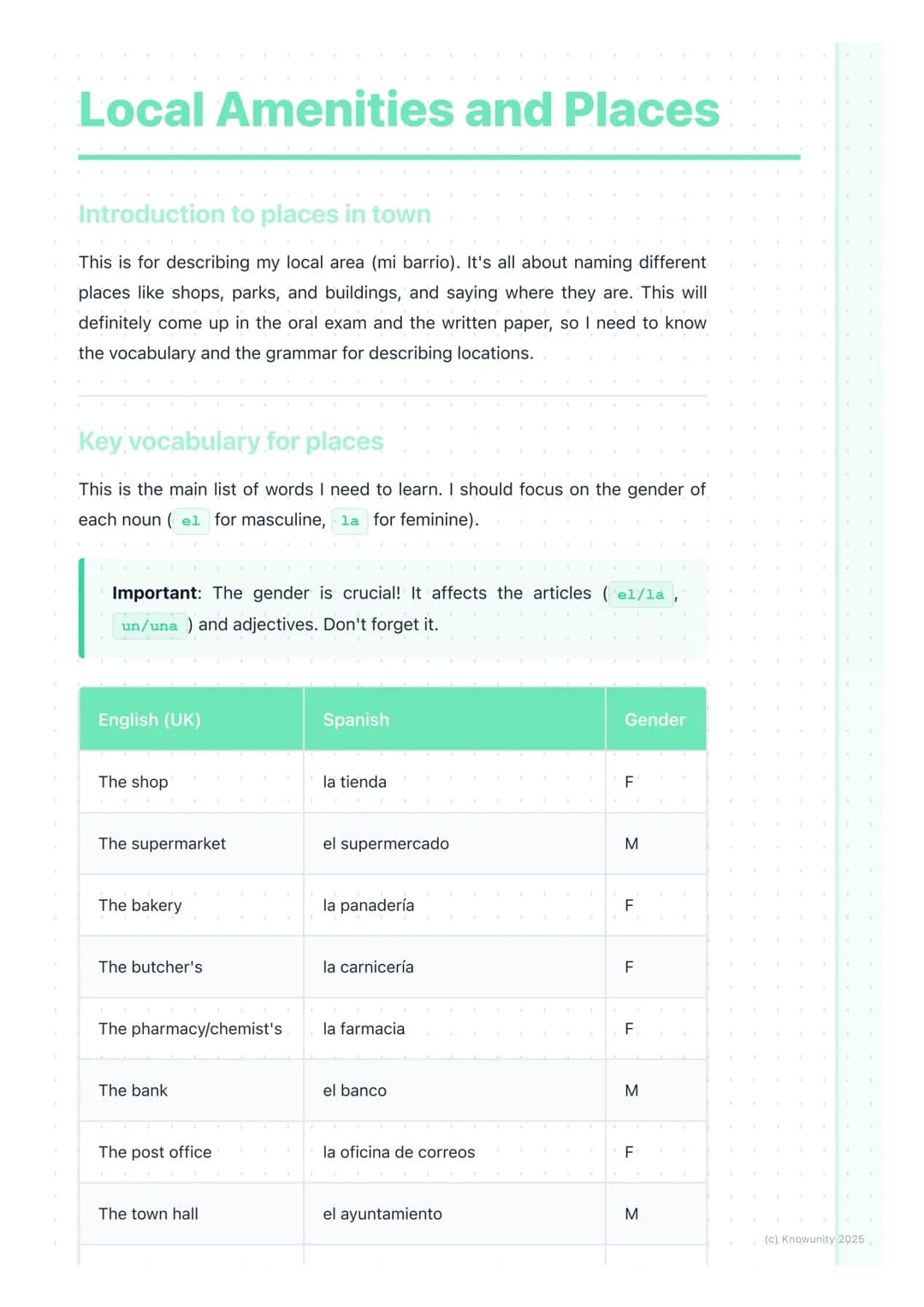
Key Vocabulary for Places
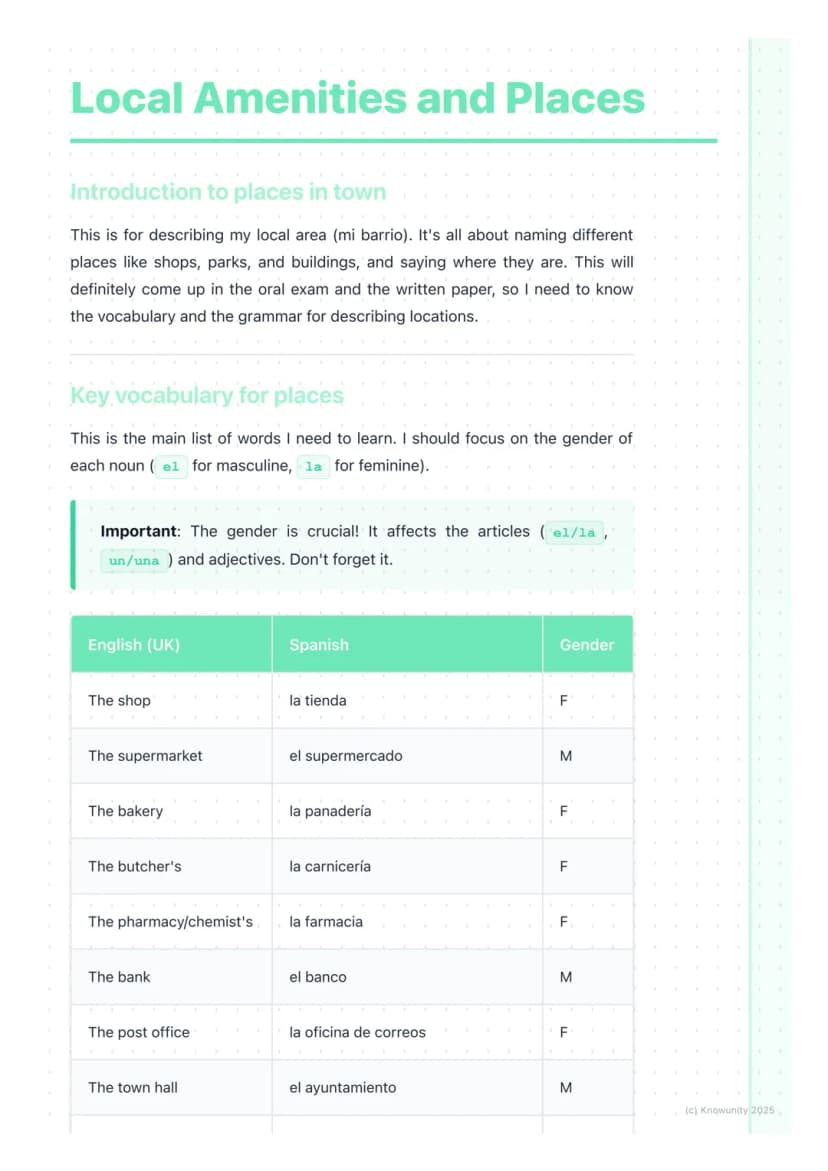
Mastering Spanish place names starts with understanding that every noun has a gender - either masculine (el) or feminine (la). This affects everything else in your sentence, so it's crucial to memorise both the word and its gender together.
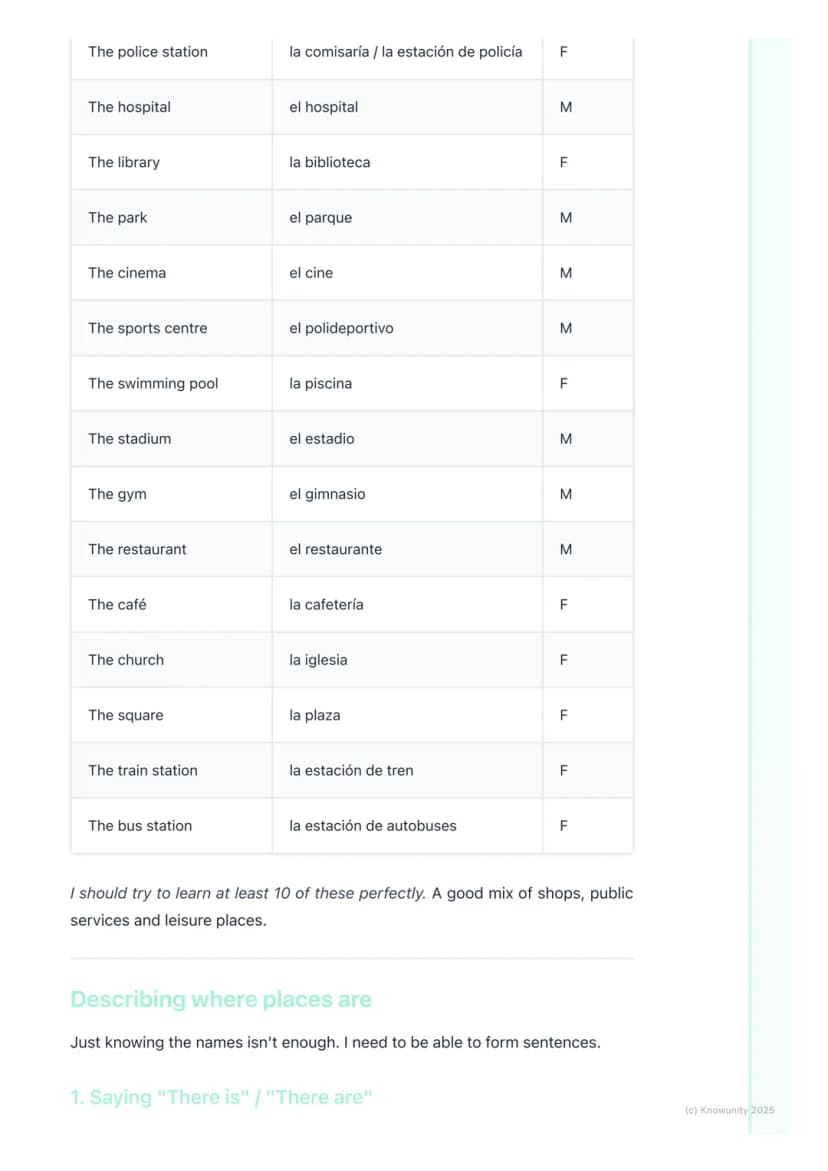
Focus on learning a good mix of shops, public services, and leisure places. Essential places include la tienda (shop), el supermercado (supermarket), la panadería (bakery), la farmacia (pharmacy), and el banco (bank). For public buildings, you'll need el ayuntamiento (town hall), la biblioteca (library), and el hospital.
Don't forget leisure facilities like el parque (park), el cine (cinema), la piscina (swimming pool), and el polideportivo (sports centre). Using more sophisticated vocabulary like polideportivo instead of basic words will boost your marks significantly.
Top Tip: Aim to learn at least 15 places perfectly with their correct genders - this range will cover most exam scenarios.
2
of 6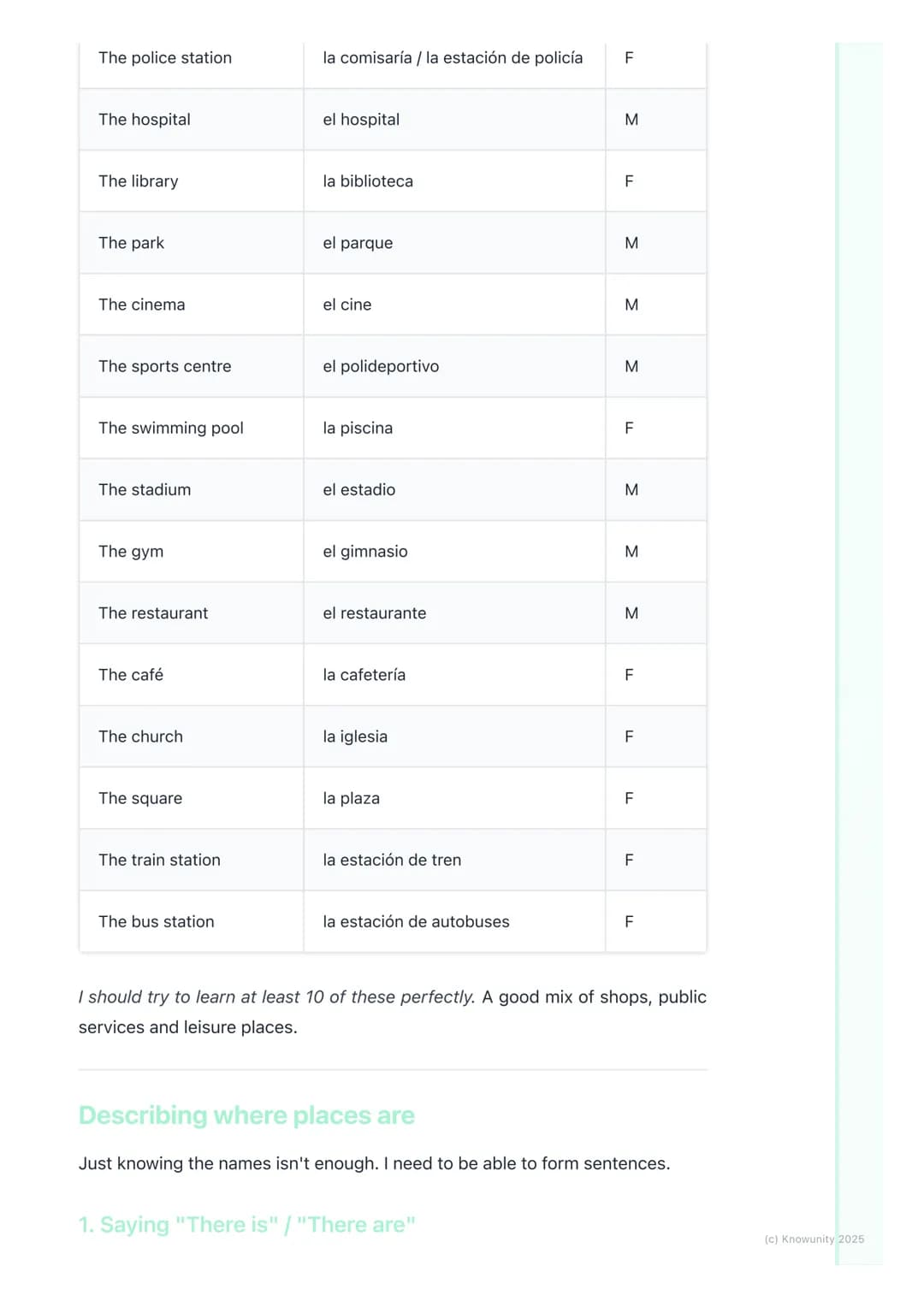
Saying "There Is" and "There Are"
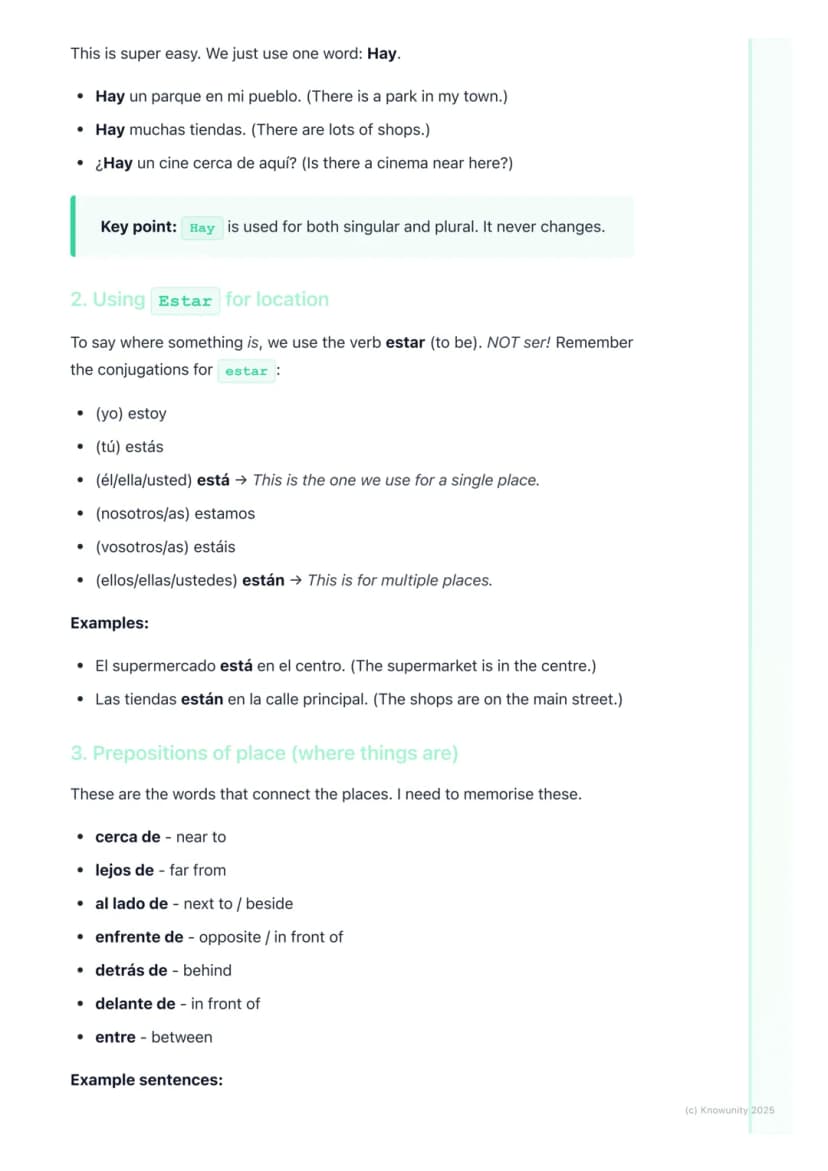
Spanish makes location descriptions incredibly simple with one magic word: Hay. Unlike English, you use the same word for both singular and plural - it never changes!
Use Hay un parque (There is a park) or Hay muchas tiendas (There are lots of shops). You can even ask questions: ¿Hay un cine cerca de aquí? (Is there a cinema near here?). This versatility makes hay your best friend for describing what exists in your area.
For describing exactly where something is located, you'll need the verb estar (to be). The key forms are está for single places and están for multiple places. Remember: El supermercado está en el centro (The supermarket is in the centre).
Remember: Never confuse hay (existence) with estar (specific location) - they serve completely different purposes!
3
of 6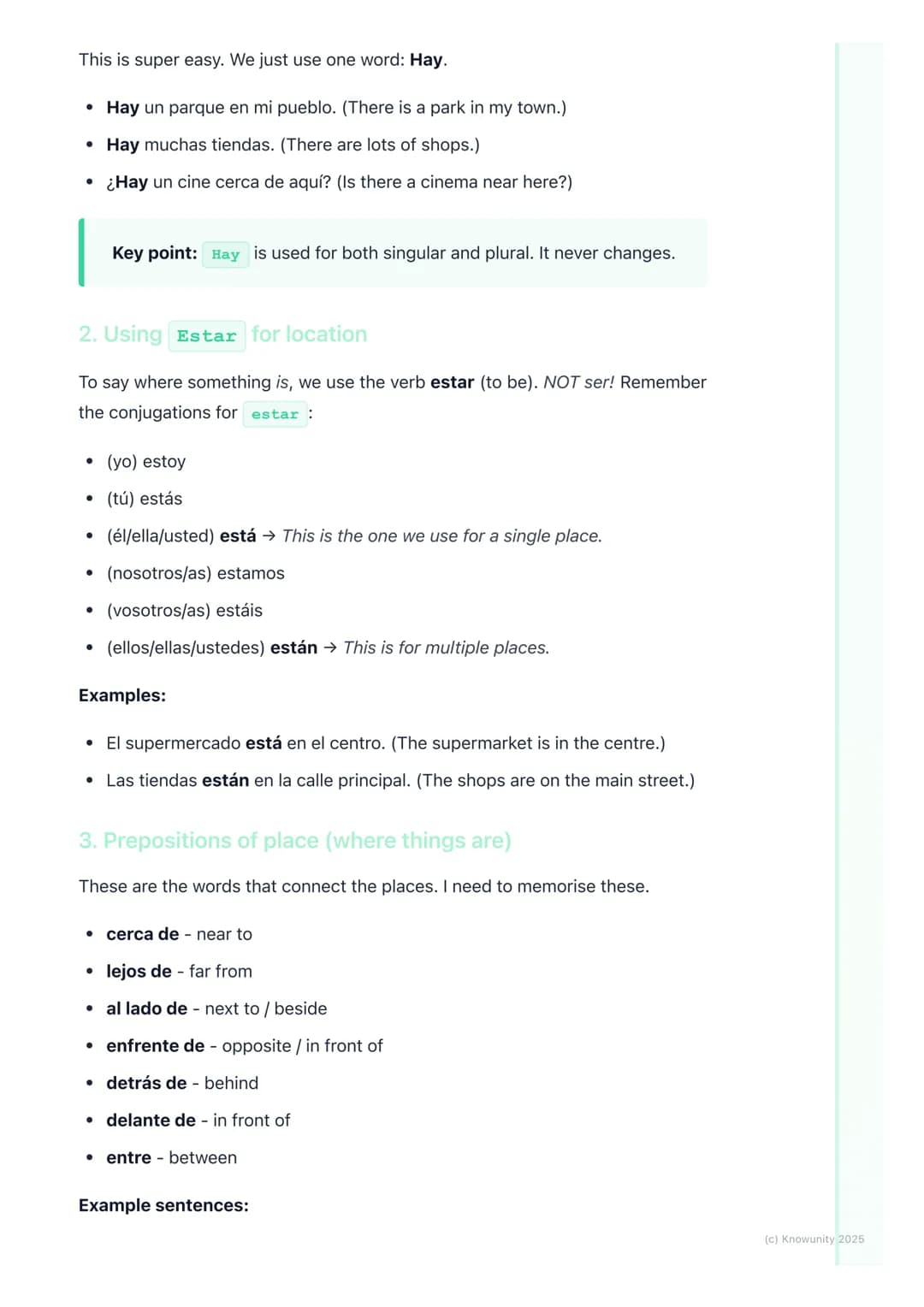
Prepositions of Place
These connecting words are essential for explaining where places are in relation to each other. The most important ones are cerca de (near), lejos de (far from), al lado de (next to), enfrente de (opposite), and entre (between).
Most prepositions include de, so don't forget it! You'll say La farmacia está al lado del banco (The pharmacy is next to the bank) or Mi casa está lejos del polideportivo (My house is far from the sports centre).
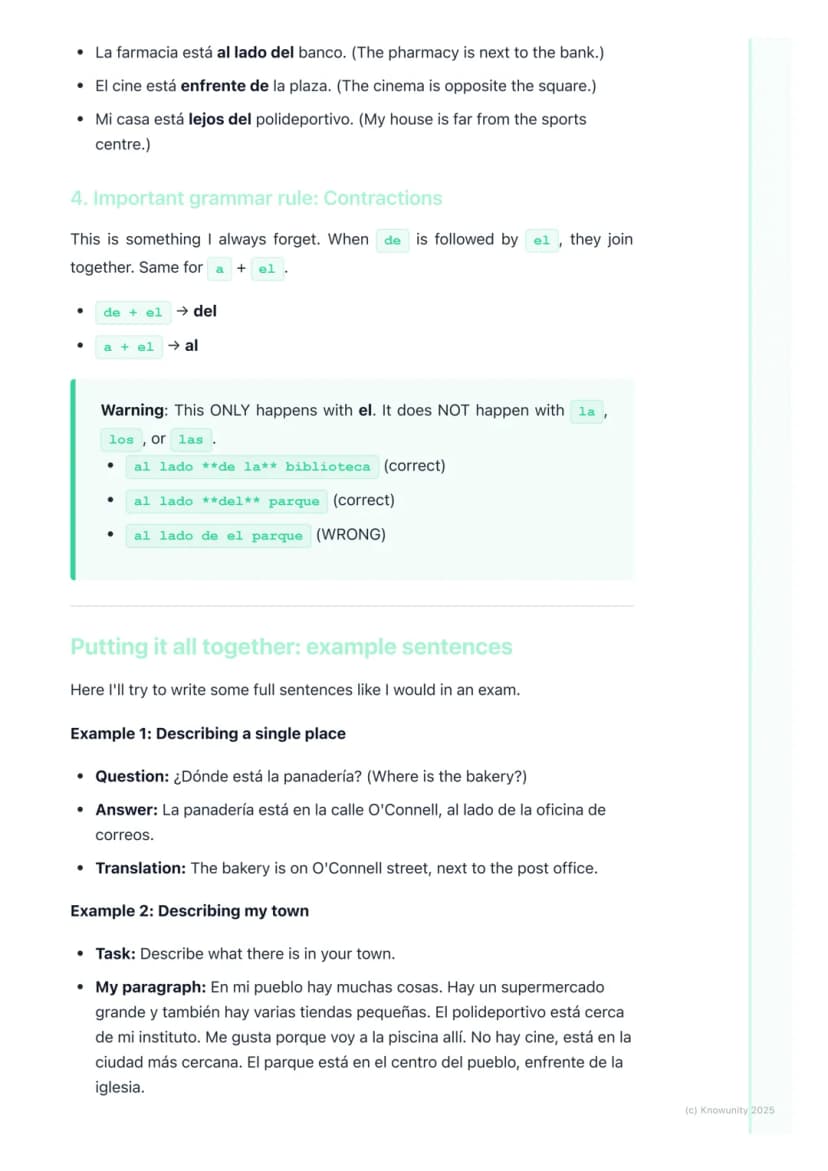
Master the contraction rules: when de meets el, they become del. When a meets el, they become al. This only happens with el - never with la, los, or las. So it's al lado del parque but al lado de la biblioteca.
Watch Out: Writing "de el" or "a el" separately is a common mistake that will cost you marks!
4
of 6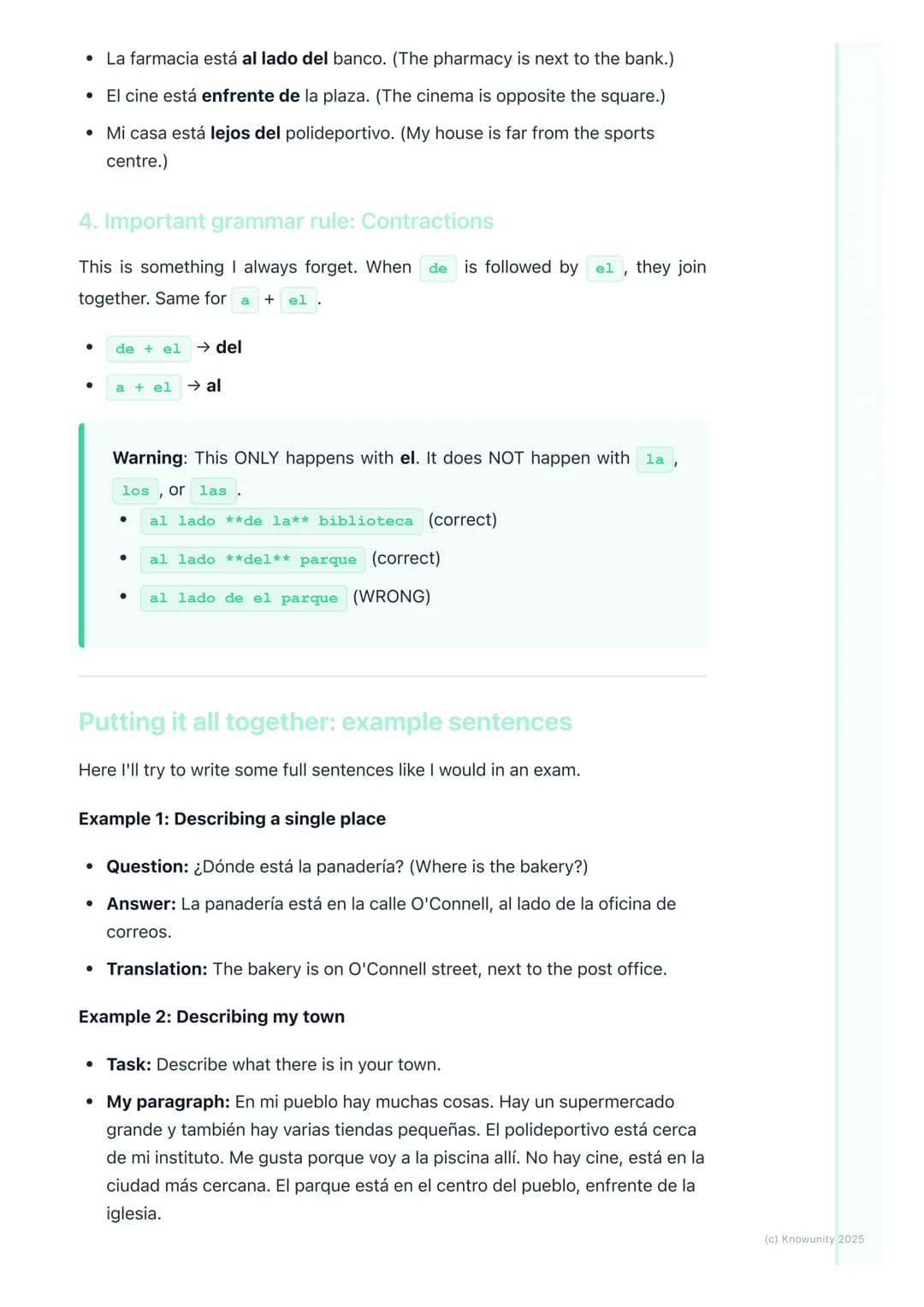
Building Complete Sentences
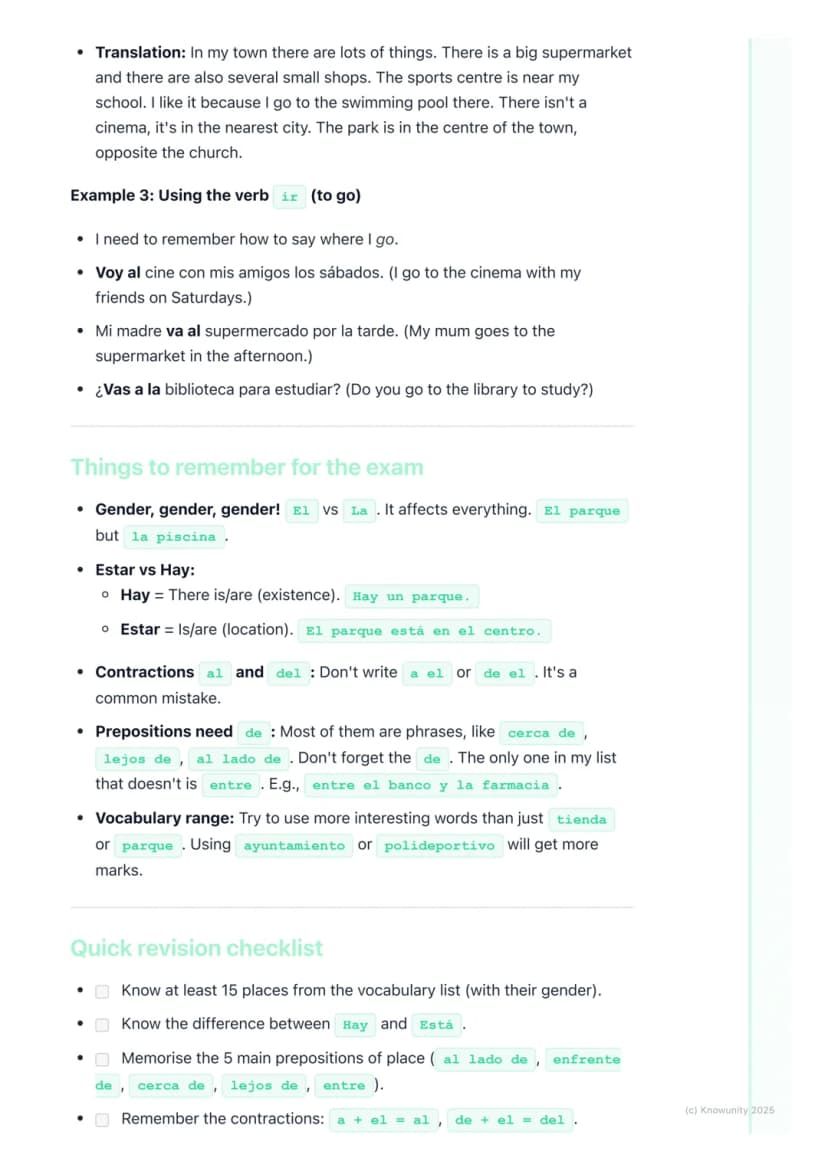
Now you can combine everything into proper descriptions. Start with simple answers like La panadería está en la calle O'Connell, al lado de la oficina de correos (The bakery is on O'Connell Street, next to the post office).
For longer descriptions, mix hay and estar effectively. Try: En mi pueblo hay muchas cosas. El polideportivo está cerca de mi instituto (In my town there are lots of things. The sports centre is near my school). This shows you understand both concepts.
Don't forget about movement! Use voy al (I go to) to add variety: Voy al cine con mis amigos los sábados (I go to the cinema with my friends on Saturdays). Remember those contractions - it's voy al cine, not voy a el cine.
Exam Success: Combining different sentence structures shows advanced understanding and earns higher marks.
5
of 6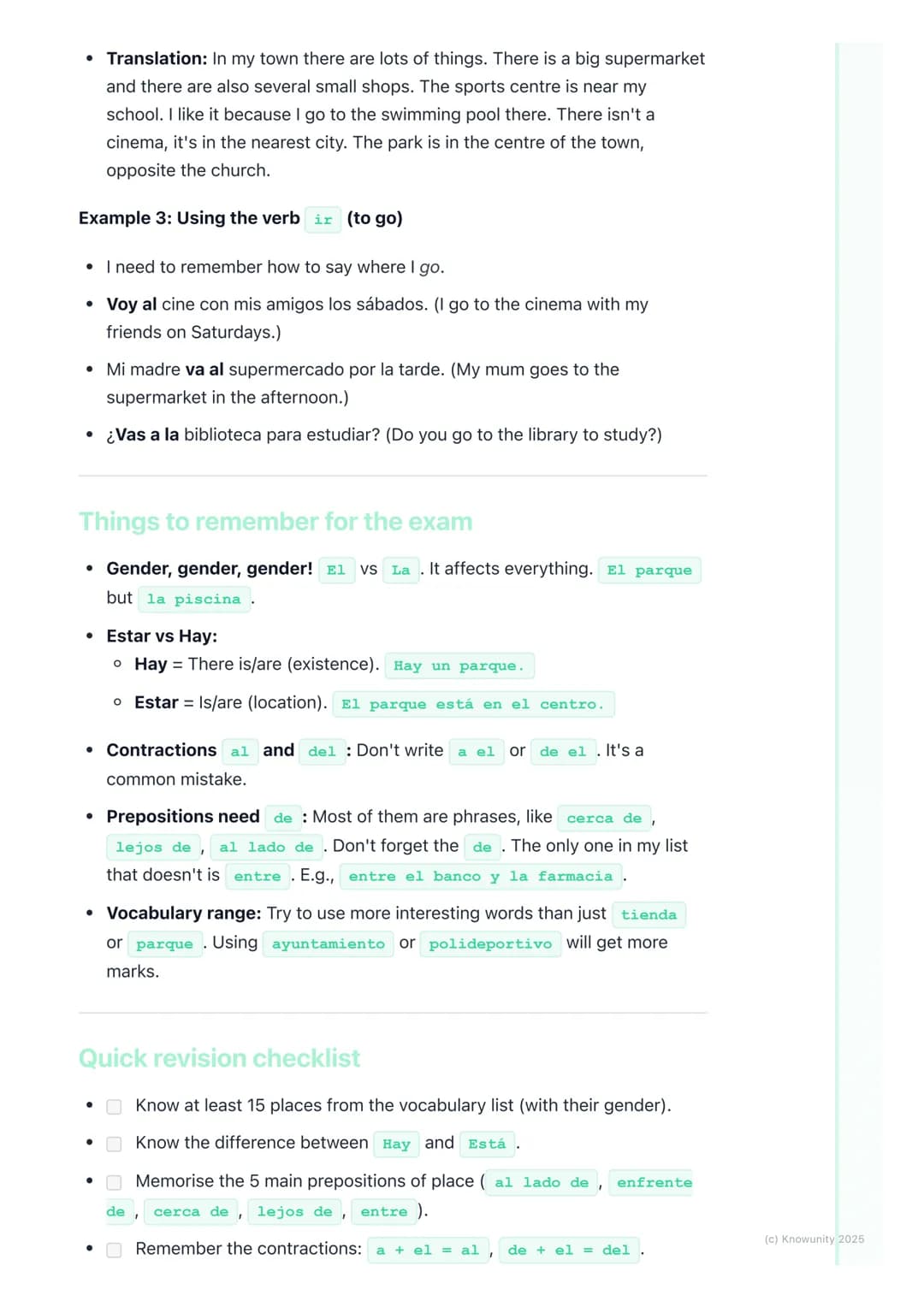
Grammar Rules That Matter
Gender consistency is absolutely crucial - el parque but la piscina. This affects articles, adjectives, and even which preposition contractions you use. Get the gender wrong and your whole sentence suffers.
The hay vs estar distinction trips up many students. Use hay when talking about what exists (Hay un parque) and estar when pinpointing exact location (El parque está en el centro). They're not interchangeable!
Most prepositions are phrases ending in de: cerca de, lejos de, al lado de, enfrente de. The exception is entre, which stands alone. So you'd say entre el banco y la farmacia (between the bank and the pharmacy).
Pro Tip: Using sophisticated vocabulary like ayuntamiento or polideportivo instead of basic words demonstrates advanced Spanish knowledge.
6
of 6
Exam Preparation Checklist
You're ready when you can write a 3-4 sentence paragraph describing your local area without hesitation. Practice combining hay and estar naturally while using varied vocabulary and correct prepositions.
Focus your revision on the essentials: 15+ place names with genders, the hay/estar difference, five main prepositions (al lado de, enfrente de, cerca de, lejos de, entre), and those crucial contractions (al and del).
Don't forget to practice using ir (to go) for talking about visiting these places. This adds another dimension to your descriptions and shows you can use multiple tenses and structures confidently.
Final Check: Can you describe your local area, explain where places are, and talk about where you go? If yes, you're exam-ready!
Mislili smo da nikad nećeš pitati...
Šta je Knowunity AI companion?
Naš AI Companion je AI alat fokusiran na učenike koji nudi više od samih odgovora. Napravljen na milionima Knowunity resursa, pruža relevantne informacije, personalizovane planove učenja, kvizove i sadržaj direktno u chatu, prilagođavajući se tvom individualnom putu učenja.
Gde mogu da preuzmem Knowunity aplikaciju?
Možeš preuzeti aplikaciju sa Google Play Store-a i Apple App Store-a.
Da li je Knowunity stvarno besplatan?
Tako je! Uživaj u besplatnom pristupu sadržaju za učenje, povezuj se sa drugim učenicima i dobijaj trenutnu pomoć – sve na dohvat ruke.
Najpopularniji sadržaj u Spanish
2SpanishTechnology, Social Media, and Digital Life
Learners will gain vocabulary to discuss modern technology, internet usage, social networking, and their impact on daily life.
5th Year20
SpanishComparatives and Superlatives
Students will learn how to compare people and things using comparative structures ('más... que', 'menos... que') and superlative forms ('el/la más...').
TY70
Najpopularniji sadržaj
9 Irish
IrishIrish oral questions and answers
Questions and answers for the leaving cert oral
5th Year4264
 English
Key Quotes : Sive
Key Quotes and explanations: Sive
6th Year2842
IrishIrish oral questions
Outline of oral questions
5th Year2055
IrishIníon- le hÁine Durkin
Aine Durkin’s poem, Iníon: Themes & summary
5th Year890
IrishIrish poetry 2027
Iníon + Dínit an Bhróin
5th Year1153
IrishLC HL notes- Iníon (poem)
Includes poem in English and Irish, theme, key words & phrases
5th Year2304
EnglishCultural Context : Shawshank Redemption : Sive : Small Things Like These
Comparative Study : Cultural Context : Shawshank Redemption, Sive and Small Things Like These
6th Year1430
IrishMo Ghrá-sa (Idir Lúibíní)
Notes on mo ghrá-sa
5th Year380
IrishAn Gaeilge Aiste
Irish Language essay
6th Year1320
Ne možeš da nađeš ono što tražiš? Istražuj druge predmete.
Učenici nas obožavaju — i ti ćeš takođe.
4.6/5App Store
4.7/5Google Play
Aplikacija je super laka za korišćenje i odlično dizajnirana. Našao sam sve što mi je trebalo i dosta sam naučio iz prezentacija! Definitivno ću koristiti aplikaciju za školski zadatak! A naravno, pomaže i kao inspiracija.
Stefan SiOS korisnik
Ova aplikacija je stvarno odlična. Tu je toliko beleški za učenje i pomoći [...]. Na primer, problem mi je francuski, a aplikacija ima toliko opcija za pomoć. Zahvaljujući ovoj aplikaciji, poboljšao sam francuski. Preporučio bih je svima.
Samantha KlichAndroid korisnik
Vau, stvarno sam oduševljena. Probala sam aplikaciju jer sam je videla u reklamama mnogo puta i bila sam potpuno šokirana. Ova aplikacija je POMOĆ koju želiš za školu i pre svega, nudi toliko stvari, kao što su vežbe i sažeci, što mi je lično bilo VEOMA korisno.
AnaiOS korisnik
Spanish2 pregledi·Ažurirano Jun 7, 2026·6 straniceExploring Local Amenities and Attractions
Learning to describe your local area in Spanish is essential for both oral and written exams. You'll need to master place names, their genders, and how to explain where everything is located using proper Spanish grammar.
1
of 6
Registruj se da vidiš sadržaj. Besplatno je!
- Pristup svim dokumentima
- Poboljšaj svoje ocene
- Pridruži se milionima učenika
Key Vocabulary for Places
Mastering Spanish place names starts with understanding that every noun has a gender - either masculine (el) or feminine (la). This affects everything else in your sentence, so it's crucial to memorise both the word and its gender together.
Focus on learning a good mix of shops, public services, and leisure places. Essential places include la tienda (shop), el supermercado (supermarket), la panadería (bakery), la farmacia (pharmacy), and el banco (bank). For public buildings, you'll need el ayuntamiento (town hall), la biblioteca (library), and el hospital.
Don't forget leisure facilities like el parque (park), el cine (cinema), la piscina (swimming pool), and el polideportivo (sports centre). Using more sophisticated vocabulary like polideportivo instead of basic words will boost your marks significantly.
Top Tip: Aim to learn at least 15 places perfectly with their correct genders - this range will cover most exam scenarios.
2
of 6Registruj se da vidiš sadržaj. Besplatno je!
- Pristup svim dokumentima
- Poboljšaj svoje ocene
- Pridruži se milionima učenika
Saying "There Is" and "There Are"
Spanish makes location descriptions incredibly simple with one magic word: Hay. Unlike English, you use the same word for both singular and plural - it never changes!
Use Hay un parque (There is a park) or Hay muchas tiendas (There are lots of shops). You can even ask questions: ¿Hay un cine cerca de aquí? (Is there a cinema near here?). This versatility makes hay your best friend for describing what exists in your area.
For describing exactly where something is located, you'll need the verb estar (to be). The key forms are está for single places and están for multiple places. Remember: El supermercado está en el centro (The supermarket is in the centre).
Remember: Never confuse hay (existence) with estar (specific location) - they serve completely different purposes!
3
of 6Registruj se da vidiš sadržaj. Besplatno je!
- Pristup svim dokumentima
- Poboljšaj svoje ocene
- Pridruži se milionima učenika
Prepositions of Place
These connecting words are essential for explaining where places are in relation to each other. The most important ones are cerca de (near), lejos de (far from), al lado de (next to), enfrente de (opposite), and entre (between).
Most prepositions include de, so don't forget it! You'll say La farmacia está al lado del banco (The pharmacy is next to the bank) or Mi casa está lejos del polideportivo (My house is far from the sports centre).
Master the contraction rules: when de meets el, they become del. When a meets el, they become al. This only happens with el - never with la, los, or las. So it's al lado del parque but al lado de la biblioteca.
Watch Out: Writing "de el" or "a el" separately is a common mistake that will cost you marks!
4
of 6Registruj se da vidiš sadržaj. Besplatno je!
- Pristup svim dokumentima
- Poboljšaj svoje ocene
- Pridruži se milionima učenika
Building Complete Sentences
Now you can combine everything into proper descriptions. Start with simple answers like La panadería está en la calle O'Connell, al lado de la oficina de correos (The bakery is on O'Connell Street, next to the post office).
For longer descriptions, mix hay and estar effectively. Try: En mi pueblo hay muchas cosas. El polideportivo está cerca de mi instituto (In my town there are lots of things. The sports centre is near my school). This shows you understand both concepts.
Don't forget about movement! Use voy al (I go to) to add variety: Voy al cine con mis amigos los sábados (I go to the cinema with my friends on Saturdays). Remember those contractions - it's voy al cine, not voy a el cine.
Exam Success: Combining different sentence structures shows advanced understanding and earns higher marks.
5
of 6Registruj se da vidiš sadržaj. Besplatno je!
- Pristup svim dokumentima
- Poboljšaj svoje ocene
- Pridruži se milionima učenika
Grammar Rules That Matter
Gender consistency is absolutely crucial - el parque but la piscina. This affects articles, adjectives, and even which preposition contractions you use. Get the gender wrong and your whole sentence suffers.
The hay vs estar distinction trips up many students. Use hay when talking about what exists (Hay un parque) and estar when pinpointing exact location (El parque está en el centro). They're not interchangeable!
Most prepositions are phrases ending in de: cerca de, lejos de, al lado de, enfrente de. The exception is entre, which stands alone. So you'd say entre el banco y la farmacia (between the bank and the pharmacy).
Pro Tip: Using sophisticated vocabulary like ayuntamiento or polideportivo instead of basic words demonstrates advanced Spanish knowledge.
6
of 6Registruj se da vidiš sadržaj. Besplatno je!
- Pristup svim dokumentima
- Poboljšaj svoje ocene
- Pridruži se milionima učenika
Exam Preparation Checklist
You're ready when you can write a 3-4 sentence paragraph describing your local area without hesitation. Practice combining hay and estar naturally while using varied vocabulary and correct prepositions.
Focus your revision on the essentials: 15+ place names with genders, the hay/estar difference, five main prepositions (al lado de, enfrente de, cerca de, lejos de, entre), and those crucial contractions (al and del).
Don't forget to practice using ir (to go) for talking about visiting these places. This adds another dimension to your descriptions and shows you can use multiple tenses and structures confidently.
Final Check: Can you describe your local area, explain where places are, and talk about where you go? If yes, you're exam-ready!
Mislili smo da nikad nećeš pitati...
Šta je Knowunity AI companion?
Naš AI Companion je AI alat fokusiran na učenike koji nudi više od samih odgovora. Napravljen na milionima Knowunity resursa, pruža relevantne informacije, personalizovane planove učenja, kvizove i sadržaj direktno u chatu, prilagođavajući se tvom individualnom putu učenja.
Gde mogu da preuzmem Knowunity aplikaciju?
Možeš preuzeti aplikaciju sa Google Play Store-a i Apple App Store-a.
Da li je Knowunity stvarno besplatan?
Tako je! Uživaj u besplatnom pristupu sadržaju za učenje, povezuj se sa drugim učenicima i dobijaj trenutnu pomoć – sve na dohvat ruke.
Najpopularniji sadržaj u Spanish
2SpanishTechnology, Social Media, and Digital Life
Learners will gain vocabulary to discuss modern technology, internet usage, social networking, and their impact on daily life.
5th Year20
SpanishComparatives and Superlatives
Students will learn how to compare people and things using comparative structures ('más... que', 'menos... que') and superlative forms ('el/la más...').
TY70
Najpopularniji sadržaj
9IrishIrish oral questions and answers
Questions and answers for the leaving cert oral
5th Year4264
EnglishKey Quotes : Sive
Key Quotes and explanations: Sive
6th Year2842
IrishIrish oral questions
Outline of oral questions
5th Year2055
IrishIníon- le hÁine Durkin
Aine Durkin’s poem, Iníon: Themes & summary
5th Year890
IrishIrish poetry 2027
Iníon + Dínit an Bhróin
5th Year1153
IrishLC HL notes- Iníon (poem)
Includes poem in English and Irish, theme, key words & phrases
5th Year2304
EnglishCultural Context : Shawshank Redemption : Sive : Small Things Like These
Comparative Study : Cultural Context : Shawshank Redemption, Sive and Small Things Like These
6th Year1430
IrishMo Ghrá-sa (Idir Lúibíní)
Notes on mo ghrá-sa
5th Year380
IrishAn Gaeilge Aiste
Irish Language essay
6th Year1320
Ne možeš da nađeš ono što tražiš? Istražuj druge predmete.
Učenici nas obožavaju — i ti ćeš takođe.
4.6/5App Store
4.7/5Google Play
Aplikacija je super laka za korišćenje i odlično dizajnirana. Našao sam sve što mi je trebalo i dosta sam naučio iz prezentacija! Definitivno ću koristiti aplikaciju za školski zadatak! A naravno, pomaže i kao inspiracija.
Stefan SiOS korisnik
Ova aplikacija je stvarno odlična. Tu je toliko beleški za učenje i pomoći [...]. Na primer, problem mi je francuski, a aplikacija ima toliko opcija za pomoć. Zahvaljujući ovoj aplikaciji, poboljšao sam francuski. Preporučio bih je svima.
Samantha KlichAndroid korisnik
Vau, stvarno sam oduševljena. Probala sam aplikaciju jer sam je videla u reklamama mnogo puta i bila sam potpuno šokirana. Ova aplikacija je POMOĆ koju želiš za školu i pre svega, nudi toliko stvari, kao što su vežbe i sažeci, što mi je lično bilo VEOMA korisno.
AnaiOS korisnik