
Workshop safety isn't just about following rules - it's about...
 Wood Technology1 pregledi·Ažurirano Jun 2, 2026·7 stranice
Essential Guide to Workshop Safety and Effective Risk Assessment
1 / 7
1
of 7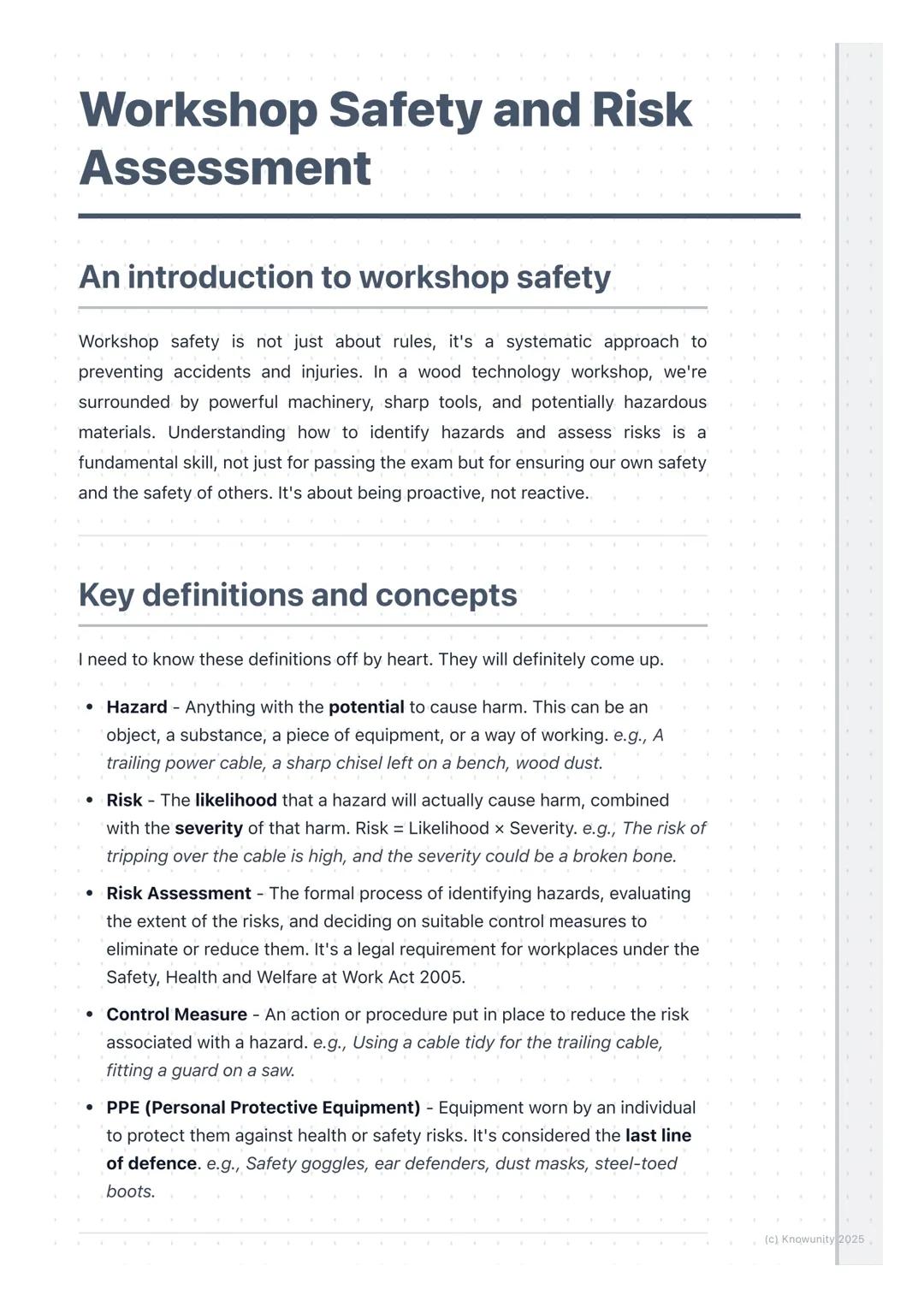
Workshop Safety and Risk Assessment
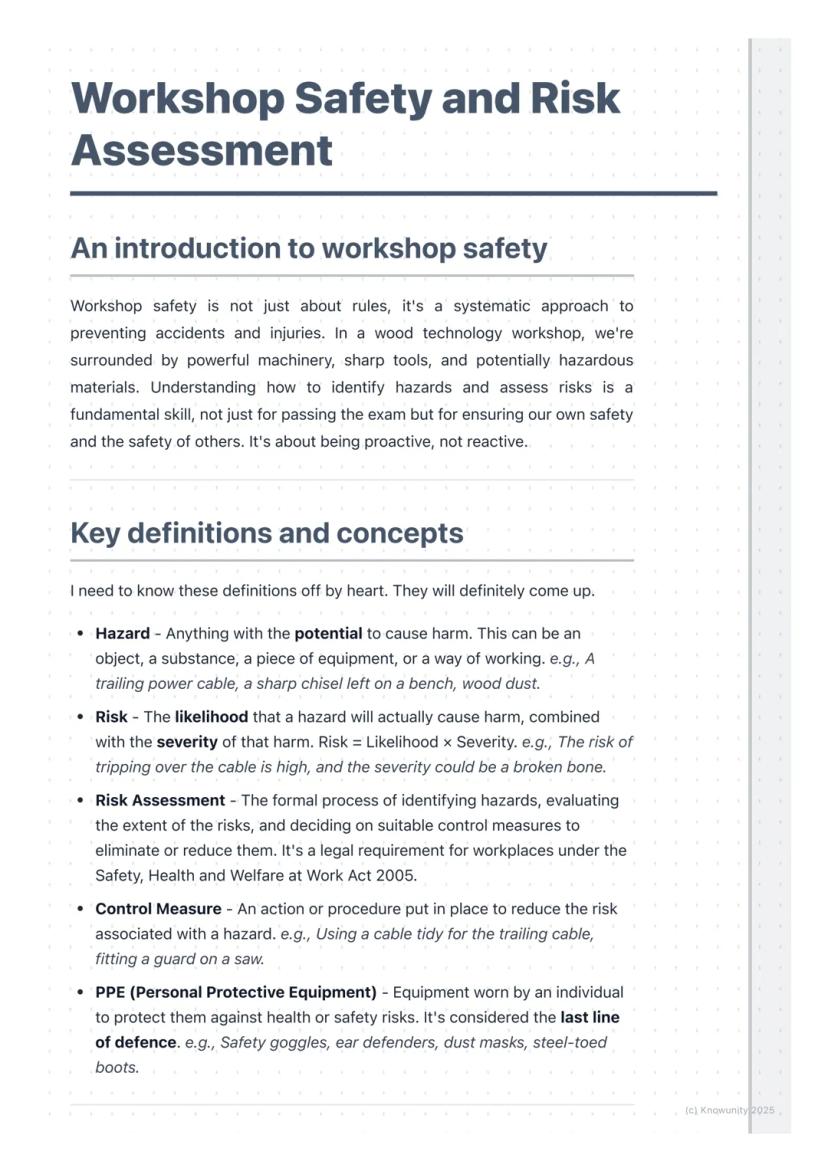
Understanding workshop safety starts with grasping that you're working in an environment full of potential dangers. Every piece of machinery, every sharp tool, and even the way you work can pose risks.
The key is being proactive rather than reactive - spotting problems before they cause accidents. This systematic approach protects everyone in the workshop, from students to teachers to visitors.
A hazard is anything that could potentially cause harm - like a trailing cable, sharp chisel on a bench, or wood dust floating in the air. Risk is the chance that hazard will actually hurt someone, calculated as likelihood multiplied by severity.
Remember: These definitions will definitely appear on your exam, so learn them off by heart!
Risk assessment is the formal process of identifying hazards, evaluating risks, and deciding how to control them. Under the Safety, Health and Welfare at Work Act 2005, it's legally required in Irish workplaces.
2
of 7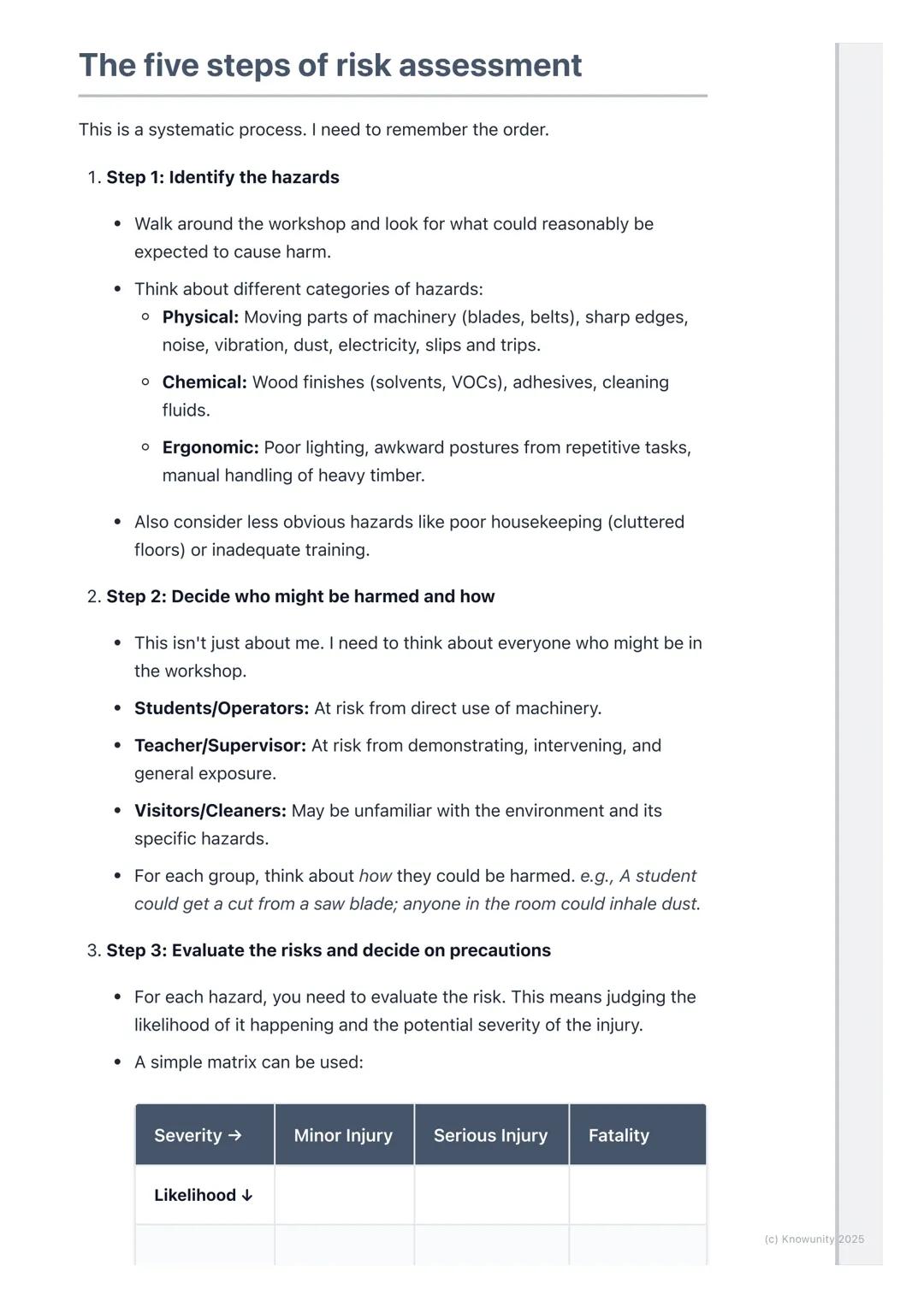
The Five Steps of Risk Assessment
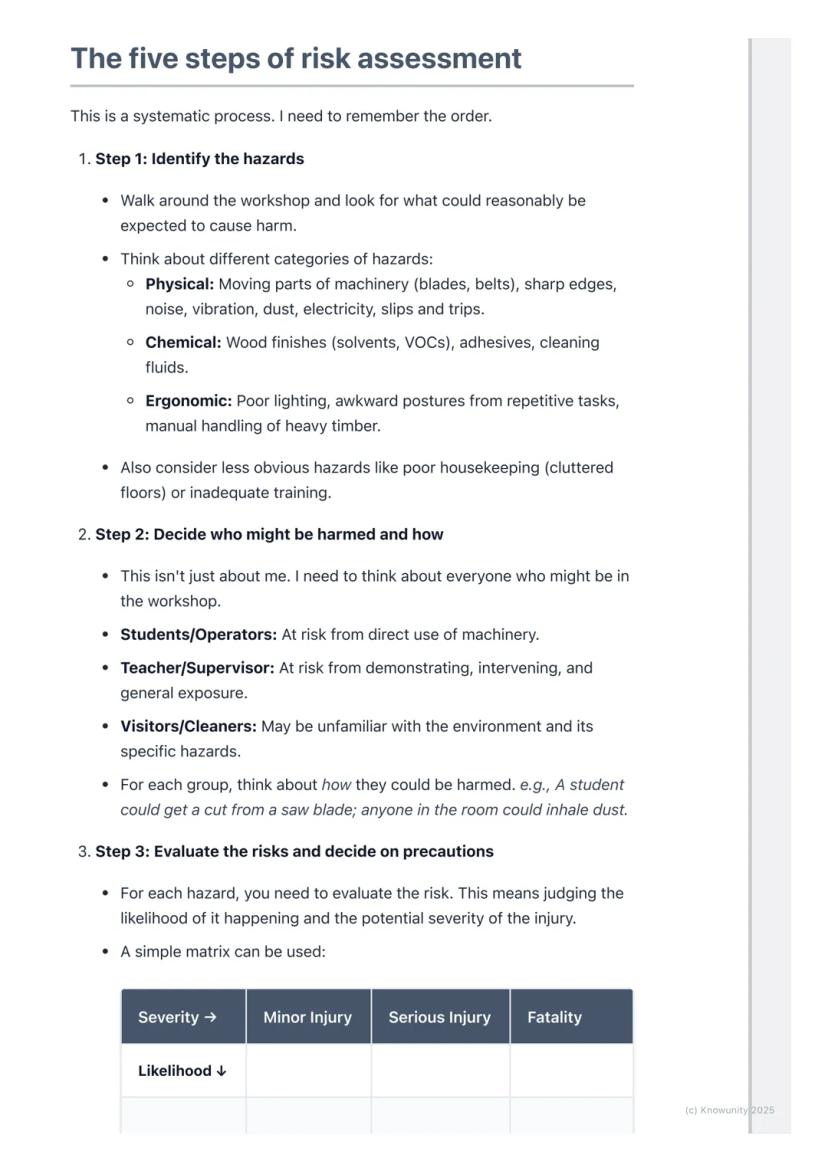
The five-step process is systematic and you need to remember the exact order for your exam. Step one involves walking around the workshop to identify what could reasonably cause harm.
Think about physical hazards like moving machinery parts, sharp edges, noise, and electricity. Consider chemical hazards from wood finishes, adhesives, and cleaning fluids. Don't forget ergonomic hazards like poor lighting and awkward postures from repetitive tasks.
Step two requires identifying who might be harmed - not just you, but teachers, visitors, and cleaners too. Each group faces different risks because they use the workshop differently.
Top Tip: Less obvious hazards like poor housekeeping and inadequate training are easy marks in exam questions!
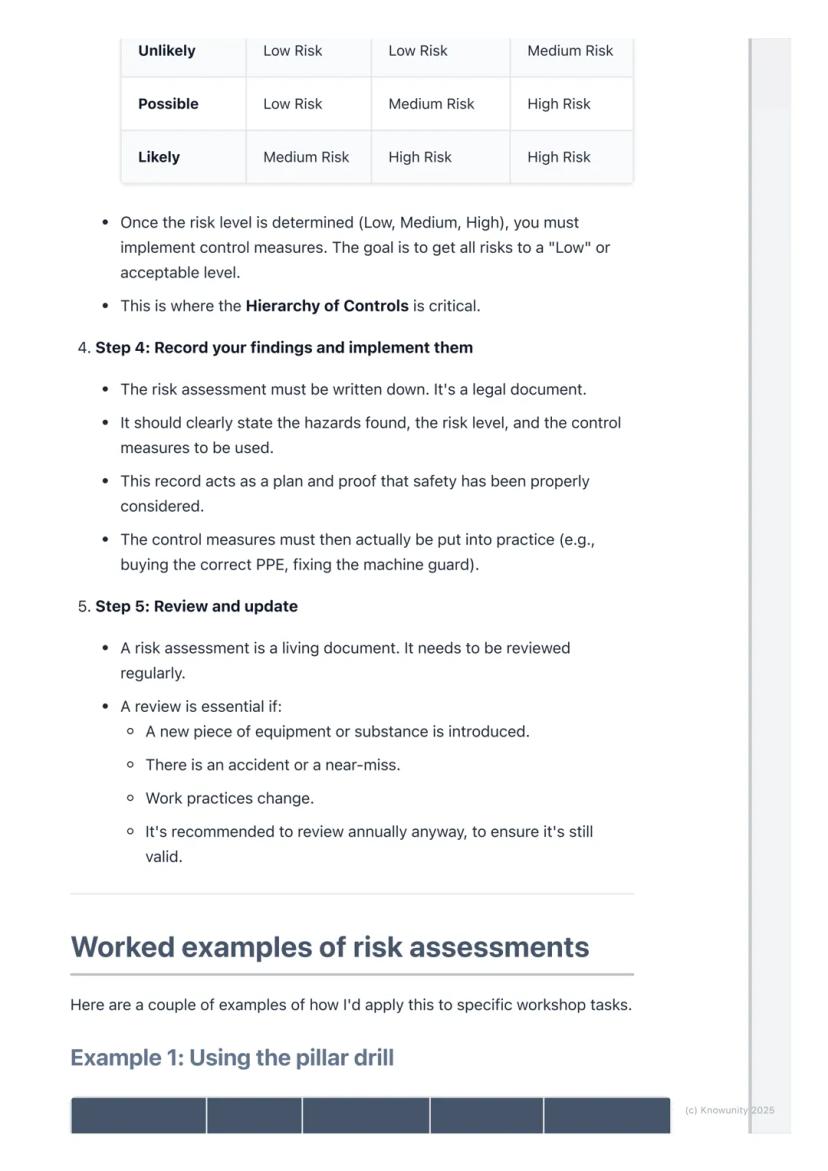
Step three involves evaluating risks using a simple matrix that considers both likelihood and severity . This helps you prioritise which hazards need immediate attention.
3
of 7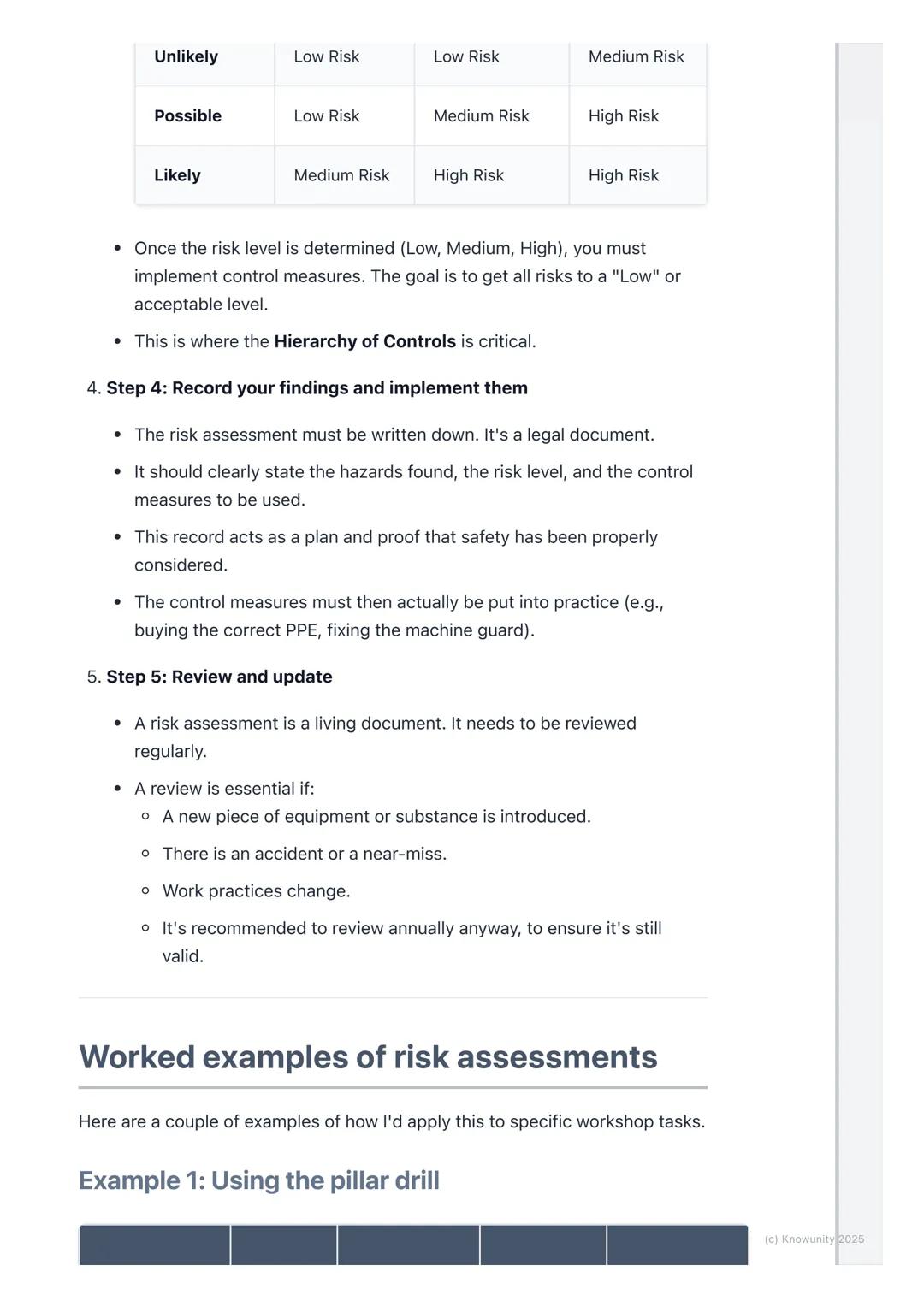
Recording and Reviewing Risk Assessments
Steps four and five focus on documentation and maintenance of your risk assessment. You must write down your findings - it's a legal document that acts as both a plan and proof that safety has been properly considered.
The control measures you identify must actually be implemented, not just written down. This means buying the correct PPE, fixing machine guards, or changing work practices.
Risk assessments are living documents that need regular review. You must update them when new equipment is introduced, after accidents or near-misses, or when work practices change.
Exam Insight: Annual reviews are recommended even when nothing changes, to ensure the assessment remains valid and current.
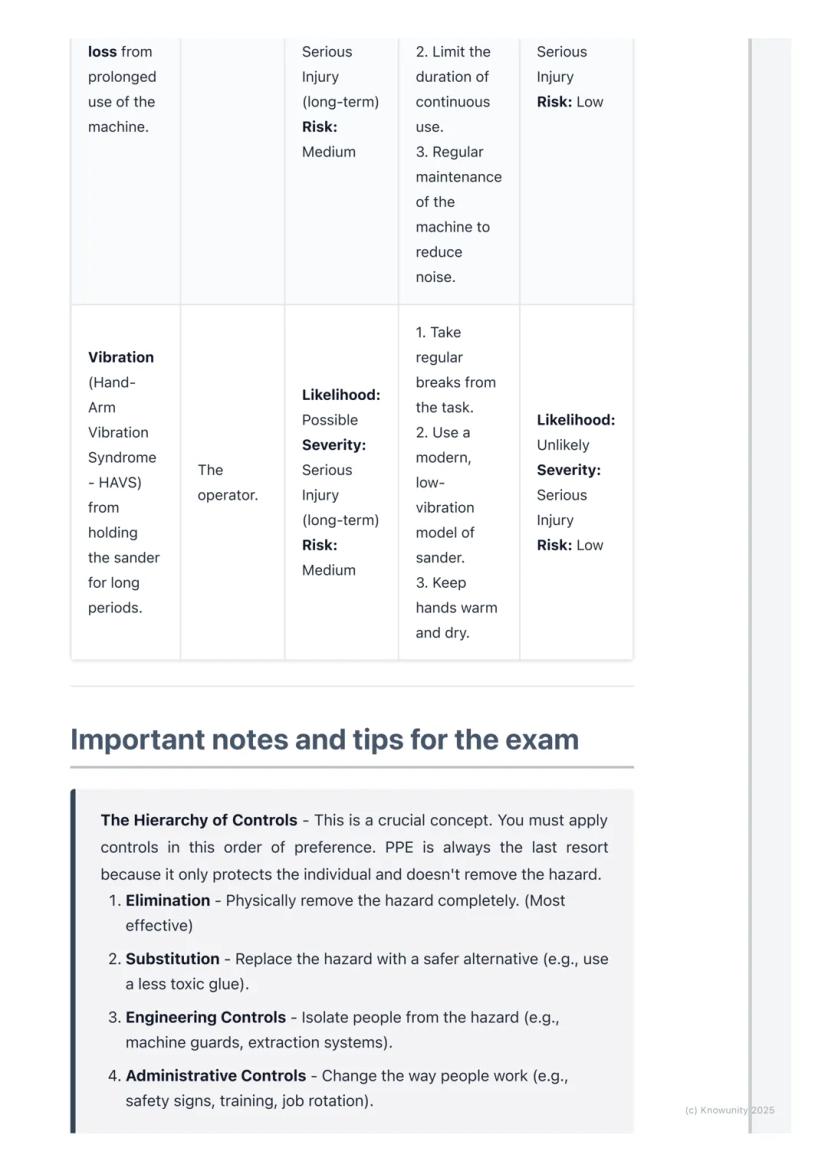
The Hierarchy of Controls is crucial here - elimination comes first, then substitution, engineering controls, administrative controls, and finally PPE. Personal protective equipment should always be your last resort, not your first choice.
4
of 7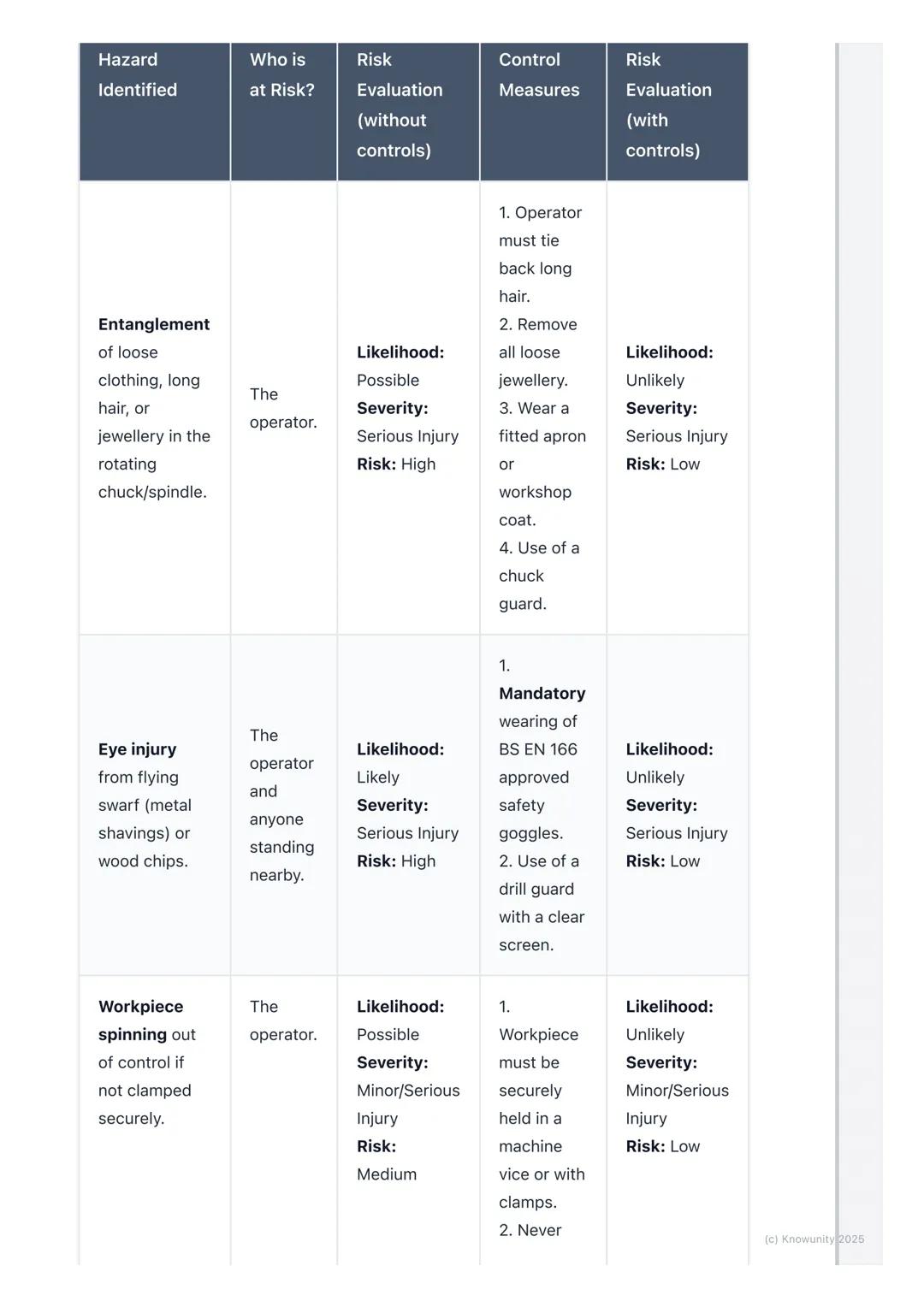
Practical Example - Using the Pillar Drill
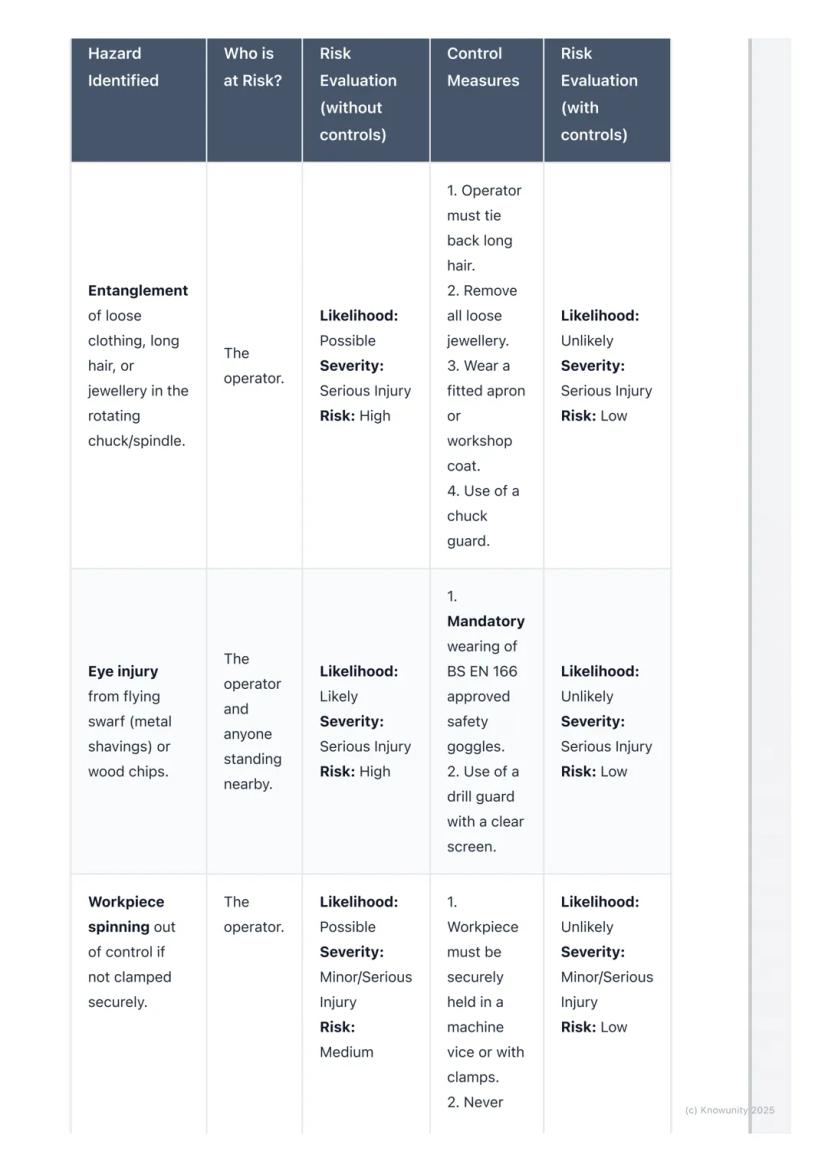
Real-world applications help you understand how risk assessment works in practice. When using a pillar drill, the biggest hazard is entanglement of loose clothing or hair in the rotating chuck.
Without controls, this creates a high risk (possible likelihood, serious injury severity). Control measures include tying back long hair, removing jewellery, wearing fitted clothing, and using chuck guards.
Eye injury from flying debris is another high-risk hazard affecting both operators and bystanders. BS EN 166 approved safety goggles and drill guards with clear screens reduce this to low risk.
Key Point: Notice how multiple control measures work together - you don't rely on just one solution to manage each hazard.
Workpieces spinning out of control pose medium risk initially. Secure clamping in machine vices, proper training, and never holding small pieces by hand bring this down to acceptable levels.
5
of 7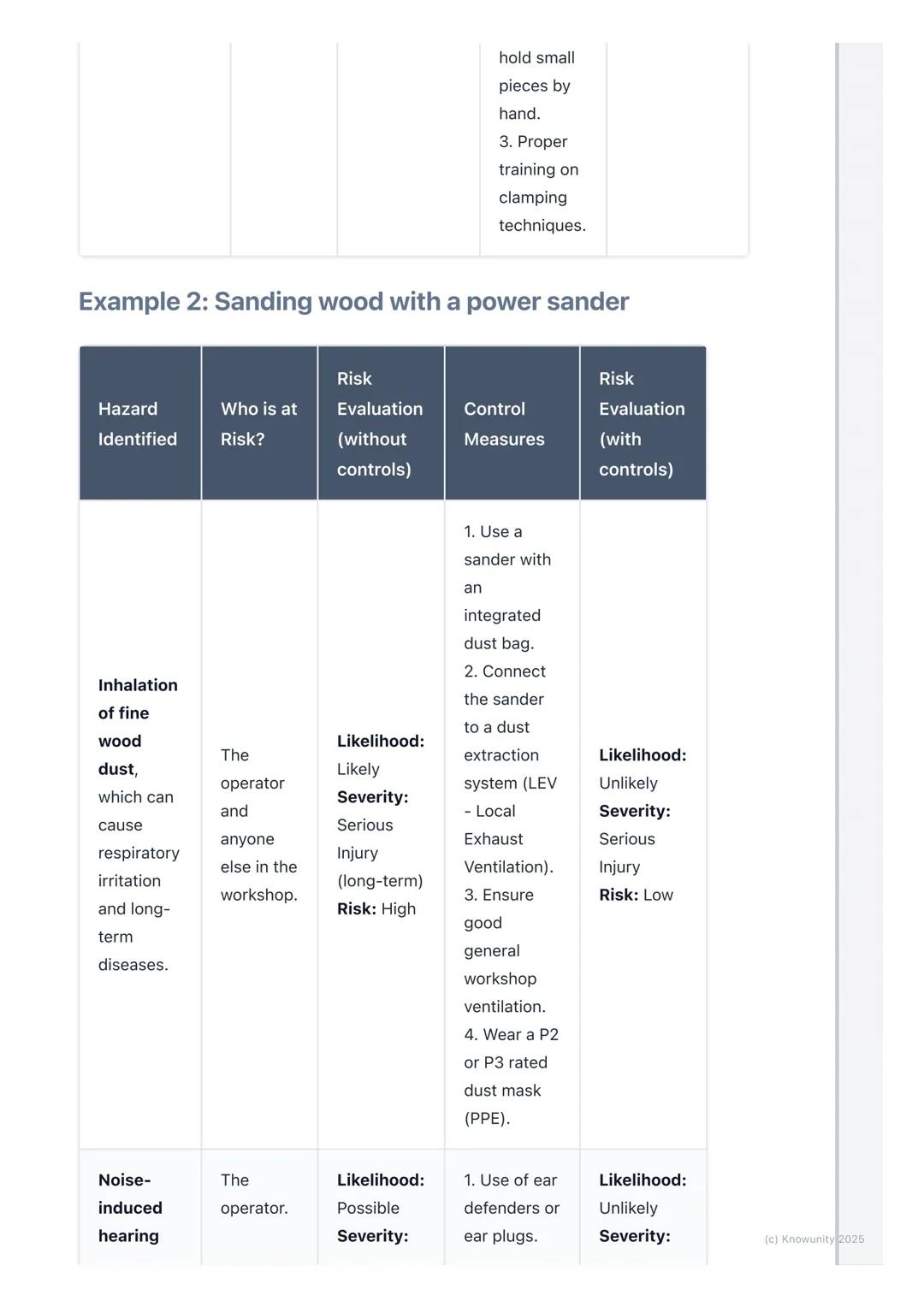
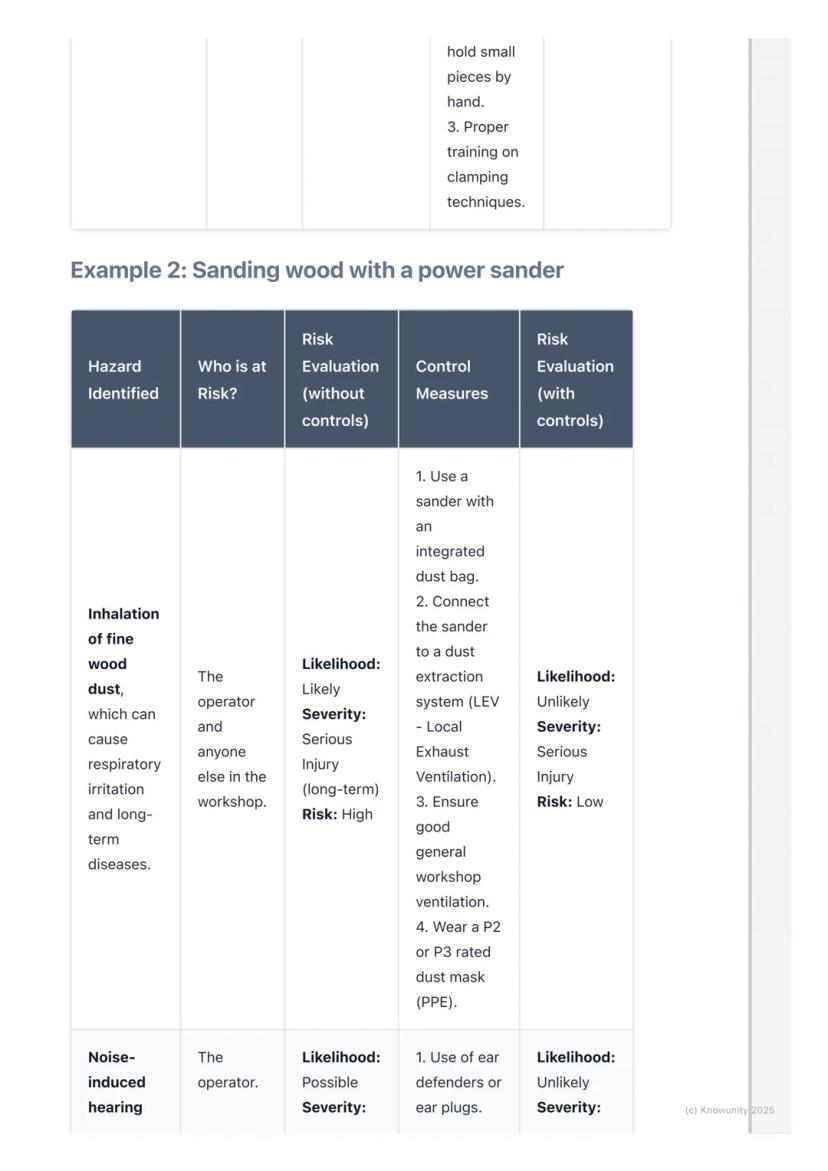
Practical Example - Power Sanding
Wood dust inhalation represents one of the most serious long-term health risks in workshops. Without controls, it's high risk because exposure is likely and can cause serious respiratory diseases over time.
Effective control combines engineering solutions (dust bags, extraction systems, ventilation) with PPE (P2 or P3 rated dust masks). This demonstrates the hierarchy of controls in action.
Noise-induced hearing loss starts as medium risk but becomes low risk through ear defenders, limiting continuous use duration, and regular machine maintenance to reduce noise levels.
Health Alert: Hand-Arm Vibration Syndrome (HAVS) from prolonged sander use is a real occupational hazard that many students don't consider.
Vibration control requires regular breaks, using modern low-vibration equipment, and keeping hands warm and dry. These administrative and engineering controls are more effective than relying solely on protective equipment.
6
of 7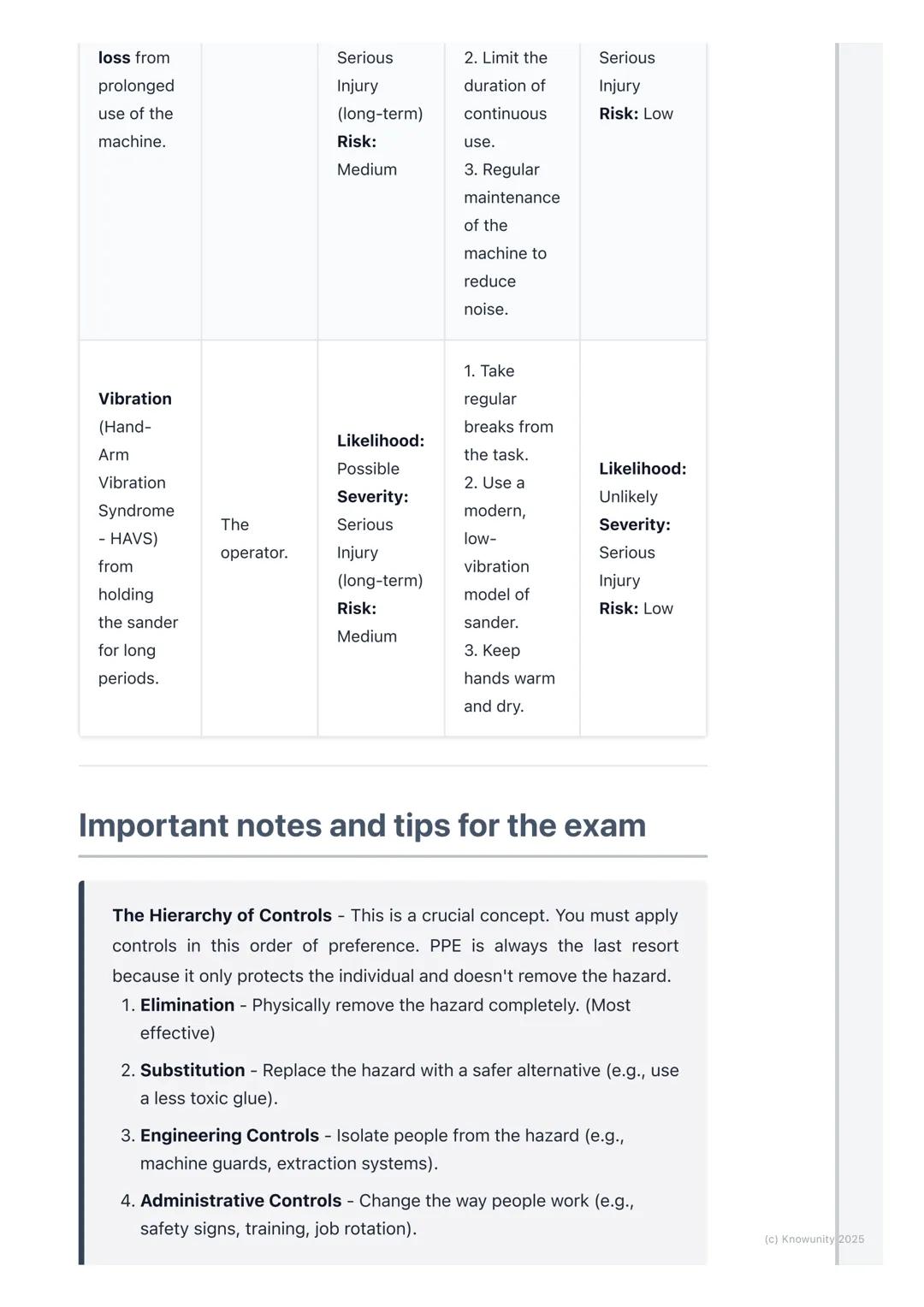
Key Concepts for Exam Success
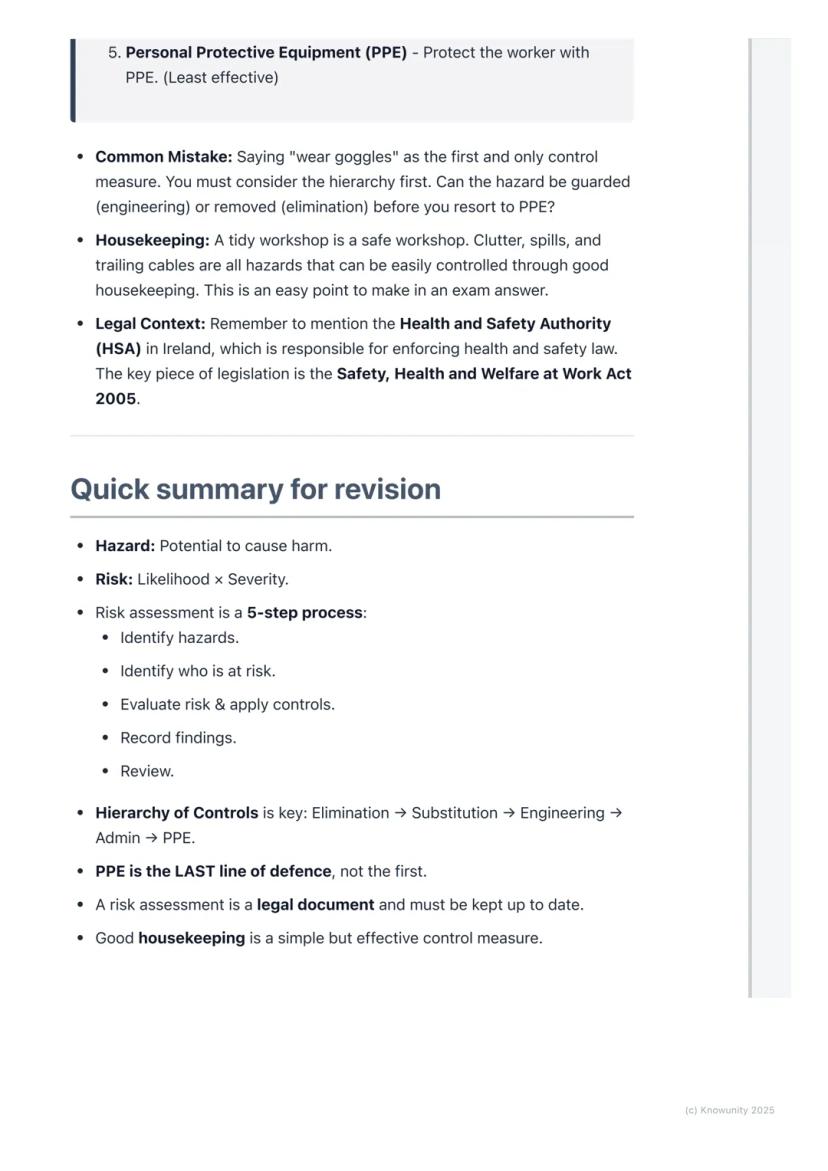
The Hierarchy of Controls is absolutely crucial for exam success. You must apply controls in the correct order: elimination, substitution, engineering controls, administrative controls, then PPE as the last resort.
A common mistake is immediately suggesting "wear goggles" without considering whether the hazard could be eliminated or engineered out first. This approach loses marks because it ignores more effective solutions.
Good housekeeping is often overlooked but represents an easy control measure that addresses multiple hazards. Tidy workshops with no clutter, spills, or trailing cables prevent many accidents.
Legal Context: Remember to mention the Health and Safety Authority (HSA) and the Safety, Health and Welfare at Work Act 2005 in exam answers.
The key legislation in Ireland is the Safety, Health and Welfare at Work Act 2005, enforced by the HSA. Understanding this legal framework shows you grasp the serious, professional nature of workshop safety.
7
of 7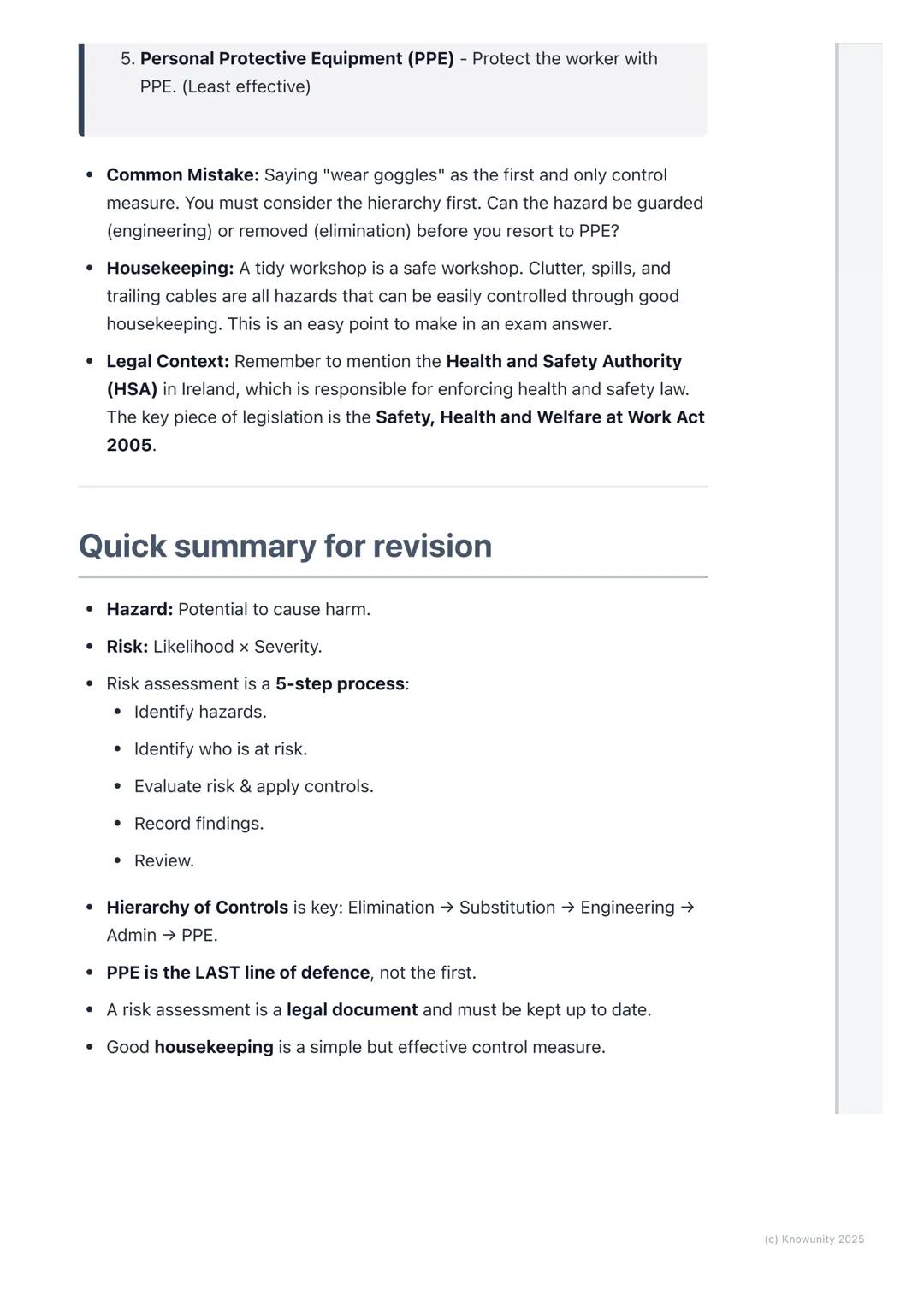
Quick Revision Summary
Risk assessment boils down to five clear steps: identify hazards, identify who's at risk, evaluate risks and apply controls, record findings, and review regularly. This systematic approach ensures nothing gets missed.
Remember that hazard equals potential to cause harm, while risk equals likelihood multiplied by severity. These mathematical relationships help you prioritise which hazards need immediate attention.
The Hierarchy of Controls runs from most effective (elimination) to least effective (PPE). Personal protective equipment only protects individuals and doesn't remove the actual hazard from the workshop environment.
Final Reminder: Risk assessments are legal documents that must be kept current - they're not just academic exercises but real workplace requirements.
Your understanding of these principles will serve you well beyond exams, whether you're working in construction, manufacturing, or any hands-on career where safety matters.
Mislili smo da nikad nećeš pitati...
Šta je Knowunity AI companion?
Naš AI Companion je AI alat fokusiran na učenike koji nudi više od samih odgovora. Napravljen na milionima Knowunity resursa, pruža relevantne informacije, personalizovane planove učenja, kvizove i sadržaj direktno u chatu, prilagođavajući se tvom individualnom putu učenja.
Gde mogu da preuzmem Knowunity aplikaciju?
Možeš preuzeti aplikaciju sa Google Play Store-a i Apple App Store-a.
Da li je Knowunity stvarno besplatan?
Tako je! Uživaj u besplatnom pristupu sadržaju za učenje, povezuj se sa drugim učenicima i dobijaj trenutnu pomoć – sve na dohvat ruke.
Najpopularniji sadržaj
9 Irish
IrishIrish oral questions and answers
Questions and answers for the leaving cert oral
5th Year4264
 English
Key Quotes : Sive
Key Quotes and explanations: Sive
6th Year2842
IrishIrish oral questions
Outline of oral questions
5th Year2055
IrishIníon- le hÁine Durkin
Aine Durkin’s poem, Iníon: Themes & summary
5th Year850
IrishIrish poetry 2027
Iníon + Dínit an Bhróin
5th Year1133
IrishLC HL notes- Iníon (poem)
Includes poem in English and Irish, theme, key words & phrases
5th Year2284
EnglishCultural Context : Shawshank Redemption : Sive : Small Things Like These
Comparative Study : Cultural Context : Shawshank Redemption, Sive and Small Things Like These
6th Year1430
IrishMo Ghrá-sa (Idir Lúibíní)
Notes on mo ghrá-sa
5th Year380
IrishAn Gaeilge Aiste
Irish Language essay
6th Year1320
Ne možeš da nađeš ono što tražiš? Istražuj druge predmete.
Učenici nas obožavaju — i ti ćeš takođe.
4.6/5App Store
4.7/5Google Play
Aplikacija je super laka za korišćenje i odlično dizajnirana. Našao sam sve što mi je trebalo i dosta sam naučio iz prezentacija! Definitivno ću koristiti aplikaciju za školski zadatak! A naravno, pomaže i kao inspiracija.
Stefan SiOS korisnik
Ova aplikacija je stvarno odlična. Tu je toliko beleški za učenje i pomoći [...]. Na primer, problem mi je francuski, a aplikacija ima toliko opcija za pomoć. Zahvaljujući ovoj aplikaciji, poboljšao sam francuski. Preporučio bih je svima.
Samantha KlichAndroid korisnik
Vau, stvarno sam oduševljena. Probala sam aplikaciju jer sam je videla u reklamama mnogo puta i bila sam potpuno šokirana. Ova aplikacija je POMOĆ koju želiš za školu i pre svega, nudi toliko stvari, kao što su vežbe i sažeci, što mi je lično bilo VEOMA korisno.
AnaiOS korisnik
Wood Technology1 pregledi·Ažurirano Jun 2, 2026·7 straniceEssential Guide to Workshop Safety and Effective Risk Assessment
Workshop safety isn't just about following rules - it's about developing a systematic mindset that'll keep you and your mates safe around powerful machinery and sharp tools. Mastering risk assessment is crucial for your exams and for real-world workshop experience.
1
of 7
Registruj se da vidiš sadržaj. Besplatno je!
- Pristup svim dokumentima
- Poboljšaj svoje ocene
- Pridruži se milionima učenika
Workshop Safety and Risk Assessment
Understanding workshop safety starts with grasping that you're working in an environment full of potential dangers. Every piece of machinery, every sharp tool, and even the way you work can pose risks.
The key is being proactive rather than reactive - spotting problems before they cause accidents. This systematic approach protects everyone in the workshop, from students to teachers to visitors.
A hazard is anything that could potentially cause harm - like a trailing cable, sharp chisel on a bench, or wood dust floating in the air. Risk is the chance that hazard will actually hurt someone, calculated as likelihood multiplied by severity.
Remember: These definitions will definitely appear on your exam, so learn them off by heart!
Risk assessment is the formal process of identifying hazards, evaluating risks, and deciding how to control them. Under the Safety, Health and Welfare at Work Act 2005, it's legally required in Irish workplaces.
2
of 7Registruj se da vidiš sadržaj. Besplatno je!
- Pristup svim dokumentima
- Poboljšaj svoje ocene
- Pridruži se milionima učenika
The Five Steps of Risk Assessment
The five-step process is systematic and you need to remember the exact order for your exam. Step one involves walking around the workshop to identify what could reasonably cause harm.
Think about physical hazards like moving machinery parts, sharp edges, noise, and electricity. Consider chemical hazards from wood finishes, adhesives, and cleaning fluids. Don't forget ergonomic hazards like poor lighting and awkward postures from repetitive tasks.
Step two requires identifying who might be harmed - not just you, but teachers, visitors, and cleaners too. Each group faces different risks because they use the workshop differently.
Top Tip: Less obvious hazards like poor housekeeping and inadequate training are easy marks in exam questions!
Step three involves evaluating risks using a simple matrix that considers both likelihood and severity . This helps you prioritise which hazards need immediate attention.
3
of 7Registruj se da vidiš sadržaj. Besplatno je!
- Pristup svim dokumentima
- Poboljšaj svoje ocene
- Pridruži se milionima učenika
Recording and Reviewing Risk Assessments
Steps four and five focus on documentation and maintenance of your risk assessment. You must write down your findings - it's a legal document that acts as both a plan and proof that safety has been properly considered.
The control measures you identify must actually be implemented, not just written down. This means buying the correct PPE, fixing machine guards, or changing work practices.
Risk assessments are living documents that need regular review. You must update them when new equipment is introduced, after accidents or near-misses, or when work practices change.
Exam Insight: Annual reviews are recommended even when nothing changes, to ensure the assessment remains valid and current.
The Hierarchy of Controls is crucial here - elimination comes first, then substitution, engineering controls, administrative controls, and finally PPE. Personal protective equipment should always be your last resort, not your first choice.
4
of 7Registruj se da vidiš sadržaj. Besplatno je!
- Pristup svim dokumentima
- Poboljšaj svoje ocene
- Pridruži se milionima učenika
Practical Example - Using the Pillar Drill
Real-world applications help you understand how risk assessment works in practice. When using a pillar drill, the biggest hazard is entanglement of loose clothing or hair in the rotating chuck.
Without controls, this creates a high risk (possible likelihood, serious injury severity). Control measures include tying back long hair, removing jewellery, wearing fitted clothing, and using chuck guards.
Eye injury from flying debris is another high-risk hazard affecting both operators and bystanders. BS EN 166 approved safety goggles and drill guards with clear screens reduce this to low risk.
Key Point: Notice how multiple control measures work together - you don't rely on just one solution to manage each hazard.
Workpieces spinning out of control pose medium risk initially. Secure clamping in machine vices, proper training, and never holding small pieces by hand bring this down to acceptable levels.
5
of 7Registruj se da vidiš sadržaj. Besplatno je!
- Pristup svim dokumentima
- Poboljšaj svoje ocene
- Pridruži se milionima učenika
Practical Example - Power Sanding
Wood dust inhalation represents one of the most serious long-term health risks in workshops. Without controls, it's high risk because exposure is likely and can cause serious respiratory diseases over time.
Effective control combines engineering solutions (dust bags, extraction systems, ventilation) with PPE (P2 or P3 rated dust masks). This demonstrates the hierarchy of controls in action.
Noise-induced hearing loss starts as medium risk but becomes low risk through ear defenders, limiting continuous use duration, and regular machine maintenance to reduce noise levels.
Health Alert: Hand-Arm Vibration Syndrome (HAVS) from prolonged sander use is a real occupational hazard that many students don't consider.
Vibration control requires regular breaks, using modern low-vibration equipment, and keeping hands warm and dry. These administrative and engineering controls are more effective than relying solely on protective equipment.
6
of 7Registruj se da vidiš sadržaj. Besplatno je!
- Pristup svim dokumentima
- Poboljšaj svoje ocene
- Pridruži se milionima učenika
Key Concepts for Exam Success
The Hierarchy of Controls is absolutely crucial for exam success. You must apply controls in the correct order: elimination, substitution, engineering controls, administrative controls, then PPE as the last resort.
A common mistake is immediately suggesting "wear goggles" without considering whether the hazard could be eliminated or engineered out first. This approach loses marks because it ignores more effective solutions.
Good housekeeping is often overlooked but represents an easy control measure that addresses multiple hazards. Tidy workshops with no clutter, spills, or trailing cables prevent many accidents.
Legal Context: Remember to mention the Health and Safety Authority (HSA) and the Safety, Health and Welfare at Work Act 2005 in exam answers.
The key legislation in Ireland is the Safety, Health and Welfare at Work Act 2005, enforced by the HSA. Understanding this legal framework shows you grasp the serious, professional nature of workshop safety.
7
of 7Registruj se da vidiš sadržaj. Besplatno je!
- Pristup svim dokumentima
- Poboljšaj svoje ocene
- Pridruži se milionima učenika
Quick Revision Summary
Risk assessment boils down to five clear steps: identify hazards, identify who's at risk, evaluate risks and apply controls, record findings, and review regularly. This systematic approach ensures nothing gets missed.
Remember that hazard equals potential to cause harm, while risk equals likelihood multiplied by severity. These mathematical relationships help you prioritise which hazards need immediate attention.
The Hierarchy of Controls runs from most effective (elimination) to least effective (PPE). Personal protective equipment only protects individuals and doesn't remove the actual hazard from the workshop environment.
Final Reminder: Risk assessments are legal documents that must be kept current - they're not just academic exercises but real workplace requirements.
Your understanding of these principles will serve you well beyond exams, whether you're working in construction, manufacturing, or any hands-on career where safety matters.
Mislili smo da nikad nećeš pitati...
Šta je Knowunity AI companion?
Naš AI Companion je AI alat fokusiran na učenike koji nudi više od samih odgovora. Napravljen na milionima Knowunity resursa, pruža relevantne informacije, personalizovane planove učenja, kvizove i sadržaj direktno u chatu, prilagođavajući se tvom individualnom putu učenja.
Gde mogu da preuzmem Knowunity aplikaciju?
Možeš preuzeti aplikaciju sa Google Play Store-a i Apple App Store-a.
Da li je Knowunity stvarno besplatan?
Tako je! Uživaj u besplatnom pristupu sadržaju za učenje, povezuj se sa drugim učenicima i dobijaj trenutnu pomoć – sve na dohvat ruke.
Najpopularniji sadržaj
9IrishIrish oral questions and answers
Questions and answers for the leaving cert oral
5th Year4264
EnglishKey Quotes : Sive
Key Quotes and explanations: Sive
6th Year2842
IrishIrish oral questions
Outline of oral questions
5th Year2055
IrishIníon- le hÁine Durkin
Aine Durkin’s poem, Iníon: Themes & summary
5th Year850
IrishIrish poetry 2027
Iníon + Dínit an Bhróin
5th Year1133
IrishLC HL notes- Iníon (poem)
Includes poem in English and Irish, theme, key words & phrases
5th Year2284
EnglishCultural Context : Shawshank Redemption : Sive : Small Things Like These
Comparative Study : Cultural Context : Shawshank Redemption, Sive and Small Things Like These
6th Year1430
IrishMo Ghrá-sa (Idir Lúibíní)
Notes on mo ghrá-sa
5th Year380
IrishAn Gaeilge Aiste
Irish Language essay
6th Year1320
Ne možeš da nađeš ono što tražiš? Istražuj druge predmete.
Učenici nas obožavaju — i ti ćeš takođe.
4.6/5App Store
4.7/5Google Play
Aplikacija je super laka za korišćenje i odlično dizajnirana. Našao sam sve što mi je trebalo i dosta sam naučio iz prezentacija! Definitivno ću koristiti aplikaciju za školski zadatak! A naravno, pomaže i kao inspiracija.
Stefan SiOS korisnik
Ova aplikacija je stvarno odlična. Tu je toliko beleški za učenje i pomoći [...]. Na primer, problem mi je francuski, a aplikacija ima toliko opcija za pomoć. Zahvaljujući ovoj aplikaciji, poboljšao sam francuski. Preporučio bih je svima.
Samantha KlichAndroid korisnik
Vau, stvarno sam oduševljena. Probala sam aplikaciju jer sam je videla u reklamama mnogo puta i bila sam potpuno šokirana. Ova aplikacija je POMOĆ koju želiš za školu i pre svega, nudi toliko stvari, kao što su vežbe i sažeci, što mi je lično bilo VEOMA korisno.
AnaiOS korisnik